


TL;DR: Prickly Bits – deep-tech startup studio helps hard-tech founders decide what to validate next
Prickly Bits (deep-tech startup studio) is a focused partner for founders with real technical assets who need to figure out the next smart move before wasting time, money, or IP.
• It helps you sort what you actually have: a prototype, research result, data asset, model, design, or know-how that could become a product, venture, licensing path, or partner opportunity.
• It helps you separate different kinds of risk: technical, product, IP, market, funding, and partner risk, so you can test the right thing first.
• It gives you a clearer path around productization, commercialization, grant strategy, and intellectual property, without pretending that a patent, prototype, or pitch deck is already a business.
• The article’s main benefit for you is simple: if your deep-tech project has substance but still feels commercially foggy, this kind of startup studio can help you make better decisions in the right order.
If you are building hard tech and feel stuck between science and business, send a short studio-fit request to Prickly Bits and clarify your next step.
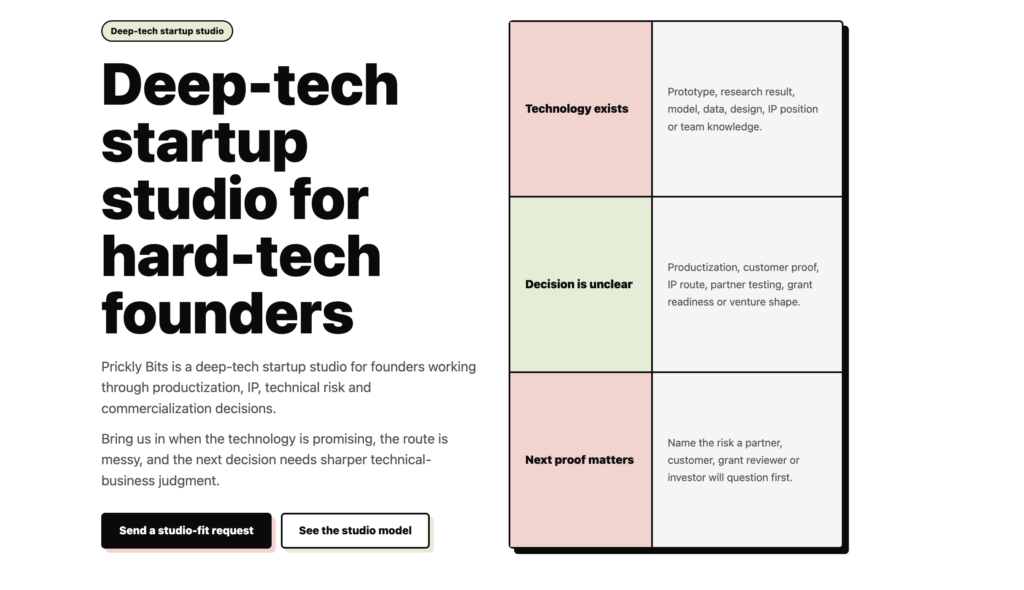
Prickly Bits – deep-tech startup studio caught my attention fast because it sits in a part of the startup world I care about deeply: the messy, expensive, often misunderstood gap between a hard technical asset and a real company people can buy from, partner with, or fund.
I say this as a female bootstrapping founder from Europe who has spent years building in deep tech, IP-heavy workflows, no-code systems, AI tooling, and startup education. I have seen brilliant technical teams get trapped in the wrong question. They ask whether the science is impressive, whether investors will like the deck, or whether the patent is enough. The sharper question is simpler: what exactly should be validated next so the technology can move toward a venture, product, or commercial path?
That is where Prickly Bits appears to position itself. Based on the public brief and the framing on Prickly Bits deep-tech startup studio website, this is not meant to be another vague startup brand covered in innovation glitter. It is being shaped as a studio for founders, technical teams, investors, and innovation partners who need clarity around productization, intellectual property, technical risk, grant strategy, and commercialization.
I like that angle because deep tech has a very specific problem. It is rarely blocked by ambition. It is blocked by sequencing. Teams do not know whether to test the market route, protect the IP, refine the prototype, package the asset, speak to grant bodies, or prepare for a partner conversation. When all risks are mixed together, people waste months and call it progress.
What is Prickly Bits really trying to do?
My read is straightforward. Prickly Bits is shaping up as a deep-tech startup studio for hard-tech founders who already have some serious technical substance, but still need help deciding what can become a product, what risk matters most, and what commercial path makes sense before they burn time and money.
This matters because deep-tech startup studio work is very different from generic startup advice. A consumer app founder can often launch, test, and pivot quickly. A deep-tech founder may be working with a research result, a CAD system, a hardware prototype, a material science process, a machine learning model tied to regulated data, or an IP-heavy engineering workflow. The costs of getting the next move wrong are much higher.
So when Prickly Bits says it wants to help clarify productization, IP, technical risk, and commercialization, I read that as a practical studio thesis:
- What exactly is the asset?
- Which risk should be tested first?
- What can become a sellable product or venture?
- What must be protected, documented, or separated before exposure?
- When does grant strategy help, and when does it become procrastination dressed up as progress?
- What kind of next conversation should the founder prepare for: partner, investor, customer, university, or grant evaluator?
That is a MUCH better framing than the usual startup-studio noise. And yes, I am intentionally prickly about this. Too many people in startup land sell confidence while avoiding decisions.
Why does a deep-tech startup studio matter more than a generic startup advisor?
Because deep tech is where shallow advice goes to die. If your startup depends on actual science, engineering, advanced software, regulated processes, CAD data, hardware systems, laboratory work, proprietary methods, or defensible IP, then generic startup templates can do real damage.
I have lived in that world through ventures such as CADChain, where IP, compliance, product packaging, engineering workflows, and technical trust were not side issues. They were the business. In these contexts, founders need someone who can think across technical assets, business model logic, commercialization pathways, and protection layers at the same time.
A real deep-tech startup studio should help teams avoid mistakes like these:
- Building a polished product around a capability that still has an untested technical failure point.
- Talking publicly before understanding what should remain confidential for IP reasons.
- Applying for grants that fund activity but do not move the venture toward commercial proof.
- Pitching investors before the product story is clear enough to survive diligence.
- Assuming a patent equals a business.
- Treating a prototype like a product, or a research result like a company.
Here is why this matters. A startup dies less often from lack of intelligence than from misordered decisions. Smart teams still fail when they validate the wrong thing first.
Who should care about Prickly Bits?
Based on the brief, the audience is well defined, and that is a good sign. Prickly Bits is not trying to appeal to every founder with a Canva logo and a dream. It appears to be aimed at people dealing with actual technical substance and actual uncertainty.
- Deep-tech founders who have a prototype, research result, or technical capability and need a sharper venture direction.
- Technical teams that can build, but need clarity on product path, validation order, and commercial packaging.
- Investors and innovation partners who want a better view of technical risk versus market readiness.
- R&D teams trying to move from lab work to market logic.
- Venture builders who need a more disciplined frame for IP-heavy opportunities.
- Technical operators working on products where the hardest question is not marketing, but what should be tested or protected next.
This target group makes sense to me. In Europe especially, I have seen many highly educated technical people who can produce extraordinary work and still struggle to package it into a startup path. Universities do not train people for this well. Most incubators do not either. They often teach pitch theatre before teaching venture judgment.
And yes, I will say the uncomfortable part: learning entrepreneurship in classrooms is mostly useless unless you are building something real at the same time. Deep tech makes that even more obvious.
What problem does Prickly Bits solve in practical terms?
The homepage brief gives away the real heart of the studio: hard technology gets stuck when the team cannot tell which risk to test next. That sentence is stronger than many polished startup websites because it describes the actual bottleneck.
In practical terms, Prickly Bits seems built to help teams answer four kinds of questions:
- Productization: what part of the technical capability can become a product people will buy, license, adopt, or integrate?
- IP and defensibility: what needs protection, what needs better framing, and what should not be disclosed too early?
- Technical risk: which technical unknown is still blocking commercial movement?
- Commercialization: what is the plausible route from technical promise to a venture direction, partner path, grant plan, or first market entry?
I like the fact that the site brief also excludes patent filing and formal legal advice as standalone specialist work. That boundary matters. A studio should know where its role ends. If everything is a service, nothing is clear.
How does the Prickly Bits method appear to work?
The most useful part of the brief is the decision path. It is plain, and plain is good. Fancy words hide confusion. Prickly Bits appears to start by making the decision smaller. I strongly agree with that. Deep-tech founders often drown because they try to answer ten giant questions at once.
The proposed path has two visible steps, and both are the right kind of blunt.
1. Frame the asset
This means describing what exists today in concrete terms. Not startup theatre. Not future fantasy. What is there now?
- Technical capability
- Prototype
- Research result
- Data asset
- Model
- Design
- IP position
- Team knowledge
That list is strong because it respects how deep-tech opportunities are born. A company does not always begin with a product. Sometimes it begins with a method, file workflow, hardware insight, algorithm, laboratory result, or protected design path.
2. Map the risk
This means sorting open questions by type, instead of letting every uncertainty blur together into panic.
- Technical risk
- Product risk
- IP risk
- Market risk
- Partner risk
- Funding risk
This is smart because each risk type needs a different test. You do not solve IP risk with customer interviews alone. You do not solve market risk by filing more patents. You do not solve technical risk by making a prettier pitch deck.
That is where a real deep-tech startup studio can earn its place. It can help founders separate uncertainties and stop treating every problem as one giant existential blur.
What makes this approach credible from my point of view?
I am biased toward practical systems. I built ventures across deeptech, IPtech, edtech, and AI-based founder tooling. I also operate with five degrees, an MBA, two decades of international work experience, and years of founder scars. That background taught me something simple: very smart people still need good decision architecture.
At CADChain, we worked on IP management and compliance tooling for CAD and 3D data. That meant I had to think across engineering, intellectual property, workflow design, commercialization, and trust. Protection could not sit in a legal silo. It had to live inside the tool and inside user behavior. I see echoes of that logic in the Prickly Bits brief.
At Fe/male Switch, I built a women-first startup game and incubator entirely with no-code systems because I believe founders should default to no-code until they hit a hard wall. That shaped my view of venture building too. The goal is not to spend more. The goal is to learn faster, with smaller bets, and with real-world consequences attached to action.
So when I look at Prickly Bits, I do not ask whether the brand sounds smart. I ask whether the operating logic is sound. And so far, it is.
What should deep-tech founders validate before asking for funding?
This is where I get a bit provocative. Too many founders seek funding before they have earned the right to ask for it. I am a bootstrapper by instinct. VC is not magic. In deep tech, premature fundraising can distort the company before the real venture question is even clear.
Before asking for outside money, most deep-tech founders should clarify these points:
- What is the asset? Say it clearly and in one sentence.
- Who feels the pain or need? Identify the buyer, user, partner, or acquirer context.
- What risk blocks adoption? Name the riskiest unknown.
- What proof would reduce that risk? Define the next experiment or evidence package.
- What part is defensible? Clarify the role of know-how, patents, process, data, or workflow lock-in.
- What is the route to market? Direct sales, partnerships, licensing, pilots, embedded tech, or something else.
- Why now? Tie the project to a real market timing or technical timing signal.
If Prickly Bits can help founders answer these questions before they get lost in investor theatre, that is real value. Not hype. Not posturing. Real value.
Where do grants fit into a deep-tech startup studio model?
Grants matter, especially in Europe, and I say that as someone who knows the region well. Europe is not the easiest place to build startups. It is slower, more fragmented, and often too fond of paperwork. Still, EU and national grants can be useful if used with discipline.
The brief mentions grant strategy, and that makes sense. A grant should not be treated as free money for vague research wandering. It should support a venture-relevant step. That is the difference between founder logic and subsidy addiction.
A sensible studio would help teams ask:
- What stage are we actually in?
- Does a grant support a near-term commercial decision?
- Will the grant force reporting overhead that slows the team down?
- Does the grant help produce technical proof, partner traction, or market validation?
- Are we building a company, or just becoming excellent at applications?
I have seen both outcomes. Grants can buy time for serious R&D. They can also trap founders in a loop where they look funded but are not building a business. A deep-tech startup studio that can distinguish between those two paths is useful.
What does Prickly Bits avoid, and why is that a good sign?
The brief is unusually clear about what should not appear in public copy. I love that. Boundaries signal maturity.
- No funding guarantees.
- No commercialization guarantees.
- No promises of technical validation.
- No shallow startup-studio fluff.
- No unsupported technical claims.
- No hype without execution detail.
This is exactly the right stance for hard-tech work. In deep tech, overclaiming is not just tacky. It can destroy trust with investors, partners, grant evaluators, and technical buyers. A studio should help sharpen decisions, not sell certainty where certainty does not exist.
Frankly, one of the fastest ways to lose credibility in this sector is to sound like LinkedIn wrote your strategy page.
When is the studio-fit question most useful?
The brief answers this well, and I agree with the framing. Prickly Bits seems most relevant when a project has enough technical depth to be interesting and enough uncertainty to require a sharper next move.
That usually looks like one of these situations:
- A research result that could become a company.
- A prototype that still lacks a believable market route.
- An IP-heavy startup concept with unclear commercial packaging.
- A technical team deciding what to validate next.
- An investor, partner, or grant conversation coming up soon.
- A product idea where the hardest risk is still fuzzy.
This is an underrated insight. The best time to ask for a studio-fit conversation is not when everything is perfect. It is when the team has enough substance to work with and enough ambiguity to make outside structure useful.
What would I do first if I were a founder approaching Prickly Bits?
I would keep it short, concrete, and unsentimental. The brief even says you do not need to send confidential material in the first message, and that is correct. Founders often overshare too early or hide behind secrecy. Both are mistakes.
If I were sending a studio-fit request, I would include:
- A short description of the technology or technical asset.
- The current stage: concept, prototype, pilot, research transfer, or early commercial.
- The next decision that feels blocked.
- The type of upcoming conversation: investor, partner, grant, customer, or internal team.
- One public link or non-confidential reference if available.
That approach saves time and forces clarity. Founders who can describe the next decision are already ahead of founders who send thirty slides of ambition and no question.
How does this connect to bootstrapping, no-code, and AI from my perspective?
At first glance, a deep-tech startup studio may sound far away from my usual drumbeat of bootstrapping, no-code, and AI co-founders. It is not. The same founder discipline applies.
I believe anyone can build an early test version of a product in absurdly little time now, especially with AI and no-code tools. That does not mean every deep-tech company can be fully built without engineering. Of course not. But it does mean founders can test narratives, interfaces, workflows, customer journeys, internal decision systems, landing pages, and even lightweight simulation layers much faster than before.
This is where a studio like Prickly Bits could become especially useful if it stays practical. Deep-tech founders do not always need more code first. Sometimes they need:
- A fast demand test
- A sharper product narrative
- A clearer proof package
- A lighter way to model the commercial path
- A better distinction between what must be custom-built and what can be mocked, simulated, or tested quickly
I am deeply pro-AI here. AI is the best co-founder available to most early-stage teams, if they know how to use it. It can help structure market research, competitor mapping, first-pass customer segmentation, draft messaging, technical documentation scaffolding, and grant preparation support. Human judgment still matters. But the old excuse of “we need a full team before we can test anything” is getting weaker by the month.
What can investors and partners learn from the Prickly Bits framing?
A lot, actually. Investors often say they want deep-tech exposure, but many still evaluate these ventures with software-startup reflexes. That creates confusion on both sides. A good deep-tech startup studio frame can help investors ask better questions.
Instead of asking only about traction, they should also ask:
- What technical claim has already been proven?
- What still needs proof?
- What is the form of defensibility?
- What is the commercialization route?
- What non-market dependencies exist, such as regulation, grants, labs, or partner channels?
- What would count as a useful next de-risking event?
Partners can also benefit from this approach. Universities, labs, R&D groups, industrial players, and venture builders often sit on promising technical assets but struggle to package them into a coherent venture path. A studio that can bridge technical substance and venture direction has a real role to play there.
What are the biggest mistakes deep-tech founders should avoid?
Let’s break it down. These are the errors I see most often, and they connect directly to why a project like Prickly Bits can matter.
- Mistaking technical elegance for market readiness. A brilliant system is not automatically a product.
- Filing or discussing IP too casually. Protection timing matters, and so does disclosure discipline.
- Chasing grants without venture logic. Money is not progress if it funds drift.
- Treating every uncertainty as equal. Some risks matter now, others later.
- Overbuilding before framing the use case. Founders often build what is possible, not what is packageable.
- Waiting for perfect certainty. Deep tech still needs staged bets, not endless contemplation.
- Using generic startup language. If your story sounds interchangeable, your venture will too.
My own founder philosophy is harsh but useful: get uncomfortable fast. Real startup learning starts when your assumptions meet the world. That applies to deep tech too, even if the world-meeting happens through pilots, partner interviews, technical diligence, design partner calls, or controlled validation steps rather than mass-market clicks.
What is my honest take on the positioning of Prickly Bits?
I think the positioning is promising because it aims for a narrow, useful place in the market instead of trying to look universally impressive. Deep-tech startup studio is a strong phrase when the site actually backs it up with concrete questions, risk mapping, and commercial decision framing.
The strongest elements in the brief are these:
- Clear audience definition
- Clear problem statement around risk sequencing
- Clear boundary against hype and guarantees
- Clear studio-fit logic
- Clear path from technology to venture direction
If Prickly Bits keeps that discipline and resists the temptation to drift into generic consultancy language, it can become a strong authority site and a credible studio brand. The educational content angle also makes sense. Founders in this category do a lot of searching before they contact anyone. They want to know whether the person on the other side understands technical uncertainty, IP sensitivity, grant logic, and commercialization friction in the same sentence.
That is exactly the kind of trust a studio should earn through content.
What should entrepreneurs take away from this?
If you are building in hard tech, engineering, scientific software, applied AI, industrial systems, advanced manufacturing, IP-heavy workflows, or lab-to-market territory, then the lesson is simple: do not ask bigger questions than your startup can answer today.
Instead, ask:
- What asset do we truly have?
- What risk matters most right now?
- What proof would change the next conversation?
- What should be protected before exposure?
- What route to product or venture direction is actually plausible?
That is why I think the Prickly Bits concept matters. It points founders back to disciplined venture-building instead of startup cosplay. And as someone who believes more women should build startups, more founders should bootstrap longer, more teams should use AI aggressively, and more people should stop waiting for institutional permission, I find that refreshing.
Next steps are simple. If your project has technical substance and commercial fog, a short studio-fit request to Prickly Bits deep-tech startup studio may be far more useful than another month of internal debate, advisor calls, or performative founder content on the internet.
Hard tech does not need more buzzwords. It needs better decisions.
People Also Ask:
What is a deep tech startup?
A deep tech startup is a company built around science, engineering, or advanced research rather than a simple app or service idea. These startups often work in areas like robotics, biotech, aerospace, clean energy, advanced materials, or artificial intelligence, and they usually take longer to build because they depend on research, testing, and technical development.
What is a startup studio?
A startup studio is an organization that creates and builds companies from the ground up. Instead of only funding outside founders, a studio helps shape ideas, test markets, build teams, and share resources like product, legal, hiring, and fundraising support across multiple new ventures.
What is a deep-tech startup studio?
A deep-tech startup studio combines the startup studio model with science- or engineering-based company building. It helps turn technical research or hard-tech ideas into real businesses by supporting venture creation, team formation, early product work, and access to networks, capital, and industry guidance.
What is Prickly Bits – deep-tech startup studio?
Prickly Bits appears to refer to a startup studio focused on deep-tech ventures. In plain terms, that means it is likely a company-building group that works on launching or supporting startups based on advanced technology or research-heavy ideas rather than only backing outside founders in a traditional accelerator format.
How is a startup studio different from an accelerator?
A startup studio usually helps create companies internally and stays closely involved in building them, while an accelerator usually works with startups that already exist and helps them grow over a set program period. Studios are more hands-on in the earliest stages, while accelerators focus more on mentorship, exposure, and investor readiness.
What are the 4 stages of a startup?
The four common startup stages are idea, validation, growth, and scale. The idea stage is where the concept is formed, validation checks whether there is real demand, growth focuses on building traction and revenue, and scale is when the company expands its team, market reach, and operations.
Why are startup studios used for deep tech ventures?
Startup studios are often used for deep tech ventures because these businesses usually need more time, technical talent, research support, and early structure than standard software startups. A studio can reduce early uncertainty by giving founders shared support, access to experts, and a repeatable company-building process.
What kinds of companies count as deep tech?
Deep tech companies often work in fields such as biotech, climate tech, semiconductors, aerospace, robotics, quantum computing, advanced manufacturing, and materials science. What makes them deep tech is that they are based on hard science or advanced engineering and usually solve technical problems that are difficult to address with simple software alone.
Is deep tech a good career choice?
Deep tech can be a strong career choice for people who enjoy science, engineering, research, and long-term technical work. It can offer strong pay, meaningful work, and the chance to help build products that affect medicine, energy, security, manufacturing, or space, though the work can also be demanding and slower moving than consumer tech.
Do deep tech startups take longer to build than regular startups?
Yes, deep tech startups often take longer to build than regular software startups because they may need research, lab work, prototypes, testing, patents, regulatory review, or hardware development before reaching the market. That longer path is one reason startup studios and other hands-on builders are often involved in this sector.
FAQ on Prickly Bits and Deep-Tech Startup Studio Work
How is a deep-tech startup studio different from an accelerator or incubator?
A deep-tech startup studio usually works on decision quality, risk mapping, and commercialization logic rather than running a cohort program. If you have an IP-heavy startup, prototype, or research asset, look for tailored guidance on productization, technical differentiation, and next-step validation instead of generic startup training.
What should a founder prepare before sending a studio-fit request?
Prepare a short, non-confidential summary covering the technology, current stage, and the exact decision you need to make next. Add one public link if possible. For a deep-tech startup studio conversation, clarity beats volume. Avoid sending sensitive documents, unpublished patent claims, or oversized pitch decks initially.
How can teams tell whether they have a product opportunity or just an interesting technology?
Ask whether the asset solves a costly problem for a specific buyer, partner, or operator. A hard-tech commercialization strategy should connect capability to adoption, not just novelty. Test willingness to engage through interviews, pilot interest, technical diligence, or design-partner conversations before assuming venture readiness.
When should a deep-tech founder involve an IP lawyer instead of a startup studio?
Bring in an IP lawyer when you need patent filing, freedom-to-operate review, licensing terms, or formal legal advice. A deep-tech startup studio can help frame IP risk, disclosure timing, and defensibility strategy, but legal protection should be handled by qualified specialists once the issue becomes formal.
What are the signs that a grant strategy is helping rather than slowing the venture?
A useful grant strategy funds a specific de-risking step tied to productization, technical validation, or market access. It becomes a problem when reporting overhead dominates progress. Choose grants that support a measurable next milestone, such as prototype proof, partner readiness, or early commercialization evidence.
How should investors evaluate a hard-tech startup before commercial traction appears?
Investors should examine technical proof, remaining unknowns, defensibility, and the logic of the next de-risking milestone. In deep-tech venture evaluation, early traction is not the only signal. Look for disciplined sequencing, credible technical claims, a realistic commercialization path, and strong judgment around risk exposure.
Can no-code and AI still help when the core product is complex deep tech?
Yes, even when the underlying innovation requires serious engineering. No-code and AI can support demand testing, workflow prototypes, landing pages, documentation, internal tools, and early messaging experiments. Deep-tech founders should reserve custom technical build time for true differentiators, not every surrounding business process.
What is the best way to prioritize risks in an IP-heavy startup?
List uncertainties by category: technical, product, IP, market, partner, and funding risk. Then ask which one most blocks the next valuable conversation or milestone. In an IP-heavy startup strategy, the goal is not solving everything at once, but identifying the risk whose reduction changes outcomes fastest.
What mistakes do technical teams make when approaching commercialization partners?
They often speak in technical depth without translating the business impact, adoption path, or integration burden. Before outreach, prepare a commercialization narrative for deep-tech partners: what exists, what problem it solves, what proof is available, what remains uncertain, and what the ideal next collaboration looks like.
How do you know when a research result is ready for venture-building support?
It is usually ready when the team can describe the asset clearly, identify a plausible use case, and name the decision that is blocked. A lab-to-market startup path begins when uncertainty can be structured. You do not need perfection, but you do need technical substance and a real next move.


