


TL;DR: New AI Model Releases News, April, 2026
April 2026 introduced groundbreaking AI tools, including Anthropic’s Claude Mythos 5 with 10 trillion parameters for advanced cybersecurity and coding, and the accessible Capabara model. Google DeepMind’s Gemini 3.1 adds real-time voice and image analysis, while Google’s compression algorithm slashes AI costs by reducing memory needs by six times.
• Entrepreneurs can use Gemini 3.1 for customer service and lightweight AI systems for affordability.
• Risks like cybersecurity misuse and economic shifts demand cautious adoption.
Start experimenting with these models to stay ahead, but prioritize safety and ethical reviews. For a deeper dive into March AI innovations, explore New AI Models September 2026.
Check out other fresh news that you might like:
AI Product Launches News | September, 2026 (STARTUP EDITION)

The New AI Model Releases this April has injected a fresh wave of optimism, curiosity, and caution into the tech landscape. For me, Violetta Bonenkamp, a founder navigating the deep waters of AI and its application to startups, these announcements are not just technological; they’re strategic chess moves that highlight where innovation is headed and what pitfalls we need to sidestep. Whether you’re an entrepreneur, a business owner, or a tech enthusiast, these model releases should have your complete attention.
Anthropic’s unveiling of two frontier AI systems, Claude Mythos 5 with a mind-boggling 10-trillion parameters, and a more humble mid-sized model, Capabara, sets the stage for AI’s role in cybersecurity, coding, and ethical development. Simultaneously, Google DeepMind’s Gemini 3.1 adds multimodal capabilities, excelling in voice and vision applications. But that’s not all. A quieter yet seismic shift comes from Google’s new compression algorithm, which could reshape the economics of AI by radically reducing memory requirements. As these developments ripple through industries, I’ve outlined below what you need to know, why it matters, and how to prepare for this volatile new AI era.
What are the most notable new AI models in April 2026?
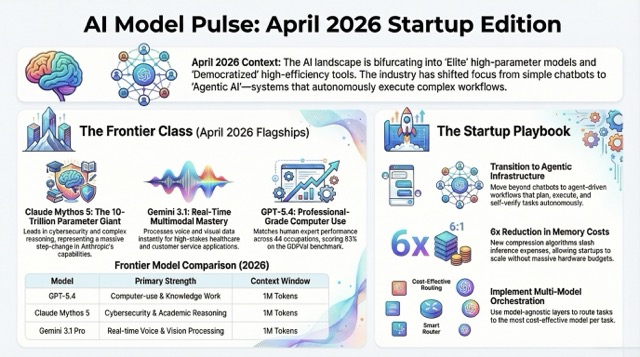
- Claude Mythos 5 by Anthropic: A hyper-advanced AI model built with 10-trillion parameters. It excels at cybersecurity, coding, and academic reasoning.
- Capabara by Anthropic: A mid-tier solution, less resource-intensive but versatile, geared for broader accessibility.
- Gemini 3.1 by Google DeepMind: A real-time, multimodal AI capable of processing both voice and visual data for industries like healthcare, customer service, and even autonomous systems.
- Google’s Compression Algorithm: Reduces KV-cache memory by six times, increasing speed and efficiency while slashing costs for inference in AI models.
These models illuminate the stark bifurcation between large-scale, high-stakes AI (like Claude Mythos) and consumer-facing, real-time applications (like Gemini 3.1). Here’s why that’s critical: It indicates we’re witnessing the AI market splitting into two paths, elite, enterprise-heavy computation and democratized, lightweight tools for all.
And on April 16 there’s been a release of Claude Opus 4.7, which is Anthropic’s newest flagship model aimed at complex reasoning and long-running agent workflows, and it already sits in the same historic week as GPT 6 and Meta’s LlamaCon releases. For European bootstrapping startups this means you can ship more experiments, automate real work across days, and compete with funded rivals by treating Opus 4.7 as a senior teammate that never sleeps, as long as you wire it into a lean stack with strict guardrails on cost and quality.
Latest AI model releases in April 2026
March and early April 2026 produced one of the densest model release windows in AI history. Three frontier models dropped in a single month: GPT-5.4 (Standard, Thinking, and Pro variants), Gemini 3.1 Ultra with native multimodal reasoning, and Grok 4.20 with enhanced real-time web access. That pace compressed the competitive gap between labs to a matter of weeks.
On the open-source side, organizations like Mistral, Zhipu AI, and Alibaba have released models that redefine what is possible in areas ranging from dense computation to visual AI. For startups, this matters because open-source options now offer frontier-competitive performance at a fraction of API cost.
Here is the quick list heading into April 2026: GPT-5.4 from OpenAI (released March 5), Gemini 3.1 Pro and Flash-Lite from Google (February and March), Claude Sonnet 4.6 and Opus 4.6 from Anthropic (February), Grok 4.20 Beta 2 from xAI (March 3), and Mistral Small 4 (March 3). Next steps: audit which of these your stack currently calls and whether a newer model improves your output quality or cuts your costs.
Latest AI developments in April 2026
The headline development is not any single model. The clearest structural signal is the Agentic AI Foundation, formed under the Linux Foundation in December 2025, anchored by contributions from Anthropic’s Model Context Protocol (MCP), OpenAI’s AGENTS.md, and Block’s goose framework. When competing labs contribute infrastructure to a neutral body, something real is happening.
On top of that, MCP crossed 97 million installs in March 2026, cementing its transition from experimental standard to foundational agentic infrastructure. Every major AI provider now ships MCP-compatible tooling.
For entrepreneurs, the practical implication is clear: agentic workflows are no longer experimental. They are production infrastructure. If your product roadmap does not include at least one agent-driven workflow, you are already behind.
AI breakthroughs, April 2026
Morgan Stanley warns that a massive AI breakthrough is imminent in the first half of 2026, driven by an unprecedented accumulation of compute at major AI labs. OpenAI’s recently released GPT-5.4 “Thinking” model scored 83.0% on the GDPVal benchmark, placing it at or above the level of human experts on economically valuable tasks.
That benchmark matters more than most. GDPVal tests AI against real professional work across 44 occupations. An 83% score means the model now matches or beats human experts in areas like financial modeling, legal drafting, and software engineering.
Also worth noting: the single most important proving ground for AI’s reasoning capabilities is coding. An AI’s ability to generate and execute code provides a bridge from the statistical world of large language models to the deterministic, symbolic logic of computers, unlocking a new era of English-language programming where the primary skill is clearly articulating a goal to an AI assistant. For non-technical founders, this is the most important shift of 2026.
AI breakthroughs or announcements (April 2026)
Several announcements stand out from the March-April window. Apple officially announced a completely reimagined, AI-powered version of Siri set to debut in 2026, transitioning into a context-aware assistant capable of “on-screen awareness” and seamless cross-app integration, partnering with Google to use its Gemini AI model running on Apple’s Private Cloud Compute.
Also: Google introduced Gemini 3.1 Flash-Lite, a new efficiency-focused model delivering 2.5x faster response times and 45% faster output generation compared to earlier Gemini versions, priced at just $0.25 per million input tokens. That pricing shift reflects a broader industry push toward affordability that directly benefits startups.
And on the infrastructure side, NVIDIA GTC 2026 was dominated by enterprise agentic deployments rather than raw benchmark announcements, with NeMoCLAW and OpenCLAW frameworks for enterprise agent orchestration drawing the largest attendance. The signal: agentic AI has moved from demo to production.
Latest AI breakthroughs in April 2026
By April 2026, the biggest obstacle to scaling AI agents, the buildup of errors in multi-step workflows, is being addressed by self-verification. Instead of relying on human oversight for every step, AI is being equipped with internal feedback loops, allowing models to autonomously verify the accuracy of their own work and correct mistakes.
On the memory front, the focus in 2026 is on building intelligent, integrated systems with context windows and human-like memory. Context windows and improved memory are driving the most innovation in agentic AI, giving agents the persistent memory they need to learn from past actions and operate on complex, long-term goals.
For startups building on top of these models, self-verification and persistent memory change your product architecture. You can now build agents that run multi-hour tasks without constant human checkpoints.
Latest xAI models released in 2026
xAI has moved fast in 2026. As of March 2026, the current flagship Grok model is Grok 4.20, released in beta on February 17, 2026, featuring a multi-agent architecture. xAI shipped Grok 4.20 Beta 2 on March 3, 2026 with five targeted fixes: better instruction following, fewer hallucinations, enhanced LaTeX support, more accurate image search, and improved multi-image rendering.
Before that, Grok 4.1 was the prior flagship. Grok 4 is xAI’s most intelligent model, featuring native tool use and real-time search integration, available to SuperGrok and Premium+ subscribers as well as through the xAI API.
Looking ahead: Grok 5 missed its Q1 deadline, with the new consensus pointing to Q2 2026. The prediction market Polymarket gives a 33% probability that Grok 5 ships by June 30, 2026. Plan your integrations accordingly.
Grok AI video generation capability (April 2026)
xAI launched real video generation in early 2026. Grok Imagine 1.0, released February 2, 2026, unlocks 10-second videos, 720p resolution, and dramatically better audio. Imagine has generated 1.245 billion videos in the last 30 days alone.
The capabilities break down into two main workflows. Text-to-video lets you generate a clip directly from a written prompt. Image-to-video takes a still image and animates it with described motion, camera behavior, and atmosphere. This is especially useful for brand content, lifestyle moments, and cinematic mini-scenes where you want consistency.
For startups, the API access matters most. Grok Imagine is publicly documented through xAI’s API and partner platforms, meaning you can integrate video generation into your product without building a media pipeline from scratch.
Latest AI model releases announcements in April 2026
February 2026 was a major month for AI model releases, with seven major releases in a single month. Google, Anthropic, OpenAI, xAI, and Alibaba all dropped significant updates within weeks of each other, with benchmark records being broken again.
March continued that momentum. The key releases and what they mean for your team:
GPT-5.4, released March 5, 2026, came with significantly improved benchmark results, including record scores in computer-use benchmarks OSWorld-Verified and WebArena Verified, and scored a record 83% on OpenAI’s GDPval test for knowledge work tasks. Gemini 3.1 Pro topped reasoning benchmarks, particularly on GPQA Diamond with 94.3%. Claude Sonnet 4.6 gave Anthropic a model that performs at near-Opus level but at the Sonnet pricing level, leading on the GDPval-AA Elo benchmark with 1,633 points.
Next steps: run a quick eval of your current model against any of these, focused on your actual use case, not generic benchmarks.
Latest AI developments news, April 2026
The spring 2026 trend can be summarized as a shift from “AI that answers” to “AI that gets things done.” The center of competition is now the full chain of holding long context, making plans, using tools, verifying results, and finishing the task.
Also in the news: OpenAI has surpassed $25 billion in annualized revenue and is reportedly taking early steps toward a public listing, potentially as soon as late 2026. Rival Anthropic is approaching $19 billion in annualized revenue.
On the hardware side, NVIDIA’s announcements showcase next-generation AI computing platforms that dramatically increase training performance while lowering costs, with data centers expanding rapidly in capacity to support inference and training at scale. This infrastructure buildout is what makes cheaper, faster API access possible for your team.
Grok xAI video generation capability in April 2026
Grok’s video generation runs through the Grok Imagine system, which now lives beyond X (Twitter) via xAI’s API. The practical takeaway is that Grok Imagine supports short-form generation workflows suitable for social clips, product teasers, lifestyle scenes, and game-trailer-style shots.
The image-to-video workflow is particularly strong. You start with a reference image, describe motion and camera behavior, and get a 10-second clip that preserves the original visual identity. For brand consistency, that is a real advantage over pure text-to-video systems.
Here is why this matters for startups: video content is expensive to produce and expensive to iterate. Grok Imagine cuts both costs. You can prototype five different product demo styles in an afternoon.
Latest AI advancements (April 2026)
The most consequential advancement of early 2026 is not model intelligence. It is agent infrastructure. Qwen3 ships both dense and Mixture-of-Experts models explicitly optimized for tool usage and agentic tasks, with hybrid thinking vs non-thinking modes for controllable reasoning budgets.
Also: NVIDIA announced new physical AI models including Cosmos and GR00T open models, an Isaac Lab-Arena evaluation environment, and edge-to-cloud training, with its Jetson Thor platform designed for real-time sensor processing and humanoid robotics workloads.
For most startups, the near-term advancement that matters is the collapse in AI pricing. Frontier-level performance is now available at a fraction of 2024 costs, meaning you can run more intelligent agents without blowing your API budget.
Current Grok model version xAI, April 2026
As of April 2026, the current publicly available Grok flagship is Grok 4.20 Beta 2. Active variants include grok-4.20-0309-reasoning and grok-4.20-multi-agent-0309 via API, alongside user-selectable modes featuring Grok 4.20.
The multi-agent architecture is what sets Grok 4.20 apart from prior versions. It features a 4-agent system: Grok (coordinator), Harper (research), Benjamin (logic/math), and Lucas (contrarian analysis) working in parallel and cross-verifying outputs.
For API users, the model string to use is grok-4.20-latest, which aliases to the most recent stable release. Grok 5 remains in training and is expected in Q2 2026.
Current Grok model version (April 2026)
Grok 4.20 Beta 2 is the current xAI flagship as of April 1, 2026. Grok 4.1, the previous major release, reduced hallucinations from 12.09% to 4.22%, a 65% improvement that makes enterprise deployment viable. Grok 4.20 built further on that reliability foundation with its multi-agent verification approach.
On the consumer side, Grok 4.20 is available to SuperGrok and X Premium+ subscribers. On the developer side, it is accessible through the xAI API with documented pricing. Grok 4.1 Fast is also available in the xAI Enterprise API for teams needing higher throughput at lower latency.
Bottom line for startups: if real-time web data is core to your product, Grok 4.20 is the strongest option available right now. If coding or long-form reasoning is your focus, Claude or GPT-5.4 still lead.
New AI model releases, April 2026
April 2026 is expected to bring continued iteration from all major labs. Anthropic is testing a frontier model internally referred to as “Claude Mythos,” described as representing a “step change in capabilities,” which could land in April or Q2 2026.
On the open-source side, GLM-4.7 from Zhipu AI has achieved top-tier rankings across both HumanEval and LEADER benchmarks, solidifying its position as a strong option for reasoning and coding tasks.
Also worth watching: Grok 5 from xAI is expected in Q2 2026 with a 6-trillion-parameter Mixture-of-Experts architecture, which would make it the largest publicly announced model ever. Whether that scale translates to practical improvements over current frontier models remains to be seen.
Latest AI news developments in April 2026
Three stories define the AI news cycle heading into April 2026. First, the race to computer-use capability: GPT-5.4 is the first general-purpose model OpenAI has released with native, state-of-the-art computer-use capabilities, enabling agents to operate computers and carry out complex workflows across applications.
Second, the economics of AI are changing fast. Oracle announced plans to cut 20,000 to 30,000 employees to redirect $8 to $10 billion toward AI infrastructure. AI cost reductions that benefit startups are a direct consequence of companies this size betting everything on infrastructure.
Third, the open-source moment is real. Open-source AI models, once playing second fiddle to their proprietary counterparts, now lead innovation in efficiency, accessibility, and performance, consistently topping benchmarks and setting new standards.
Grok xAI current model version in April 2026
Grok 4.20 Beta 2. That is the current xAI flagship as of April 1, 2026. The model is available via API under the grok-4.20 model family, with reasoning and multi-agent variants accessible for developers. Grok 4.1 Fast remains available for high-throughput, cost-sensitive applications.
xAI uses aliases to help users automatically migrate to the next version of the same model. The modelname alias points to the latest stable version, modelname-latest points to the absolute latest, and modelname-date refers to a specific frozen release for workflows requiring consistency.
For production deployments, pin to the dated version (e.g., grok-4.20-0309) rather than the alias. That way, a new model release does not change your production behavior unexpectedly.
xAI Grok latest model version, April 2026
xAI’s model lineup as of April 2026 sits at Grok 4.20 (flagship), Grok 4.1 Fast (speed-optimized), and grok-code-fast-1 for agentic coding tasks. xAI introduced grok-code-fast-1 as a speedy and economical reasoning model that excels at agentic coding.
Grok 5, with its 6-trillion-parameter Mixture-of-Experts architecture, is expected in Q2 2026. In a MoE architecture, only a subset of parameters activates per query, meaning Grok 5 will not require 6T parameters worth of compute for every response, making it more cost-efficient than the raw parameter count suggests.
For startups, the smart move right now is to build model-agnostic API abstraction layers. When Grok 5 drops, you want a model swap to be a single string change, not a refactor.
Latest AI model releases in 2026
Seven major model releases landed in February 2026 alone, with Google, Anthropic, OpenAI, xAI, and Alibaba all shipping significant updates within weeks of each other.
Let’s break it down. February brought: Gemini 3.1 Pro (Google, February 19), Claude Opus 4.6 and Sonnet 4.6 (Anthropic, February), Grok 4.20 Beta (xAI, February 17-18), and Grok Imagine 1.0 (xAI, February 2). March added: GPT-5.4 (OpenAI, March 5), Mistral Small 4 (March 3), Gemini 3.1 Flash-Lite (Google, March), and GPT-5.4 mini and nano (OpenAI, March 17).
Gemini 3.1 Pro posted leading scores on 13 of 16 benchmarks, with 77.1% on ARC-AGI-2, more than double Gemini 3 Pro’s score. That kind of generational leap within a single model family illustrates how fast capabilities are moving.
Latest AI trends, April 2026
Four trends define April 2026 for anyone building with AI. First, the shift to agentic workflows. Every major model release in 2026 emphasizes agentic capabilities. An agentic AI can break down complex goals into steps, execute those steps across multiple systems, and adapt when something goes wrong. It is the difference between a chatbot and an employee.
Second, multi-model orchestration. The most effective AI architecture in 2026 does not use one model. It routes different requests to different models based on what the task actually needs, reserving frontier models for tasks that genuinely need peak intelligence.
Third, open-source parity. Open models from Mistral, Meta (Llama 4), and DeepSeek now match commercial models on many benchmarks at a fraction of the cost. And fourth, computer-use capabilities are becoming standard, enabling AI agents to operate actual software interfaces rather than just generating text.
Latest artificial intelligence breakthroughs, April 2026
A major breakthrough fueling 2026 productivity gains is AI-driven coding, where generative AI tools assist or even automate large parts of software creation. Development timelines that once took weeks are now measured in hours or minutes.
Also: generative AI is now embedded into domains as varied as gaming, scientific research, drug discovery, and climate modeling. In scientific communities, generative models help simulate biological systems, aiding in drug discovery, protein folding analysis, and generating synthetic data for complex experiments.
And the recursive self-improvement loop is getting closer. xAI co-founder Jimmy Ba suggests recursive self-improvement loops, where AI autonomously upgrades its own capabilities, could emerge as early as the first half of 2027. For entrepreneurs building long-term, this is the planning horizon to keep in mind.
Latest AI models, April 2026
Here is your quick reference for the current frontier models as of April 2026:
GPT-5.4 (OpenAI): Best all-rounder, leads in computer-use benchmarks. 1M token context window, 83% GDPVal score. Available via ChatGPT and the API.
Claude Sonnet 4.6 (Anthropic): Best for agency workflows, content pipelines, and sustained agentic work. Leads the GDPval-AA Elo benchmark with 1,633 points and ships with a 1 million token context window.
Gemini 3.1 Pro (Google): Leads reasoning benchmarks with 94.3% on GPQA Diamond. Most cost-effective output pricing at $2 per million tokens.
Grok 4.20 (xAI): Best for real-time data access and multi-agent workflows.
The AI race in 2026 features unprecedented diversity: choose based on your specific needs, GPT-5.4 for general excellence, Claude for coding and writing, Gemini for multimodal tasks, and Llama for open-source deployments.
Latest Grok model version xAI in April 2026
Grok 4.20 Beta 2, released March 3, 2026, is xAI’s current public flagship. It features the 4-agent internal system (Grok, Harper, Benjamin, Lucas) and real-time X/web data access.
Grok 5’s headline number is 6 trillion parameters, double the rumored 3 trillion in Grok 4 and roughly six times larger than GPT-4’s estimated parameter count. The full Q2 2026 release window remains the consensus target.
For developers already on Grok 4.x via the xAI API: no migration is needed until Grok 5 drops. Use the dated model string to lock your production environment. Run evals on Grok 5 before switching, particularly for your highest-traffic, cost-sensitive endpoints.
AI (artificial intelligence) news, April 2026
The biggest business news in AI heading into April: OpenAI surpassed $25 billion in annualized revenue and is reportedly taking early steps toward a public listing, potentially as soon as late 2026, while Anthropic is approaching $19 billion in annualized revenue. These numbers signal that enterprise AI adoption has moved well past the experimental phase.
Also notable: SpaceX acquired xAI, deepening the connection between Musk’s ventures and accelerating xAI’s compute buildout. And Apple announced a completely reimagined Siri debuting in 2026, powered by Google’s Gemini model running on Apple’s Private Cloud Compute.
For startups, this consolidation and revenue acceleration means the underlying infrastructure is getting more reliable, more competitive, and cheaper per token.
AI technology breakthroughs, April 2026
NVIDIA’s recent announcements showcase next-generation AI computing platforms that dramatically increase training performance while lowering costs. Data centers are expanding rapidly in capacity to support inference and training at scale.
On the model architecture side: Kimi K2.5 from Moonshot AI, released January 2026, is open source, multimodal, and includes a “swarm mode” that can direct up to 100 sub-agents in parallel. That kind of coordination capability, available openly, changes what small teams can build.
Also: a Google researcher and a Turing Award winner published a paper exposing the real crisis in AI: it is not training but inference. The hardware being used was never designed for inference at current scale. This bottleneck is what labs are quietly racing to solve, and whoever cracks it first will reshape the economics of AI deployment.
AI tools updates in April 2026
Writing tools got meaningfully better in Q1 2026. Claude leads in writing quality, producing the most natural prose and capable of 128K token output in a single pass. GPT-5.4’s Canvas editor is the best editing environment for iterative drafting.
For coding: Vibe coding, building apps through natural language instead of traditional coding, was named a 2026 breakthrough by MIT Technology Review. Tools like Cursor Composer, Claude Code, and Replit Agent let you describe what you want and the AI builds it.
For research: Gemini 3.1 Pro’s Deep Research feature and GPT-5.4 Thinking’s improved web research both cut research time significantly. Gemini’s Deep Research scans top-ranking results, summarizes content trends, and generates comprehensive reports, transforming hours of manual analysis into a five-minute read.
Also worth noting: Claude, ChatGPT, and Gemini all now have an agent mode that lets them control your browser on your behalf, useful for booking, browsing, and multi-step web tasks.
OpenAI AI model releases in April 2026
OpenAI’s 2026 release cadence has been fast. The timeline: GPT-5.3 Instant (February), GPT-5.4 and GPT-5.4 Thinking (March 5), GPT-5.4 mini and nano (March 17), and GPT-5.4 Pro. As of February 13, 2026, OpenAI retired GPT-4o, GPT-4.1, GPT-4.1 mini, and GPT-5 (Instant and Thinking) from ChatGPT. GPT-4o is fully retired from all plans after April 3, 2026.
If your product still calls GPT-4o, migrate now. That deadline is April 3.
GPT-5.4 incorporates the frontier coding capabilities of GPT-5.3 Codex while improving how the model works across tools, software environments, and professional tasks involving spreadsheets, presentations, and documents. For startups building productivity tools, this is the model that raises the baseline your users will expect.
New AI models released in April 2026
Heading into April 2026, the models most likely to release or update soon include Claude Mythos (Anthropic), Grok 5 (xAI, Q2 window), and further GPT-5.x iterations from OpenAI. The Manifold prediction market for April 2026 AI model releases tracks Claude Mythos, Haiku 4.6, GPT-5.5, and Gemini 3.1 Ultra as the candidates most likely to land this month.
On the open-source side, DeepSeek’s next flagship is expected, though reports from Reuters describe delays to DeepSeek’s R2 successor due to performance concerns and export-control chip constraints.
The pace means your stack needs to be model-agnostic. Hard-coding a specific model name into your product logic is technical debt that compounds every month.
New AI model releases in April, 2026
As of April 1-2, 2026, the most current public flagships are: GPT-5.4 Thinking (OpenAI), Claude Sonnet 4.6 (Anthropic), Gemini 3.1 Pro (Google), and Grok 4.20 Beta 2 (xAI). No major new model has dropped in the first two days of April, though the expectation across prediction markets is that at least one significant release lands before April 30.
As March ended, the dust is settling on what has been the most competitive month in AI history, giving developers and enterprises time to evaluate the four flagship models that launched last month month.
Use this window to run proper evaluations on your specific workloads before the next release cycle forces another round of decisions.
AI breakthroughs or announcements or releases in April 2026
Let’s break it down by category. Releases: GPT-5.4, Claude Sonnet 4.6, Gemini 3.1 Pro, Grok 4.20 Beta 2, Mistral Small 4, and GPT-5.4 mini/nano. Announcements: Apple’s Gemini-powered Siri, xAI’s SpaceX acquisition, Anthropic’s Claude Mythos testing, and xAI’s Colossus 2 supercluster at full operation.
Breakthroughs: GPT-5.4 scored 83% on GDPVal, a test measuring how well AI can do jobs with real economic value, meaning the AI is now as good as or better than human experts at many professional tasks. That is not a marginal gain.
Also: Sora’s shutdown revealed the economic reality of compute-heavy media generation, with OpenAI quietly winding down the Sora public API citing unsustainable inference costs per generated minute. Video generation at scale remains expensive.
Grok xAI current model version, April 2026
Grok 4.20 Beta 2. Released March 3, 2026. Multi-agent architecture with four specialized sub-agents. Real-time web access via X. Available on grok.com, the X platform apps, and via the xAI API.
Following 2026 controversies over non-consensual deepfakes, xAI restricted Grok’s image editing and generation features, including blocks on edits of real people in revealing clothing and geoblocking in certain jurisdictions. If your product involves image generation, be aware of these restrictions when evaluating Grok Imagine as a vendor.
Grok 5 remains the big upcoming release. xAI’s Colossus 2 supercluster in Memphis, Tennessee, is fully operational and actively training Grok 5.
xAI Grok current model version, April 2026
Same answer, more detail. Grok 4.20 Beta 2 is the current version. The multi-agent system is its defining feature: four specialized agents work in parallel and cross-verify each other’s outputs before the final response surfaces. This architecture reduces hallucinations and improves reliability on complex, multi-step tasks.
For API developers: the model identifier is grok-4.20-0309-reasoning for the reasoning variant and grok-4.20-multi-agent-0309 for the multi-agent variant. Use the -multi-agent variant for tasks requiring research, logic, and contrarian verification. Use the -reasoning variant for pure analytical depth.
The price of agent tools on the xAI API dropped by up to 50% to no more than $5 per 1,000 successful calls. That makes Grok considerably more accessible for startups running high-volume agent workflows.
Latest AI model releases February- April 2026
The February to April 2026 window is the densest model release period in AI history. Count them: seven major releases in February, four more in March, with April expected to add at least one or two more.
Claude Sonnet 4.6 in Claude Code testing was preferred over the previous Sonnet 70% of the time. On the GDPval-AA Elo benchmark, Sonnet 4.6 leads the entire field with 1,633 points, above Opus 4.6 and Gemini 3.1 Pro.
Gemini 3.1 Pro is the most advanced Pro-tier model as of February 2026, featuring a 1M-token context window, 77.1% on ARC-AGI-2, and multimodal reasoning across text, images, audio, video, and code.
For startups, the practical move is to stop trying to use the “latest” model and start trying to use the “right” model. Match capability to task, and your API costs will drop significantly.
Latest AI trends in April of 2026
Here is what is actually changing week by week in April 2026. First, computer-use agents are becoming standard developer tools. Second, multi-model routing is replacing single-model dependence. Third, context windows have crossed 1 million tokens across multiple frontier models, making it practical to feed entire codebases or document libraries into a single request.
The AI race of 2026 has moved past simple “AI coding assistants” that complete a line of code and is now focused on “AI software developers” that can take a task, analyze a codebase, plan, write code, run tests, and fix their own bugs.
And pricing keeps dropping. Gemini Flash-Lite at $0.25 per million input tokens sets a new floor for frontier-adjacent capability. Open-source alternatives like DeepSeek V4 Lite are priced even lower. For startups, the cost-per-intelligence metric is improving faster than almost any other factor in your stack.
Latest artificial intelligence developments, April 2026
Building products in 2026 means designing them around multi-model orchestration, agent workflows, and deeper AI integration. AI is now the architecture, not a feature bolted onto existing systems.
Also: the biotech industry is preparing for a landmark year in 2026 as several drug candidates discovered and optimized by AI reach mid-to-late-stage clinical trials, with a focus on oncology and rare diseases. AI is generating real scientific results, not just demos.
And the regulatory picture is shifting. 2026 sees a corresponding emphasis on AI governance and ethics, with organizations embedding AI governance specialists and ethics frameworks into their development processes. If your product handles sensitive data or makes decisions that affect users significantly, build your governance layer now.
Current Grok version xAI April 2026
Grok 4.20 Beta 2. That is the answer. For anything requiring consistency in a production environment, pin to grok-4.20-0309 rather than the rolling alias. For development and experimentation, grok-4.20-latest gives you automatic access to the most recent patch updates.
The version you should be watching is Grok 5, expected Q2 2026. Grok 5 uses a Mixture-of-Experts architecture with 6 trillion total parameters, the largest publicly announced AI model ever. Only a subset of parameters activates per query, meaning cost per call will be more manageable than the raw scale implies.
Build your evaluation pipeline now. When Grok 5 drops, you want to benchmark it against your specific workloads within days, not weeks.
AI writing tools updates, April 2026
The AI writing tool landscape has matured fast in 2026. Claude produces the most natural prose and can output 128K tokens in a single pass, making it the leader for long-form content, instruction-following, and documents where tone and texture matter.
GPT-5.4’s Canvas editor is the best iterative drafting environment, letting users steer the model mid-response. Gemini’s writing workspace integrates directly with Google Docs and includes a Deep Research feature that replaces hours of manual SERP analysis.
Claude is the tool that best follows complex instructions, even in long prompts with many constraints, making it the strongest choice for content pipelines with strict style guides or brand voice requirements.
For startups building content products on top of AI APIs: Claude Sonnet 4.6 for quality at scale, GPT-5.4 for structured output and tool integration, and Gemini Flash-Lite for high-volume, cost-sensitive generation. Mix them based on the task.
OpenAI ai model releases, April 2026
OpenAI has retired several older models and is consolidating around the GPT-5.x family. GPT-4o is fully retired from all ChatGPT plans after April 3, 2026. If your product still calls GPT-4o, that is your immediate action item.
The current OpenAI lineup: GPT-5.3 Instant (fast, everyday tasks), GPT-5.4 Thinking (deep reasoning), GPT-5.4 Pro (maximum capability), and GPT-5.4 mini (cost-efficient reasoning fallback). GPT-5.4 is 33% less likely to make errors in individual claims compared to GPT-5.2, and overall responses are 18% less likely to contain errors.
That reliability improvement is the real story. Fewer hallucinations mean fewer human review cycles, which means lower operational cost for products that depend on AI-generated outputs at scale.
New AI models released in April 2026
April 2026 is expected to be another active release month. Anthropic is testing Claude Mythos internally. xAI is targeting Q2 for Grok 5. OpenAI is iterating on GPT-5.4 with additional variants. And Google continues to update the Gemini 3.1 family with Flash and Flash-Lite variants optimized for different price-performance points.
The open-source space continues to be active, with Mistral’s community-engaged development ecosystem seeing its GitHub repository double in forks and merged pull requests in just three months.
For entrepreneurs: stop waiting for the “right” model to build on. Every model released this year is good enough to ship a product. The variable is your prompt architecture, your evaluation pipeline, and your product thinking.
New AI model releases planned in April 2026
The most current public flagships remain GPT-5.4 Thinking (OpenAI), Claude Sonnet 4.6 (Anthropic), Gemini 3.1 Pro (Google), and Grok 4.20 Beta 2 (xAI).
The next major expected releases are Claude Mythos (Anthropic, timing uncertain), Grok 5 (xAI, Q2 2026), and GPT-5.5 (OpenAI, likely mid-2026). Prediction markets suggest Claude Mythos is the most likely April release.
Use the early April window to consolidate your evals. Run your top use cases through all four flagship models. Build a scoring sheet. When the next round drops, you will have a baseline to compare against in hours rather than weeks.
AI breakthroughs or announcements or releases, April 2026
The single most important frame for understanding April 2026: the performance at the top is so close that the “best” model is no longer a simple “who” but a “which” — which model is purpose-built for your specific task. The key skill is no longer just using a model; it is system architecture.
Releases to watch: Claude Mythos (step-change in Anthropic’s capabilities), Grok 5 (6T parameters, Q2), and GPT-5.5 (mid-2026). Announcements to track: Apple’s Gemini-powered Siri launching alongside iOS 26.4, and xAI’s Colossus 2 expansion to 1.5 gigawatts in April.
Here is the action: pick one model for each of your three most important AI workflows. Evaluate quarterly. Build routing logic that lets you swap without refactoring. The companies that will win in 2026 are not the ones using the best model. They are the ones with the cleanest model abstraction layer and the fastest eval cycle.
How can entrepreneurs and business owners leverage these innovations?
Let’s face it: not every entrepreneur has access to AI models running on 10-trillion parameters. The good news? You don’t necessarily need them. Here’s how to make these developments actionable for your business:
- Utilize real-time multimodal systems like Gemini 3.1: If your business involves customer service, implement tools that integrate voice and vision AI into your daily operations. Imagine a support assistant that can recognize frustrated tones in real-time and adjust its responses.
- Be an early adopter of compression-enabled AI: Google’s new algorithm lays the groundwork for reduced infrastructure costs. Start eyeing collaborations with providers or agencies adopting similar compression techniques, so you ride the wave of cost-effective scalability.
- Monitor cybersecurity advancements: Claude Mythos 5 signals a critical trend, AI-driven systems that can identify vulnerabilities in software. Partner with cybersecurity firms testing early versions of such tools to protect your assets.
Personally, I see an enormous opportunity to delegate startup mechanics to AI co-founders. When combined with no-code tools, AI has the potential to function like a team of strategic advisors for solopreneurs.
Are there any risks involved with the new AI models?
AI, for all its promise, introduces a suite of risks. Here are the three red flags to keep in mind:
- Cybersecurity implications: While Claude Mythos 5 is designed to tackle vulnerabilities, leaked drafts have already sparked concerns about the potential for misuse by malicious actors. If you’re running a tech company, consider robust audits before implementing AI-driven code review systems.
- Economic displacement: Google’s compression algorithm might decrease demand for hardware-intensive solutions from companies like Micron, sending ripple effects through vendor ecosystems. Whether you’re a software or hardware player, understand where these trends will squeeze your margins.
- Ethics and rollout strategies: Tools like Capabara are rolling out with a specific focus on responsible AI, but this phased approach leaves smaller businesses navigating uncertainties about access and cost structures in the short term.
As a founder, I avoid over-reliance on any AI innovation that lacks clear safety mechanisms. Tools should evolve alongside safeguards, not precede them.
What should you avoid when adopting AI?
- Blindly scaling. Not every business “needs” AI. Deploy it only after verifying whether it aligns with specific bottlenecks.
- Skipping ethics. If you’re developing AI solutions, resist cutting corners on ethical reviews. Ask the hard questions early, your customers are watching.
- Overinvesting early: Experiment through shared cloud environments or lightweight offerings before committing resources to proprietary AI deployments.
What’s my unique takeaway as an entrepreneur?
In my career, I’ve treated tech adoption like an evolving battlefield rather than a predictable road map. Tools like Claude Mythos 5 and Gemini 3.1 represent both swords and shields, they can propel your business or expose it to new vulnerabilities. The secret? Default to experimentation. Treat these AI systems like tools in a game: set objectives, test their limits, and iterate your strategy. Never expect a tool to solve a poorly defined business problem. The best AI usage begins with clarity, not magic.
If you’re ready to dive deeper into these innovations, follow the detailed breakdowns of Claude Mythos and Gemini 3.1 in expert articles at Geeky Gadgets’ analysis or Fortune’s insights. These will help you stay ahead of the curve. Remember, in the game of business, the win goes to those who adapt quickest, even when playing with AI.
People Also Ask:
Which are the new AI models?
Recent AI models include Google’s Gemini 1.5 and 3.1 series, OpenAI’s GPT-5.4, and Anthropic’s Mythos. These models focus on advanced reasoning, multitasking, and domain-specific applications.
What is the $900,000 AI job?
The $900,000 AI job refers to a product manager position at Netflix focused on machine-learning projects. This role aims to develop strategies and oversee AI advancements effectively.
What are the next AI models coming out?
New AI models expected in 2026 will utilize real-time data processing, multimodal reasoning, and specialized capabilities, indicating significant advancements in artificial intelligence.
What are the big 4 AI models?
The Big 4 AI models refer to prominent releases from leading companies, often including OpenAI’s GPT series, Google’s Gemini models, Anthropic’s Claude, and xAI’s Grok.
What is Anthropic’s Mythos AI model?
Anthropic’s Mythos is described as its most powerful AI model to date. It integrates advanced reasoning capabilities and presents substantial implications for cybersecurity.
What improvements does Google’s Gemini 3.1 offer?
Google’s Gemini 3.1 series enhances processing speeds by 2.5× and improves efficiency for tasks requiring data synthesis or complex problem-solving.
How does OpenAI’s GPT-5.4 differ from previous versions?
GPT-5.4 introduces native computer-use capabilities, allowing users improved interaction with software and platforms compared to earlier versions.
Why is Claude Mythos considered groundbreaking?
Claude Mythos by Anthropic is highlighted for its performance, advanced adaptability, and focus on cybersecurity challenges, marking a step forward in AI development.
What are the main focuses of AI models in 2026?
AI models in 2026 emphasize adaptability with real-time data processing, multimodal functionality, and solutions tailored to specific industries.
How are AI models updated over time?
AI models are revised based on advancements in algorithms, processing power, and practical feedback, leading to enhanced capabilities and targeted applications.
FAQ on Navigating the Latest AI Model Releases
How do multimodal AI systems, like Gemini 3.1, impact industries like healthcare?
Gemini 3.1 enables real-time voice and vision processing, expanding possibilities in healthcare diagnostics, patient monitoring, and remote consultations. It integrates seamlessly into workflows, reducing operational friction. Discover AI-driven healthcare advancements.
Can startups benefit from Google’s compression algorithm even with limited budgets?
Yes, Google’s algorithm decreases memory costs by six times, allowing startups to leverage high-caliber AI without expensive hardware investments. Early adoption of compression solutions can lead to scalable growth at reduced costs.
What ethical considerations should startups prioritize when adopting mid-tier AI systems like Capabara?
Startups should ensure responsible AI deployment by conducting impact assessments, addressing biases, and implementing user-centric safeguards, key elements highlighted by Anthropic’s ethical focus in Capabara’s rollout. Learn more about ethical AI tools.
How might AI-induced cybersecurity risks change in the wake of Claude Mythos 5?
Claude Mythos 5 strengthens cyber defense but also poses dual-use risks. Deploy AI-driven audits and align with trusted cybersecurity protocols to mitigate vulnerabilities while optimizing protection. Dive into cybersecurity shifts.
Are lightweight AI tools, like Gemini 3.1, viable for solopreneurs?
Absolutely. Solopreneurs can integrate lightweight AI tools, like Gemini 3.1, for task automation, video consultations, and customer service enhancements without heavy infrastructure costs. Explore game-changing AI tools for startups.
How should startups approach collaboration with AI vendors testing new models?
Startups should negotiate trial access to advanced systems like Claude Mythos 5, promote shared accountability, and demand clear documentation of usage limitations to mitigate risks and gain early-stage advantages.
Why are real-time AI systems pivotal for customer interaction optimization?
Real-time multimodal AIs, such as Gemini 3.1, allow businesses to understand customer behavior instantly, via tone, facial cues, or reactions, turning insights into adaptable support and tailored communication strategies. Explore customer interaction advancements.
How can businesses maintain competitive edges amidst AI-driven economic disruptions?
Regularly audit processes, adopt scalable solutions like Google’s KV-cache compression, and monitor supply chain shifts, as AI reshapes cost structures globally.
What’s the right balance for startups between experimenting with elite and consumer AI tools?
Begin with budget-friendly systems like Capabara for testing, then scale to enterprise tools after proving ROI. This balance ensures insight-driven investments while avoiding unnecessary overhead. Discover scalable AI frameworks for startups.
How can founders cultivate an adaptive mindset for AI innovation?
By treating advancements, like Claude Mythos and Gemini 3.1, as iterative tools rather than definitive solutions, testing use cases, and focusing on problem clarity, founders can leverage AI effectively without overdependence. Master adaptive strategies for AI tool adoption.

