


TL;DR: Twin Where – Geometric digital twin helps you define what your model is actually for before you buy software or trust vendor claims.
• Twin Where – Geometric digital twin is a technical resource hub that shows you the difference between a 3D model, CAD, BIM, point cloud, and a true geometric digital twin tied to real work.
• The main benefit for you is clarity: you can check whether your model has the right geometry, semantic structure, fidelity, ownership, and update path for planning, maintenance, monitoring, or simulation.
• The article argues that many founders and business teams waste money by calling any 3D model a “digital twin” without knowing what the model can support in practice.
• It points you to a readiness checklist, FAQ, and contact path so you can scope your use case first, ask better vendor questions, and avoid buying tools too early.
Start with the readiness checklist, review the FAQ, and contact Twin Where once you can describe your model, its source, and its job in plain English.
Twin Where – Geometric digital twin starts from a point I care about deeply: if your geometry is wrong, stale, shallow, or detached from the job it must support, you do not have a digital twin worth trusting. I built this project because too much digital-twin content floats between vendor hype and academic abstraction, while founders, engineers, architects, and 3D teams need plain technical language, sane definitions, and decisions they can act on. As a female European bootstrap founder, I like systems that earn their keep, and I have little patience for decorative 3D theater dressed up as serious infrastructure. Twin Where exists to make geometric digital twins easier to understand, scope, and question before teams waste time, budget, and credibility.
The public hub at Twin Where geometric digital twin resource hub explains how 3D models, BIM, CAD, point clouds, GIS context, and operational data relate to each other when a team wants more than a static visual asset. That distinction matters for startup founders too, even if the site speaks first to engineers and AEC teams. If you are building anything around construction tech, industrial software, simulation, robotics, asset monitoring, or spatial software, your business model can break on one boring question: what exactly is the model, and what can it actually do?
Here is why I made Twin Where sharp, technical, and intentionally narrow. I do not want loose metaverse language. I do not want claims that every 3D model is suddenly a live twin. I do not want founders buying tooling before they understand model fidelity, semantic structure, source data, ownership, update paths, and intended use. I have spent years around CAD, IP, deeptech, startup systems, and AI-assisted building, and the same pattern keeps repeating: teams overspend when they skip definitions.
What is Twin Where actually announcing?
Twin Where is a technical resource and planning hub focused on the geometric digital twin. The project explains the building blocks behind useful twins, with special attention to geometry, 3D model structure, CAD and BIM semantics, point-cloud workflows, data relationships, and the situations where a static model is enough. This matters because many teams start with software shopping before they check whether the underlying model can support planning, analysis, monitoring, maintenance, or simulation.
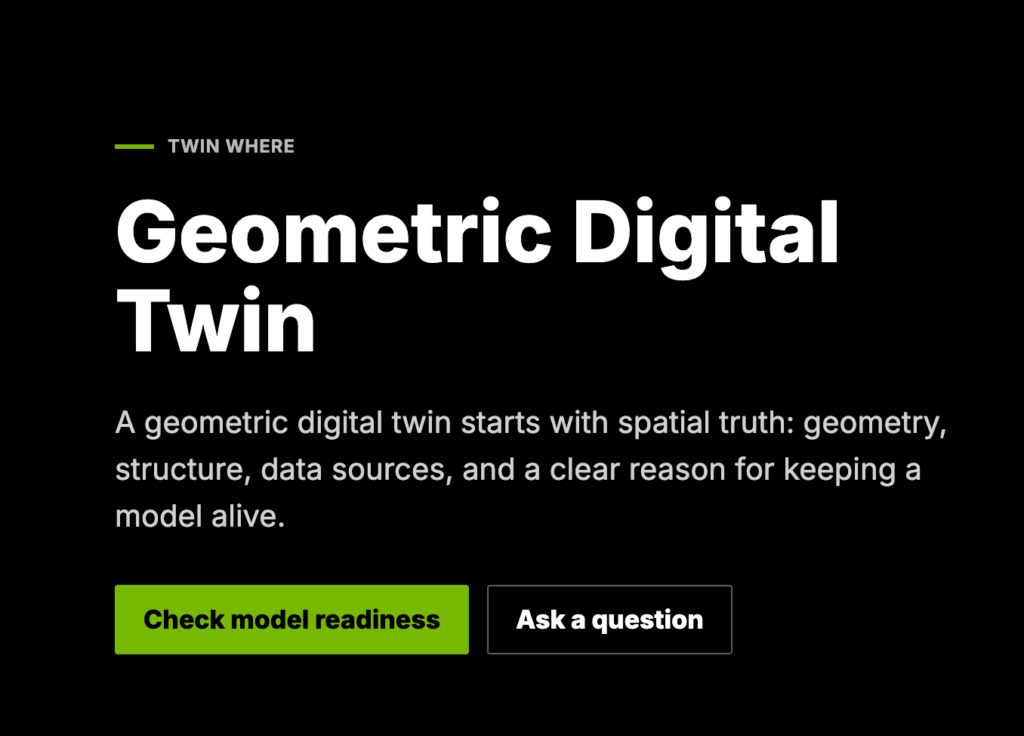
The project is not presenting vague magic. It is presenting a decision framework. On the homepage, the promise is direct: “A geometric digital twin starts with spatial truth: geometry, structure, data sources, and a clear reason for keeping a model alive.” I like that sentence because it forces discipline. A twin should be alive for a reason, not because the phrase sounds fundable in a pitch deck.
And yes, I am saying this as a founder who prefers bootstrapping over VC theater. If you are a founder building around digital-twin software, your first unfair advantage is not hype. It is clarity. Clarity makes sales easier, product scope tighter, SEO stronger, and onboarding less painful. It also saves you from building a product nobody can define.
- Main topic: geometric digital twin
- Connected entities: 3D model, CAD, BIM, point cloud, GIS context, semantic structure, model fidelity, update cycle, interoperability, simulation, monitoring, maintenance
- Main action for readers: use the readiness checklist and contact path before choosing tools or vendors
- Main audience: engineers, architects, 3D teams, CAD teams, AEC professionals, simulation teams, and technical founders
Why does the phrase “geometric digital twin” matter so much?
Because words shape scope, and scope shapes cost. A plain 3D model shows shape. A geometric digital twin supports a job that depends on structured spatial data. That job might be planning a retrofit, coordinating a construction sequence, comparing as-designed and as-built conditions, preparing simulation inputs, checking maintainability, or linking geometry to asset records. If the model cannot support a real decision, the twin language is probably doing too much work.
This is one of the reasons I care so much about monosemanticity, even if most people never use that word. Terms should point to one thing in context. When I say BIM here, I mean Building Information Modeling data and model structures used in architecture, engineering, and construction workflows. When I say CAD, I mean Computer-Aided Design files and geometry used in engineering and design workflows. When I say point cloud, I mean measured spatial data captured by laser scanning, LiDAR, photogrammetry, or related methods, often used as a basis for as-built modeling or condition capture.
Founders ignore these distinctions at their own risk. A startup that says it supports “digital twins” but cannot explain whether it starts from CAD geometry, BIM objects, mesh models, or point clouds will create confusion in sales calls, demos, procurement, and product development. Confusion kills trust. Trust kills deals when it disappears.
What does Twin Where separate clearly?
- 3D model: shape representation, often enough for visualization or simple communication
- BIM model: geometry plus building-oriented structure and metadata, useful in AEC workflows
- CAD model: design geometry with engineering intent, often rich in constraints, assemblies, and technical detail
- Point cloud: captured reality data, useful for measurement, comparison, and as-built reconstruction
- Geometric digital twin: geometry kept alive in a workflow so it supports decisions and remains linked to structured context
- Operational digital twin: a wider system that may include live or periodic operational data, asset state, monitoring, and process context
That taxonomy is not academic fluff. It helps teams ask better buying questions and helps founders build cleaner product categories. I wish more startups did this before naming every dashboard “AI twin platform.”
What problem does Twin Where solve for technical teams and founders?
The project solves a boring but expensive problem: teams often do not know whether they have a model, a usable model, or a model that can support a digital twin workflow. Those are different states. A founder may think, “we already have Revit,” or “we scanned the site,” or “the supplier gave us CAD.” None of that tells me whether the geometry is complete, whether objects are semantically meaningful, whether the file can be exchanged cleanly, whether ownership is clear, or whether anyone has planned updates.
That is why the project routes people toward the geometric digital twin readiness checklist. I like checklists because they force honesty. I also like them because they are bootstrap-friendly. Before you spend on consultants, custom software, or polished pilots, you should know what data you have and what your intended use demands.
In startup terms, Twin Where helps teams avoid three common traps:
- Trap 1: buying a platform before defining the model job
- Trap 2: assuming a visually good model is technically ready
- Trap 3: mixing unrelated use cases into one bloated product story
I have seen this pattern in deeptech and founder education again and again. People love abstraction because it feels smart. Real progress starts when someone asks, what exactly are we maintaining, why, how often, and for which decision?
How does a geometric digital twin differ from a normal 3D model?
Let’s break it down. A normal 3D model can be useful and still not qualify as a geometric digital twin. It may show shape, proportion, and visual arrangement. It can help with presentation, concept communication, marketing visuals, or rough spatial understanding. That is fine. Not every model needs to become a twin.
A geometric digital twin goes further because the geometry is part of a maintained decision system. The model has structure, source traceability, update logic, and a role in a workflow. It may connect to BIM object data, asset IDs, point-cloud comparisons, operational records, inspection histories, or simulation preparation. The exact mix changes by use case, but the geometry is not dead decoration.
Here is the practical difference in plain language. If a model can be deleted tomorrow with no effect on operations, planning, analysis, or maintenance, it is probably just a model. If teams depend on it to compare conditions, plan work, trace components, understand change over time, or support engineering decisions, you are moving into twin territory.
Quick decision test
- Does the geometry support a real task beyond viewing?
- Can someone explain the source of the model?
- Is the geometric fidelity fit for the intended job?
- Is there semantic structure, not just surfaces and pretty screenshots?
- Is there an update path?
- Is ownership and access clear?
- Can the model exchange data with the next tool in the workflow?
If most answers are no, you do not have a readiness problem alone. You have a scope problem.
Why should entrepreneurs care about model fidelity and data structure?
Because bad geometry creates bad software businesses. That may sound harsh, but I stand by it. Founders love front-end stories, AI labels, and market-size slides. Buyers who work with facilities, construction, industrial assets, and simulation care about whether the model reflects reality at the level their job requires. If your product sits on top of poor source geometry or weak semantics, the interface will not save you.
Model fidelity means the degree to which geometry and related structure are suitable for a given use. It does not mean “highest detail possible.” That mistake burns budget fast. A model fit for wayfinding and rough spatial communication does not need the same detail as clash review, retrofit planning, fabrication coordination, or engineering simulation preparation. Fidelity is contextual, and that is exactly why Twin Where matters. It frames fidelity around the job.
Data structure matters just as much. A mesh may look impressive, but a visually rich model with weak semantics can fail in scheduling, maintenance mapping, or asset linking. A startup founder who learns this early can build better product positioning. Do not sell “beautiful 3D.” Sell the model state needed for a clear operational question.
What founders often get wrong
- They confuse visual realism with technical usefulness.
- They think live data is mandatory for every twin story.
- They skip ownership and licensing questions around source files.
- They assume interoperability will sort itself out later.
- They pitch one giant platform before proving one narrow workflow.
- They fail to define whether they are selling planning support, monitoring support, simulation preparation, or maintenance support.
I am a big believer in building fast, especially with AI and no-code tools, but speed without definitional discipline creates junk. Anyone can build a prototype fast now. That is exactly why founders need stronger judgment about what their prototype actually represents.
What does Twin Where teach on the homepage and why is that useful?
The homepage does something many technical websites fail to do: it gives a clear conceptual entry point without drowning readers in vendor language. It explains that Twin Where helps technical readers separate useful planning from hype. It also introduces the practical distinction between a 3D model and a geometric digital twin, then points users toward the readiness checklist, FAQ, and contact path.
I like this structure because it respects the way smart readers think. First, define the object. Next, define the job. Then, inspect readiness. Only after that should anyone discuss tooling, stack choices, or vendor categories. Too many sites reverse that sequence because software sales teams prefer urgency over understanding.
The homepage also states a message I strongly agree with: Twin Where is built for technical readers who want clear explanations without vague 3D claims. That matters. It signals that this project is not trying to seduce the wrong audience. It is trying to help the right one make fewer expensive mistakes.
What the homepage helps users decide
- When a 3D model is enough
- When a CAD or BIM model needs richer semantics
- When point-cloud capture should feed a model update path
- When geometry is central to the workflow and not just visual context
- What should be checked before choosing tools
Why is the readiness checklist the smartest conversion path?
Because a checklist is honest. It helps people qualify themselves before they ask for help, and it attracts the right kind of lead. The readiness page at Geometric Digital Twin Readiness Checklist focuses on source model, fidelity, semantics, update path, ownership, and use case. Those are the right questions. They are plain enough for planning and technical enough to filter out people who only want buzzwords.
From a founder point of view, this is smart content architecture. Educational content should not just bring traffic. It should shape better conversations. A good pre-conversion page makes the eventual contact richer, faster, and more specific. It also improves search visibility because it matches the language real users search for, such as “digital twin readiness,” “BIM vs digital twin,” “point cloud digital twin workflow,” and “model fidelity for simulation.”
If I were advising a startup in this space, I would say the same thing I say in many other domains: build trust by naming the prep work clearly. People are tired of being told to book a demo before they even understand the category.
What a good readiness checklist should force teams to answer
- What is the source of the geometry?
- What level of detail is actually required?
- Which semantic fields must exist for the intended job?
- Who owns the model and who can edit it?
- How will updates happen, and how often?
- Which file formats or exchanges are required?
- What business or engineering decision depends on the model?
What are the real use cases behind geometric digital twins?
This is the section where a lot of nonsense usually enters the room, so I prefer to stay concrete. A geometric digital twin can support planning, monitoring, maintenance, simulation preparation, retrofit work, asset understanding, and as-built comparison. The exact workflow differs by sector, and the point is not to force one stack onto every team. The point is to identify when geometry must stay tied to structured meaning over time.
Use case 1: AEC retrofit planning
An architecture or construction team starts with existing building documentation, a BIM file of mixed quality, and a fresh point-cloud scan of the site. They need to assess where the building differs from the old model, which spaces can be repurposed, and which building systems require coordination. A static rendering is not enough. They need geometry that can be checked, compared, annotated, and linked to work planning.
Use case 2: Industrial asset understanding
An industrial team has CAD assemblies, partial scans of a facility area, and maintenance records spread across systems. They want a usable geometric reference for access planning, inspection support, and change tracking. Again, shape alone is not enough. The model needs structure, identifiers, and a maintenance logic that keeps it useful after initial setup.
Use case 3: Simulation preparation
Simulation teams often need geometry that is neither too raw nor too decorative. If the model is overbuilt with irrelevant detail, the prep becomes slow and messy. If the model lacks needed structure, the simulation setup becomes error-prone. A geometric digital twin framing helps define what geometry should be preserved, simplified, or enriched for the intended simulation task.
Use case 4: Construction progress and as-built comparison
A team compares design intent with scanned site conditions over time. The value comes from keeping geometry connected to time, source, and decision points. That can support issue review, coordination, and better planning. It does not require fantasy language. It requires a disciplined model workflow.
Notice what all these examples share. They are not about pretty viewers. They are about geometry in service of work.
What makes Twin Where useful in a search market full of noise?
The digital-twin search space is messy. You get giant vendors, academic papers, buzzword consultants, and unrelated search noise. That is exactly why a focused educational site can win. Twin Where adds practitioner-friendly structure to a search results page that often swings between sales copy and research language. It gives people a plain taxonomy, workflow framing, readiness questions, and cleaner terms.
As someone obsessed with SEO, information architecture, and founder self-reliance, I think this is one of the strongest moves a niche project can make. You do not need to scream louder than giant software firms. You need to be more precise than they are. Precision wins search when the query is technical and the reader is serious.
This is also where founders should pay attention. A lot of startup teams think content is soft work. Wrong. In technical markets, content often becomes pre-sales qualification, category education, trust building, and objection handling at the same time. A site like Twin Where is not just content. It is market framing.
Why this matters for AI search and answer engines
- Clear definitions improve retrieval quality.
- Strong entity relationships help answer engines map concepts correctly.
- Question-based headings mirror real search behavior.
- Specific terms like CAD, BIM, point cloud, model fidelity, and semantic structure create stronger topical signals.
- A checklist format makes answers easier to cite and summarize.
That is one reason I keep telling founders to invest in SEO literacy. If you can structure knowledge well, you do not just rank better. You think better.
How does my founder perspective shape the way I read this project?
I do not come at this from a fluffy content angle. I have worked across deeptech, startup systems, education design, AI tooling, and CAD-linked IP questions. At CADChain, I have dealt with CAD files, 3D workflows, rights, trust, and the ugly reality that technical systems fail when governance, ownership, and structure are ignored. That background makes me skeptical of broad claims and very interested in what happens inside the workflow.
I also bootstrap, and bootstrappers develop a good allergy to expensive ambiguity. If you do not have infinite money, every unclear term becomes a future bill. Every unclear boundary becomes feature creep. Every vague promise becomes support debt. Twin Where feels useful to me because it does the opposite. It narrows the problem. It names the parts. It tells readers to check readiness before shopping.
As a woman in startups, I will add another layer. Too many technical spaces still reward confidence theater over systems thinking. Projects like Twin Where matter because they privilege technical clarity over swagger. I want more women building in deeptech, AEC tech, industrial software, and AI-heavy infrastructure, and one way to make that happen is simple: publish clearer maps. Women do not need more slogans. We need better operating material.
What should founders avoid when building around digital twins?
Let’s get provocative for a minute. A lot of founders in spatial tech are building wrappers around confusion. They pitch giant category words, slap on AI, throw in a 3D viewer, and hope buyers fill in the technical gaps themselves. That worked better a few years ago. It works less now. Buyers are tired, budgets are tighter, and technical teams ask harder questions.
Next steps. If you are in this market, avoid the following mistakes early.
- Do not call every model a digital twin. You cheapen your own category and confuse buyers.
- Do not skip the source-data story. If geometry comes from CAD, BIM, scan data, or mixed sources, say so clearly.
- Do not promise outcomes your model layer cannot support. Fancy dashboards cannot rescue weak geometry.
- Do not ignore file governance. Ownership, permissions, and update rights matter.
- Do not bloat the product scope. Win one workflow first.
- Do not sell visual polish as proof of technical depth. Sophisticated buyers know the difference.
- Do not hide behind consultants. Founders should understand their own model logic well enough to explain it plainly.
I am very blunt about this because I have seen too many startups waste months building around category confusion. AI helps small teams move faster, yes. No-code helps founders test ideas faster, yes. Still, no tool stack can save a founder who does not know what object they are selling.
What pages inside Twin Where deserve attention first?
If you are a technical founder, AEC operator, or 3D team lead, I would start with three pages.
- Geometric Digital Twin Readiness Checklist for model-source and workflow planning questions
- Geometric Digital Twin FAQ for short answers on models, BIM, point clouds, data, and readiness
- Digital Twin Planning Resources for the contact path and planning support context
The FAQ page matters more than many people think. In technical markets, FAQs are not filler. They are compressed objection handling. They also map well to search behavior because real people ask short, messy questions before they are ready to contact anyone.
The services page also takes the right angle. It does not overclaim a giant fixed service package. It positions Twin Where as a planning resource for teams before they choose tools, vendors, or workflows. That restraint builds trust. Overpromising kills trust faster than underdesign ever will.
How can a startup use Twin Where as a practical planning tool?
You do not need to be a giant engineering team to get value from this material. A founder can use it to tighten positioning, qualify leads, and shape product scope. A freelancer can use it to avoid vague project requests. A business owner can use it to test whether a vendor proposal describes a real model workflow or just a shiny interface.
A simple founder workflow
- Read the homepage and write your own one-sentence definition of the twin you claim to support.
- Go through the readiness checklist and mark every unknown in your current workflow.
- List the source data you actually have: CAD, BIM, point cloud, mesh, GIS, asset records, or other inputs.
- Define one job the geometry must support, such as retrofit planning or as-built comparison.
- Write down the minimum semantic fields needed for that job.
- Map how updates will happen and who owns the source of truth.
- Use the FAQ to tighten your sales language and remove vague claims.
- Contact Twin Where if you need planning support after you can describe the problem clearly.
This kind of sequence sounds simple, and that is exactly why it works. Most startup damage happens before software gets built. It happens when teams agree on words that mean different things to different people.
Why does this project fit the moment right now?
Because we now have two forces colliding. First, more teams have access to 3D capture, BIM content, CAD exports, viewer tech, and AI-assisted analysis. Second, more buyers have become suspicious of broad software claims. That creates a gap, and Twin Where fits inside it. The gap is simple: teams can get geometry more easily than they can classify and maintain it correctly.
I also think there is founder FOMO in this space for the wrong reasons. People see massive categories like digital twins, industrial AI, or smart buildings and assume they need a huge funded play. I disagree. A bootstrap founder can win by owning one painful question and answering it better than bigger companies. The Twin Where angle proves that educational precision itself can be a wedge.
My broader founder belief applies here too: default to AI and no-code for early experiments, but do not let speed turn into sloppiness. Anyone can spin up a viewer, a content site, a workflow mockup, or a lead funnel quickly. The hard part is not shipping pixels. The hard part is choosing a precise technical promise and defending it with clean language.
What is my final take on Twin Where?
I think Twin Where is doing something smart, disciplined, and badly needed. It treats the geometric digital twin as a technical concept that deserves exact language, not trend-chasing noise. It helps readers distinguish among 3D models, BIM, CAD, point clouds, and maintained twin workflows. It offers a readiness checklist instead of premature software pressure. And it speaks to people who actually have to make decisions with geometry, not just admire it on a screen.
That is also why I respect the project from a founder angle. It shows restraint. It picks a clear scope. It chooses educational depth over empty scale theater. Frankly, more startups should work like this. Build narrower. Name things better. Teach the market while you qualify it. And if you are a woman founder entering deeptech, remember this: you do not need permission to build in technical categories that men have made unnecessarily opaque for years. You need structure, speed, stubbornness, and a willingness to learn by building.
If you want the practical next step, start with the geometric digital twin readiness checklist, review the geometric digital twin FAQ, and use the Twin Where contact path once you can describe your model, its source, its job, and its update logic in plain English. That alone will put you ahead of a shocking number of teams claiming they are building twins.
People Also Ask:
What is Twin Where – Geometric digital twin?
Twin Where – Geometric digital twin is a type of digital twin focused on the 3D shape, position, and spatial relationships of real-world objects or places. It creates a virtual model of an asset such as a building, bridge, factory, or city space, often using point clouds, CAD, BIM, GIS, sensor feeds, or imaging data. Its purpose is to show where things are, how they connect, and how the physical space changes over time.
What is a digital twin in simple words?
A digital twin is a virtual copy of a real object, place, or system. It is linked to real-world data so the digital version can reflect what is happening in the physical one. You can think of it as a living digital model that helps people monitor, analyze, and manage something in the real world.
How is a geometric digital twin different from a 3D model?
A 3D model is usually a static visual representation, while a geometric digital twin is tied to real-world context and often updated with current data. A geometric digital twin does more than show shape. It can include object identity, location, condition, connections, and links to operational or sensor information. That makes it more useful for monitoring, planning, and decision-making.
What are the four types of digital twins?
The four commonly cited types of digital twins are component twins, asset twins, system twins, and process twins. Component twins represent single parts, asset twins represent complete physical assets, system twins show how multiple assets work together, and process twins model full workflows or operations. In some fields, geometric digital twins are treated as a spatial layer that supports these broader categories.
Can a human have a digital twin?
Yes, a human can have a digital twin in some medical, fitness, and research settings. This usually means a virtual model built from health records, scans, wearable data, genetics, or physiological measurements. The goal is to study health patterns, predict responses to treatment, or simulate outcomes, though this kind of twin is more complex and sensitive than an asset-based digital twin.
How much does a digital twin cost?
The cost of a digital twin can range from a small pilot budget to a very large enterprise project. Price depends on the size of the asset, the quality of the geometry, the amount of live data, software tools, sensors, and the level of detail required. A simple 3D-based twin may cost far less than a full geospatial or industrial twin connected to real-time systems.
What data is used to build a geometric digital twin?
A geometric digital twin is often built from point clouds, laser scans, photogrammetry, BIM files, CAD drawings, GIS layers, drone imagery, and sensor data. These sources help define shape, size, position, and spatial relationships. In many projects, this geometry is then linked with metadata such as asset IDs, maintenance records, and live operational readings.
What is a geospatial digital twin?
A geospatial digital twin is a digital twin built around location and spatial context. It represents physical objects, infrastructure, terrain, and relationships across a site, campus, or city. It usually combines mapping, 3D geometry, and real-world data so users can understand not just what something is, but where it is and how it relates to its surroundings.
What is a geometric digital twin used for?
A geometric digital twin is used for tasks such as facility management, navigation, construction tracking, asset inspection, maintenance planning, and infrastructure analysis. It helps teams see physical conditions in context and compare the real asset with its digital version. This is useful in buildings, bridges, factories, transport networks, and urban planning.
Why is geometry important in a digital twin?
Geometry matters because it gives the digital twin its spatial structure. It shows the size, shape, orientation, and placement of objects, which is necessary for understanding how assets fit together and behave in real spaces. Without accurate geometry, a digital twin may still hold data, but it loses much of its value for visualization, analysis, and physical context.
FAQ on Twin Where and Geometric Digital Twins
How do you choose between a mesh, BIM model, CAD model, or point cloud for a geometric digital twin?
Choose based on the job, not the file type alone. Point clouds suit capture and comparison, CAD suits engineering intent, BIM suits structured building workflows, and meshes suit visualization. For a geometric digital twin workflow, start by defining decisions, required semantics, update needs, and exchange formats.
What file formats matter most in a geometric digital twin workflow?
The right formats depend on authoring tools and downstream use. Common choices include IFC, RVT, DWG, STEP, OBJ, FBX, E57, and LAS/LAZ. Teams should test interoperability early, document the source of truth, and avoid assuming exports preserve semantics, hierarchy, or identifiers correctly.
When is scan-to-BIM worth the effort for a digital twin project?
Scan-to-BIM is worth it when measured reality must become structured, queryable geometry for planning, coordination, or maintenance. It is often unnecessary for simple viewing. Before investing, define required model fidelity, object granularity, and whether the resulting BIM model will actually be maintained over time.
How should teams handle version control and change tracking in a 3D digital twin?
Use a clear source-of-truth model, dated revisions, change logs, and ownership rules. Store geometry, linked metadata, and scan updates in a controlled workflow. For geometric digital twin change tracking, teams should record what changed, why it changed, who approved it, and which decision depended on it.
What metadata is usually essential in a geometric digital twin model?
Essential metadata depends on use case, but common fields include asset ID, location, type, material, status, revision date, source file, and owner. If a model supports maintenance or planning, add inspection history and relationship fields. Keep metadata lean, consistent, and tied to actual operational questions.
How can a founder tell if a digital twin startup idea is too broad?
If the product claims to serve construction, facilities, industrial monitoring, simulation, and smart cities at once, it is probably too broad. Start with one narrow workflow. A strong geometric digital twin startup usually solves one specific problem with defined geometry, semantics, update logic, and user responsibility.
What are the biggest hidden costs in geometric digital twin projects?
Hidden costs usually come from cleanup, re-modeling, bad exports, unclear ownership, missing semantics, and unplanned updates. Teams also underestimate coordination across vendors and departments. To control geometric digital twin project cost, define model purpose early, audit source data, and budget for maintenance, not just setup.
Can a small team build a useful digital twin without buying an expensive platform?
Yes, if the use case is narrow and the geometry is fit for purpose. Many teams can begin with existing CAD, BIM, or scan data plus disciplined naming, metadata, and review processes. Expensive software cannot fix weak source models, unclear scope, or missing update responsibilities.
How do GIS context and building or asset models work together in practice?
GIS gives broader spatial context such as site, terrain, utilities, and surroundings, while BIM or CAD gives object-level geometry and technical structure. A useful geometric digital twin often needs both. Teams should decide what stays at geospatial level versus model level to avoid unnecessary complexity.
What should a team prepare before contacting Twin Where for planning help?
Prepare a short description of the asset or site, source files available, intended use case, current problems, required outputs, and update expectations. Include whether you have CAD, BIM, point clouds, GIS, or mixed data. That makes digital twin planning support faster, sharper, and more useful.


