
The Dutch government just told every Dutch resident to eat less meat and less cheese. I am going to tell you why, as a female founder, that might be the most expensive nutritional mistake you ever make.
I am an entrepreneur. I have run on adrenaline, on bad coffee, and occasionally on nothing. And I have learned, the hard way, that your brain is not a separate entity from your body. What you feed one, you feed the other. The moment I started treating nutrition as a business decision, my output changed. This article is supposed to make you think instead of blindly following guidelines that may damage your health.
TL;DR
The Netherlands Nutrition Centre’s April 2026 update to its “Wheel of Five” cuts recommended weekly meat intake by 40%, halves daily cheese to 20 grams, and pushes a 60/40 plant-to-animal protein split. The environmental logic is clear. The health logic for female entrepreneurs, especially those over 35, is dangerously incomplete. Animal protein delivers complete amino acid profiles, heme iron, vitamin B12, zinc, and creatine in forms your body absorbs far more readily than plant alternatives. Low iron and B12 deficiency are directly linked to brain fog, depression, anxiety, sleep disruption, and cognitive impairment. For women running startups on tight margins, where every decision costs either money or momentum, chronic micronutrient depletion is not a health inconvenience. It is a revenue threat.
The New Dutch Guidelines: What Actually Changed
On April 9, 2026, the Netherlands Nutrition Centre published a major update to its Schijf van Vijf (Wheel of Five), the first full revision in a decade. The headline changes for adults:
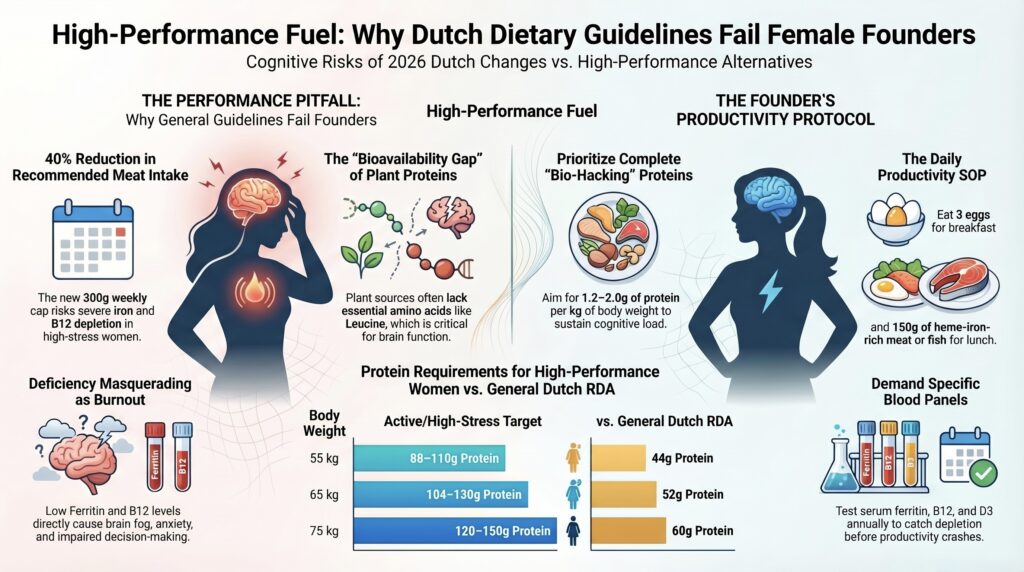
- Weekly meat intake drops from 500 grams to 300 grams maximum, with red meat capped at 100 grams
- Processed meats and cold cuts move from daily to “as little as possible”
- Daily cheese consumption drops from 40 grams to 20 grams
- The recommended protein split shifts from 50/50 plant-to-animal to 60/40 in favour of plants
- Weekly legume consumption more than doubles, from up to 180 grams to 250 grams
The stated rationale mixes climate targets with chronic disease prevention. Nitrogen emissions, greenhouse gas reduction, and cardiovascular risk all feature in the official justification. The update places the Netherlands among a growing group of European countries aligning national dietary advice with 2030 climate goals.
That context matters as much as real data-based science, which is a hard thing to come by these days. These nutritional guidelines are built for a general population who don’t understand much about the science behind physical health, weighted towards planetary sustainability as a criterion that is put so much higher that human health. And of course, they were not designed for women, let alone female entrepreneurs.
But that should not surprise anyone.
Why Female Founders Are a Completely Different Case
Let me be direct. I am not writing this to argue that meat is good and vegetables are bad. Anyone reading this who survives on processed food and skips vegetables is not my audience. I am writing this for the smart founder who is already trying to eat well and is doing her best to have great mental health and get enough quality sleep, who heard these guidelines, and who is now doubting if the steak is better than lentils because the Dutch government said so.
However, more and more entrepreneurs get into biohacking, because we treat health as one of the most important resources we have.
Here is what the guidelines do not account for:
You are under sustained, high-level cognitive and physiological stress. Running a bootstrapped startup is not a nine-to-five with a catered lunch. It is decision fatigue compounded hourly, sleep deprivation, cortisol spikes, and months where you are executing on willpower alone.
You are almost probably a menstruating woman. These is the life stage where iron depletion happens fastest. The older you get the more muscle mass begins to decline in ways that compound over years, and where hormonal shifts genuinely alter how your body processes and demands protein.
You cannot afford to experiment. A large corporation can absorb a quarter of low productivity. A bootstrapped startup cannot. When you lose two weeks to brain fog (read up about how our memory works) and exhaustion (which might lead to burnout), you lose revenue, momentum, and sometimes the desire to run a company.
The Protein Problem: Complete vs. Incomplete
Here is the science that the Dutch guidelines (hopefully) acknowledge but do not fully apply to women in high-performance contexts.
Proteins are made from 20 amino acids, nine of which are essential, meaning your body cannot produce them and you must get them from food. These nine are histidine, isoleucine, leucine, lysine, methionine, phenylalanine, threonine, tryptophan, and valine. Animal proteins like meat, dairy, and eggs naturally provide all nine essential amino acids needed for muscle maintenance and brain function. Most plant proteins do not.
This is not a moral position. It is biochemistry.
Leucine, found in high concentrations in meat and whey dairy, is the amino acid most responsible for triggering muscle protein synthesis. Tryptophan, found in animal products, is the precursor to serotonin, the neurotransmitter most directly linked to mood stability. Tyrosine, abundant in meat and cheese, is the precursor to dopamine, the neurotransmitter that drives motivation and focus.
When your protein intake drops or shifts heavily towards plant sources without precise complementary planning, the raw material supply for these neurotransmitters falls. You do not notice it in a week. You notice it across months as a slow erosion of sharpness, motivation, and emotional resilience.
Research from 2022 found that older adults who severely decreased their animal protein intake had a 48% higher chance of cognitive impairment. A 2025 study found that people over 60 with high protein intake at dinner were significantly less likely to show low cognitive performance. The mechanistic pathway is clear: amino acids are required for neurotransmitter synthesis, and when they are restricted, brain chemistry suffers.
For a founder, your brain is your primary asset. Impairing it voluntarily is poor business strategy.
Iron: The Hidden Revenue Killer for Female Founders
Iron is where the stakes get very specific for women.
According to the World Health Organization, iron deficiency affects nearly 30% of the global population, with menstruating women disproportionately at risk. And here is what most general dietary advice skips over entirely: you can be iron deficient without being anemic. Your hemoglobin can look normal on a blood test while your ferritin (stored iron) is already crashing.
The consequences of low ferritin without clinical anemia are not abstract. A large 2020 study published in BMC Psychiatry found that people with iron deficiency anemia had a significantly higher incidence and risk of anxiety disorders, depression, sleep disorder, and psychotic disorders. Research from the University of Michigan found that 60% of participants whose anxiety had not responded to therapy achieved remission once their ferritin levels were raised above 30 micrograms per litre.
Let that sink in. Not therapy. Not medication. Iron.
Now consider this in startup terms. You are second-guessing decisions you would normally make confidently. You are anxious in investor conversations for no clear reason. You are lying awake at 2am unable to switch off, even though you are exhausted. You have written off these symptoms as “the startup life.” Some of them are iron deficiency.
The critical difference between heme iron (from meat) and non-heme iron (from plants) is bioavailability. Your body absorbs heme iron at roughly 15 to 35 percent efficiency. Non-heme iron absorbs at 2 to 20 percent, and absorption varies sharply depending on what else you eat with it. Lean red meat, fish, and poultry are the most efficient dietary sources of heme iron, and the Dutch guidelines have now capped red meat at 100 grams per week.
For a menstruating founder already running an iron deficit, that ceiling is not enough.
Vitamin B12: The Deficiency That Masquerades as Burnout
B12 is found in sufficient amounts only in animal foods. There is no plant food that contains it naturally in the amounts your nervous system requires.
People with low or deficient B12 levels feel foggy-headed and have difficulty concentrating and completing tasks, according to multiple peer-reviewed studies. Deficiency is associated with irritability, memory loss, depression, and cognitive disturbances. A 2020 study gave B12 replacement therapy to 202 people with mild mental impairment and low B12 levels, and after three months, 84% reported significant improvements in focus, memory, and forgetfulness.
B12 deficiency is slow-moving and easy to misread. It accumulates over months. By the time you notice it, you have already lost significant productivity. And because studies suggest up to 20% of people over the age of 60 are deficient, and because absorption declines with age, the window where dietary intake really matters is the decade before you think it applies to you.
The new Dutch guidelines actively encourage dairy alternatives, which are often B12-fortified. Fortified foods are not the same as whole food sources. The bioavailability and stability differ. If you shift to dairy alternatives and do not track your B12 intake obsessively, you will slide into deficiency without knowing it.
The Female Factor: Why This Gets Worse After 35
Most nutritional guidelines are built on research done primarily in men, or in post-menopausal women. The 35 to 55 range, the exact decade when most female founders are building their most ambitious companies, is nutritionally under-studied and hormonally turbulent.
As estrogen levels begin to fluctuate and decline from around age 40 onwards, several things happen simultaneously:
- Muscle mass begins to decline faster than at any earlier point in life
- Bone density drops, with women losing up to 20% of bone mass in the years around menopause
- The anabolic response to protein decreases, meaning you need more protein to get the same muscle-building effect
- Neurotransmitter production becomes less stable as hormonal regulators shift
- Sleep architecture changes, with more frequent disruptions
Stanford’s Lifestyle Medicine programme recommends women in their 40s aim for 1.2 to 1.6 grams of protein per kilogram of body weight per day, which translates to roughly 80 to 100 grams daily. The Dutch RDA of 0.8 grams per kilogram, which the new guidelines are built around, falls significantly short of this for active, high-stress women.
And creatine, a compound found naturally only in animal products, is receiving serious research attention for perimenopause specifically. Creatine plays a critical role in energy production and brain function, and emerging research suggests that supplementation may reduce brain fog, moodiness, and cognitive symptoms during perimenopause.
Meat and dairy are your primary dietary creatine sources. Cutting them reduces your intake to near zero unless you supplement.
Dairy and Cheese: 20 Grams Is Not Enough
The halving of the cheese recommendation from 40 to 20 grams per day deserves specific attention.
Cheese is one of the most calorie-dense, nutrient-efficient foods available. That’d on top of it being supper yummy. Per gram, it delivers calcium, protein, B12, zinc, and fat-soluble vitamins. For a bootstrapped founder eating at a desk, it is also fast, no preparation required, and stable at room temperature.
Calcium is essential for bone density, but its role in neural signalling often gets overlooked. Calcium is involved in the release of neurotransmitters, in muscle contraction (including the heart), and in regulating sleep via interactions with magnesium and melatonin pathways.
20 grams of cheese per day delivers approximately 120 milligrams of calcium. The recommended daily intake for women is 1000 milligrams, rising to 1200 milligrams after 50. This means cheese, under the new guidelines, contributes roughly 10 to 12% of your daily calcium requirement. The rest must come from other dairy, fortified products, or supplementation.
This is manageable with planning but most people don’t know how supplementation works. Moreover, in the Netherlands it’s virtually impossible to get blood tests to track your health, so it’s an extremely unwise move to stop eating animal proteins and move on with your life.
Unless you want your life quality to deteriorate.
What the Science Says About Diet, Sleep, and Startup Performance
Sleep is where nutrition and performance intersect most visibly, and where female founders lose the most ground.
Iron deficiency directly impairs melatonin regulation, leading to insomnia, and multiple trials show that iron therapy improves sleep quality and daytime alertness. Iron also directly links to restless legs syndrome, a condition that disproportionately affects women and that destroys sleep quality without causing obvious symptoms during the day.
How many women in the Netherlands know their iron level? What about ferritin? The short answer is almost nobody does because you can’t get tested regularly.
Tryptophan from protein converts to serotonin and then to melatonin. Restrict your tryptophan intake and you restrict your body’s ability to self-regulate sleep onset. This is not a supplement-store claim. Vitamin B12 deficiency is associated with depression, memory loss, and cognitive disturbances, all of which impair sleep architecture.
The relationship between sleep deprivation and decision quality in founders is well-established. Research consistently shows that sleep-deprived individuals overestimate their own competence, take worse risks, and underestimate costs. If your nutrition is contributing to poor sleep, the downstream effect on your startup decisions is real and measurable.
The Bootstrapped Startup Nutrition Framework
Here is what I actually do, what I recommend to female founders in my network, and what is grounded in the research above. This is not a diet plan. It is a productivity protocol.
The core principle: Eat enough complete protein at every meal to meet your brain’s amino acid requirements, combine it with a wide variety of vegetables, and treat animal products as tools for micronutrient density, not just protein.
Daily Protein Targets for Female Founders
| Body Weight | Minimum Daily Protein | Active/High-Stress Target |
|---|---|---|
| 55 kg | 66g | 88–110g |
| 65 kg | 78g | 104–130g |
| 75 kg | 90g | 120–150g |
| 85 kg | 102g | 136–170g |
Based on 1.2–2.0g/kg/day for active, high-cognitive-load women
Practical Daily SOP for Bootstrapped Founders
Morning (fuel cognitive output):
- 3 eggs cooked in butter or olive oil (18–21g protein, B12, iron, choline for memory)
- Greek yogurt or cottage cheese (15–20g protein, calcium)
- Handful of berries or sliced vegetables on the side
Midday (sustain focus through afternoon decision-making):
- 100–150g of meat or oily fish (chicken thigh, salmon, sardines, lean beef)
- 200g mixed vegetables, roasted or raw, with olive oil
- Legumes 2 to 3 times per week alongside meat, not instead of it
Evening (rebuild and prepare for sleep):
- Slow-digesting protein (casein from cottage cheese or Greek yogurt, or a moderate portion of meat or eggs)
- Leafy greens for magnesium, which supports sleep onset
- Hard cheese in a reasonable amount, 30 to 40 grams, despite what the guidelines say
Weekly priorities:
- Red meat 2 to 3 times per week, not 100g total. The new Dutch cap is a ceiling for a general population, not a prescription for a female founder under chronic stress.
- Liver or organ meat once every two weeks: the most nutrient-dense food per calorie available, excellent for iron, B12, and zinc
- Oily fish twice per week for omega-3 fatty acids, which reduce systemic inflammation
Mistakes to Avoid When Navigating These Guidelines
Mistake 1: Treating the new guidelines as designed for you. They are not. They are built for a general adult Dutch population with an average activity level and an institutional mandate to reduce nitrogen emissions. Your context is radically different.
Mistake 2: Replacing meat with ultra-processed plant proteins. Many meat substitutes are high in sodium, additives, and anti-nutrients that actually inhibit iron and zinc absorption. Recent research shows that only 26% of plant-based meat products currently meet nutritional guidelines for ready-made foods. Replacing a chicken breast with a plant-based nugget is a nutritional step down, not a lateral move.
Mistake 3: Not getting your ferritin tested. Standard blood tests check hemoglobin, not ferritin. You can have normal hemoglobin and critically low ferritin. Ask your GP explicitly to test serum ferritin. If it is below 30 micrograms per liter, address it before you assume your fatigue and brain fog are just startup life.
Mistake 4: Going dairy-free without replacing calcium and B12 systematically. Fortified plant milks vary enormously in their nutrient content. Some are genuinely useful. Many are expensive water with added flavour. If you cut dairy, you need a replacement strategy, not an assumption.
Mistake 5: Under-eating protein during perimenopause because you are trying to reduce calories. Your muscle mass decline accelerates faster than your calorie requirement. Cutting protein to cut calories during perimenopause is a metabolic trap. You lose muscle, your resting metabolism drops, and you end up needing even less food to maintain weight while needing even more protein to function. This spiral costs you both productivity and long-term health.
Mistake 6: Relying on supplements as primary sources. Iron tablets without food context are poorly absorbed and cause gastrointestinal issues that disrupt your schedule. Heme iron from food absorbs better and does not come with those side effects. Supplements complement a good diet. They do not replace one.
What to Actually Tell Your Doctor
If you are a female founder in the Netherlands or elsewhere in Europe and you are concerned about your nutrition, here is what to ask for specifically at your next check-up:
- Serum ferritin (not just hemoglobin or iron)
- Vitamin B12 (not just the basic metabolic panel)
- Vitamin D3 (low D3 compounds fatigue and mood issues)
- Thyroid panel (TSH, T3, T4), because thyroid dysfunction mimics burnout and is frequently missed
- Zinc levels
If any of these are low, address them with both dietary changes and supplementation under medical guidance. Do not wait until symptoms become severe. The drift from optimal to deficient is slow, which is exactly why most founders miss it until they are months into underperforming.
The Environmental Argument: What it means for human health
I want to touch upon the climate dimension briefly , because dismissing it entirely would lead to people saying “but what about the environment?”.
The environmental case for reducing animal product consumption at a population level is very hyped. According to some studies, conventional meat accounts for 27% of emissions and land use linked to Dutch diets, and dairy contributes 23% of greenhouse gas output. Do I trust the veracity of studies like this? No, I do not. I have seen far too many studies conducted to prove the point that needs to be proven.
I am not saying I don’t trust that the climate deserves our attention. What I am saying is that I value my health more than any hypothetical climate change.
The question that I want you to think over is whether a female founder at a critical stage of physical and cognitive performance should follow a population-level guideline designed with average sedentary adults in mind, without specific adaptation for her context.
The answer is no. Not without professional nutritional guidance that accounts for your specific biomarkers, stress load, hormonal stage, and performance demands.
However, getting this nutritional guidance is a challenge in the Netherlands that is comparable to building a startup in Europe. It’s super hard.
Reducing ultra-processed meat consumption, choosing grass-fed beef over factory-farmed, sourcing dairy from local producers where possible, and increasing vegetable intake alongside maintained protein: these are positions any founder can hold simultaneously. You can care about the planet and eat enough protein. Don’t let the narrative ruin your health.
What I Eat When I Am Building
When I launched CADChain in 2018, I was working fifteen-hour days. My nutritional decisions were driven almost entirely by cost and speed, which meant I was chronically under-eating protein and over-relying on carbohydrates for energy.
The result was a pattern I have heard from dozens of female founders in the Fe/male Switch community: energy crashes at 3pm, difficulty forming long sentences in the evening, sleep that felt non-restorative, and emotional volatility that I attributed entirely to stress.
The moment I shifted to deliberately structured protein intake across three meals, including red meat every day, eggs almost daily, full-fat Greek yogurt, and hard cheese in amounts the Dutch government now disapproves of, the afternoon crashes stopped. Sleep deepened within and the length of deep sleep increased. The emotional volatility flattened.
I am not claiming nutrition fixed everything, but it fixed more than I expected, and I wish I understood how human body and mind works sooner. I wish kids got taught these things at school. I wish the government cared about our health a bit more.
A Note on Budget, Because This Is for Bootstrappers
Meat and dairy are not cheap in 2026, and I am not going to pretend otherwise. Here is how to get maximum nutritional value per euro:
- Eggs are the most cost-efficient complete protein available. Buy them in bulk. Eat three a day without guilt.
- Chicken thighs cost significantly less than breast and contain more iron and zinc. Use them.
- Canned sardines and mackerel are the most affordable oily fish source and are nutritionally superior to fresh salmon for B12 and omega-3. A can costs under one euro.
- Liver (chicken liver especially) is cheap, cooks in ten minutes, and contains more iron and B12 per gram than almost any other food. Most people avoid it due to taste. Marinate it in lemon juice and garlic for ten minutes before cooking and the bitterness largely disappears.
- Full-fat Greek yogurt is one of the highest-protein, highest-calcium dairy options per euro. The fat slows digestion and keeps you full longer, which matters when you are skipping lunch because a client call ran long.
- Hard cheeses in larger quantities than the guidelines suggest are not going to damage your health. 40 to 50 grams per day of good quality cheese is a reasonable position for a high-performance woman, regardless of what a guideline designed for a sedentary general population recommends. And get that glass of wine in the evening if you feel like it.
FAQ: Nutrition, Protein, and Performance for Female Entrepreneurs
What are the best animal protein sources for female entrepreneurs on a budget?
Eggs, chicken thighs, canned sardines and mackerel, chicken liver, full-fat Greek yogurt, cottage cheese, and hard cheese represent the best value-per-nutrient options available in European supermarkets. All of these deliver complete amino acid profiles, heme iron, B12, and calcium at a cost significantly below premium cuts of red meat. For a bootstrapped founder, the goal is nutrient density per euro, not prestige cuts. A daily intake structured around two to three eggs at breakfast, 100 to 200 grams of chicken or canned fish at lunch, and a dairy-based evening option easily meets both protein and micronutrient targets without exceeding a modest food budget.
How does low iron specifically affect startup performance for women?
Iron depletion, even without clinical anemia, directly impairs dopamine, serotonin, and norepinephrine synthesis, the three neurotransmitters most responsible for motivation, mood regulation, and executive function. A founder with low ferritin will experience what feels like burnout: difficulty making decisions, reduced capacity for creative thinking, persistent low-level anxiety, and non-restorative sleep due to iron’s role in melatonin regulation. Research consistently shows that women of menstruating age are the highest-risk group for iron deficiency globally. The key diagnostic step is testing serum ferritin specifically, since standard blood panels often miss depletion until it becomes full anemia. Heme iron from meat and fish absorbs two to five times more efficiently than non-heme iron from plant sources.
Should female founders follow the new Dutch dietary guidelines for protein?
The new Dutch guidelines are designed for a general adult population and incorporate environmental sustainability as an equal criterion alongside nutritional health. They are not designed for women under sustained cognitive and physical stress, nor do they account for the hormonal and metabolic demands of perimenopause. Female founders, especially those over 35, typically need more protein than the guidelines’ baseline 0.8 grams per kilogram per day, with research from Stanford and multiple nutrition journals suggesting 1.2 to 1.6 grams per kilogram as appropriate for active women in cognitively demanding roles. The guidelines should be adapted with professional nutritional guidance for individual high-performance contexts.
What is the connection between vitamin B12 and cognitive performance for entrepreneurs?
Vitamin B12 is essential for maintaining the myelin sheath surrounding nerve cells, the structure that allows neurons to communicate rapidly and accurately. When B12 is low, neural communication slows. Founders experience this as difficulty concentrating, slower recall, reduced ability to hold complex information in working memory, and a generalised cognitive heaviness that is often misidentified as overwork or decision fatigue. B12 is found naturally only in animal products, and its absorption declines with age, meaning the risk increases precisely as founders approach their most experienced and productive years. A 2020 study found that 84% of participants with mild cognitive impairment related to low B12 showed significant improvement in focus and memory after three months of B12 replacement therapy.
How much protein does a 40+ female founder actually need?
Research from Stanford’s Lifestyle Medicine programme, multiple nutrition journals, and perimenopause-specific dietitians consistently places the optimal protein target for active women over 40 at 1.2 to 1.6 grams per kilogram of body weight per day, with some research supporting up to 2.0 grams during periods of high physical or cognitive stress. This translates to roughly 80 to 130 grams of protein daily for a 65 to 80 kilogram woman, spread across three meals with 25 to 40 grams per sitting. As estrogen declines, the anabolic response to protein becomes less efficient, meaning more protein is needed to achieve the same muscle maintenance effect. Cutting protein during perimenopause to meet population-level guidelines actively accelerates muscle loss, which in turn slows metabolism, impairs insulin sensitivity, and compounds cognitive and energy challenges.
Can plant protein fully replace animal protein for female startup founders?
Plant proteins can contribute to total protein intake and provide nutritional value, particularly legumes and seeds. The limitations are specific and practical. Most plant proteins are incomplete, lacking one or more essential amino acids in sufficient quantities. Their protein bioavailability is generally lower than animal sources, meaning a stated 20 grams of protein from lentils delivers fewer usable amino acids to your cells than 20 grams from chicken. Plant sources also contain zero heme iron and zero B12. Achieving full nutritional equivalence on a fully plant-based diet requires precise complementary protein pairing, B12 supplementation, and close monitoring of iron and zinc status. This is achievable but demands significantly more planning and monitoring than is possible within the Dutch healthcare system. A practical hybrid approach, maintaining animal protein for its micronutrient density while increasing vegetable and legume variety, delivers better nutritional outcomes with less overhead.
How does diet affect sleep quality for female entrepreneurs?
Sleep disruption in female founders is frequently nutritional in origin, even when it is attributed entirely to stress. Iron deficiency directly impairs melatonin production and is strongly associated with restless leg syndrome, a condition that causes sleep fragmentation without necessarily preventing sleep onset, making it easy to miss as a diagnosis. B12 deficiency is associated with depression and cognitive disruption that impairs sleep architecture. Tryptophan from protein is the dietary precursor to serotonin and melatonin, and restricting protein intake reduces the raw material available for these sleep-regulating compounds. Magnesium, found in green vegetables, nuts, and dairy, supports the transition to sleep by moderating cortisol. A diet that maintains adequate animal protein, includes magnesium-rich vegetables, and avoids heavy carbohydrate loads in the evening will measurably improve sleep quality within two to four weeks for most women with nutritional deficiencies.
What blood tests should a female founder get to assess nutritional status?
The standard annual blood panel misses several nutritionally significant markers. Female founders should specifically request serum ferritin (not just hemoglobin), vitamin B12 (not just the basic panel), vitamin D3, a full thyroid panel (TSH, free T3, free T4), and zinc levels. If these are not included in your standard check-up, request them by name. In the Netherlands, GP referrals for extended panels need to be demanded because the docs are not really interested in healthy population. Getting these numbers annually is significantly cheaper than the productivity losses caused by undetected deficiencies. Optimal ferritin for a high-performing woman is above 50 micrograms per litre, not just “within normal range,” which can include values as low as 12 in most lab reference systems.
How does creatine in animal products support brain function for women?
Creatine is a tripeptide compound found naturally only in animal muscle tissue. It plays a central role in cellular energy production, particularly in organs with very high energy demands like the brain and skeletal muscle. The body produces some creatine endogenously, but dietary intake from meat and fish contributes meaningfully to total creatine stores, particularly during high-demand periods. Emerging research, including studies specifically examining perimenopause, suggests that creatine supplementation at 3 to 5 grams per day may reduce brain fog, improve mood, and support cognitive resilience during hormonal transition. Cutting animal products substantially reduces dietary creatine to near zero. Women who eliminate or drastically reduce meat and fish intake while not supplementing creatine are leaving a meaningful cognitive support compound out of their system at a life stage when they need it most.
What should a female founder’s sample nutrition day look like for maximum productivity?
A productivity-optimised nutrition day for a female founder looks like this. Breakfast: three eggs cooked in olive oil or butter, full-fat Greek yogurt with a handful of berries, black coffee or tea with no sugar. This delivers approximately 35 to 40 grams of complete protein, B12, iron, choline for memory, and calcium to start cognitive function cleanly. Midday: 130 to 150 grams of chicken thigh, salmon, or lean beef with 200 grams of roasted mixed vegetables in olive oil and a small serving of legumes two to three times per week. This delivers 35 to 45 grams of complete protein, heme iron, zinc, and micronutrients for sustained afternoon cognitive performance. Evening: cottage cheese or a moderate serving of meat or eggs, leafy greens for magnesium, 30 to 40 grams of hard cheese, and no heavy starchy carbohydrates that spike insulin and fragment sleep. Total daily protein: 90 to 120 grams. This framework costs under 10 euros per day in most European cities and can be prepared in under 30 minutes total.
Next Steps
Check your blood panels first. Go to a private lab if you can’t get the GP to cough up the referral. Everything else is secondary to knowing your baseline.
Then audit your current protein intake for one week by logging what you actually eat, not what you intend to eat. Most founders discover they are eating significantly less protein than they believe, and significantly more refined carbohydrates.
Feed yourself accordingly.
The information in this article is for educational purposes and does not constitute medical advice, but if you are an entrepreneur, you should understand this. Consult a qualified physician (good luck with that in the Netherlands) before making significant changes to your diet or supplementation.
