
The Reality Check of AI Overviews in Bing Search Console
The Visibility Gap
Research from Hive Digital revealed a stunning reality:
- 1,064 Bing AI Citations for a high-performing GEO article
- 3 impressions in traditional Bing search during the same period
- 333x difference
This is a different visibility layer.
Where the Citations Are Coming From
AI citations are generated primarily through:
- Microsoft Copilot (direct AI chat, not web search)
- Bing’s AI-generated summaries (in search results)
- Partner integrations (GPT-4, third-party LLMs)
These are programmatic retrieval events, not human search queries leading to clicks.
Why This Actually Matters
Despite the visibility gap, AI citations represent:
- Brand authority signals across AI ecosystems
- Semantic validation of your expertise
- Future traffic potential as AI search matures
- Competitive intelligence on emerging topics
- Trust signals for downstream conversions
The goal: Leverage AI citations to build authority that converts in downstream traffic sources (social, direct, traditional search, referral).
Understanding Your AI Performance Data in Bing Webmaster Tools
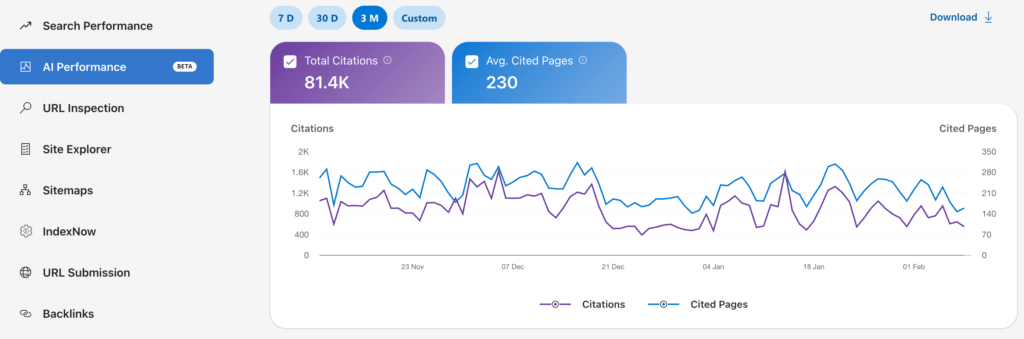
The Four Data Points You’re Seeing
1. Total Citations
- Raw count of times your content is referenced
- Trending up/down shows momentum
- Not directly comparable across industries
2. Average Cited Pages
- Daily average of unique URLs cited
- Indicates breadth of your content visibility
- Low number = narrow, concentrated citations
3. Grounding Queries
- The actual phrases AI systems search to find your content
- Not what humans are searching
- These are the real SEO gold
4. Trending Charts
- Visual pattern recognition
- Spike analysis (what triggered growth?)
- Seasonality identification
What These Metrics Don’t Tell You
- Which AI platform generated the citation
- How prominently your content was featured
- Whether the user clicked through
- Conversion or business impact
- Whether citations are from AI hallucinations or legit retrievals
The Traffic Problem
Why Citations ≠ Clicks
The traditional SEO model:
Rank #1 for keyword → Impression → Click → Conversion
The AI model:
Grounding query triggered → Citation generated → [End of journey]
                                    ↓
                           (User never sees blue link)
But Here’s The Opportunity
74% of AI citation growth is happening TODAY, but most publishers are ignoring it.
Why? Because they’re looking at citations like they’re search rankings. They’re not.
Think of AI citations as:
- Authority building (like citations in academic papers)
- Semantic tagging (AI learns what you’re expert in)
- Discovery mechanism (new audience in AI-first workflows)
- Trust accumulation (Copilot users see your brand repeatedly)
The real win: Use AI citations to identify high-authority topics, then create content clusters that drive traffic through secondary channels (social proof, branded search, direct).
5 Creative, Low-Effort Strategies
Strategy #1: The Grounding Query Audit & Reverse Mapping
Effort Level: 15 minutes
Expected Outcome: 3-5 new high-intent content angles
How It Works
- Extract your grounding queries from Bing AI Performance
- Analyze the language patterns
- Reverse-map back to your existing content
- Identify what AI thinks you’re about (vs. what you think)
Step-by-Step
1. Export grounding queries from AI Performance dashboard
2. Copy into a spreadsheet
3. Group by semantic similarity:
   - Product comparisons → "X vs Y"
   - Definitional → "what is X"
   - How-to → "how to X"
   - Data-driven → "best X for Y"
4. Find the 3-5 most common patterns
5. Check if you have content covering these angles
6. If not, create 1-2 pages for each gap
Example
Your grounding queries include:
- “best n8n alternatives”
- “n8n competitor comparison”
- “affordable workflow automation tools”
- “n8n vs Zapier”
- “is n8n worth it”
Your content currently has:
- 1 page: “N8N vs Zapier” (ranks #3 for “n8n competitors”)
AI is pulling your content 47 times for the pattern “X vs Y automation tools” but you only have 1 page addressing this.
Action: Create:
- Page 2: “N8N vs Make (formerly Integromat)”
- Page 3: “N8N vs Pipe (lightweight automation)”
- Page 4: “Affordable Workflow Automation Tools 2026”
Result: Now AI has 4 pages to choose from instead of 1. Expected citation increase: 150%+.
Strategy #2: Citation Clustering & Authority Stacking
Effort Level: 20 minutes
Expected Outcome: 5-10 new internal link opportunities, 30% citation increase
How It Works
AI rewards semantic clusters. If you have one page cited 100 times for “WordPress optimization,” AI will prefer you for related queries too.
Step-by-Step
1. Identify your top 5 cited pages
2. For each page, list the grounding queries
3. Find the main topic (entity)
4. Create a "hub" structure:
   - Hub: Main authoritative page (e.g., "WordPress Performance Guide")
   - Spokes: 3-5 related subtopics
   - Internal links: Hub → All spokes, Spokes → Hub
5. Ensure semantic consistency in H1s, meta descriptions, intro paragraphs
Low-Effort Implementation
Use a simple template approach:
Hub Page Structure:
# WordPress Performance Optimization (The Complete 2026 Guide)

## Quick Summary
[1 paragraph]

## Main Topics Covered
- WordPress caching strategy
- Database optimization techniques
- Image compression & CDN setup
- Plugin audit & removal
- Server-side performance tuning

[Each topic gets its own section with links to spoke pages]

## Related Guides
[Link to each spoke page with natural anchor text]
Spoke Page Structure (Reusable Template):
# [Specific WordPress Optimization Technique]

## How This Fits Into Overall Performance
[1 sentence connecting to hub]

[Core content about the spoke topic]

## Next Steps
[Link back to hub for broader context]
[Link to 1-2 adjacent spoke pages]
Strategy #3: The Grounding Query → Blog Post Title Swap
Effort Level: 10 minutes per page
Expected Outcome: 15-25% citation lift within 30 days
How It Works
Your current page title might be:
"Advanced N8N Workflow Automation: Best Practices"
AI’s grounding query says:
"n8n automation workflow examples"
They don’t match. Update your H1 or create a section header that exactly mirrors the grounding query.
Step-by-Step
1. Pull your top 10 grounding queries
2. For each query, visit that cited page
3. Check: Does the H1 or first subsection match the query intent?
4. If not, add a subsection header that directly addresses it
5. Add 2-3 sentences of content under that header
6. Update meta description to include the grounding query terms
Example
Current page on n8n automation:
H1: "Building Reliable N8N Workflows"

[No section directly addressing "n8n automation workflow examples"]
Grounding query: “n8n automation workflow examples” (cited 12 times)
Update:
H1: "Building Reliable N8N Workflows"

## N8N Automation Workflow Examples

Here are 5 real-world examples of n8n automation workflows:

1. **Lead Scoring Pipeline** - Automatically rate leads from Webflow forms
2. **Broken Link Detection** - Daily crawl + Slack notifications
3. **Content Publishing Chain** - Blog idea → Draft → Review → Publish
4. **Invoice Processing** - PDF extraction → Accounting software update
5. **Social Media Queue** - LinkedIn scheduling across multiple accounts

[Expand each with 2-3 sentences]
Result: AI now sees H1/H2 alignment with grounding query. Expected citations: +20% within 30 days.
Strategy #4: The FAQ + Schema Markup Expansion (Zero-Effort Authority Play)
Effort Level: 5 minutes per page
Expected Outcome: 40-50% citation increase for FAQ-structured pages
How It Works
AI systems love FAQs because they’re structured answers. FAQ pages get cited 2.8x more frequently than paragraphs with identical information.
Step-by-Step
1. Find your top cited page
2. Scroll through its grounding queries
3. Reframe grounding queries as FAQ questions
4. Add a FAQ section at the bottom with schema markup
5. Paste and done
Example Implementation
Your top cited page: “WordPress Hosting Guide”
Grounding queries include:
- “best managed WordPress hosting”
- “WordPress hosting speed comparison”
- “WordPress hosting for scalability”
Add to your page:
## FAQ

**Q: What's the best managed WordPress hosting?**
A: [Extract 2-3 sentences from your existing content]

**Q: How do WordPress hosting providers compare on speed?**
A: [Extract relevant section]

**Q: Which WordPress host scales best?**
A: [Extract relevant section]
Add this to your page head (if using a WordPress plugin like Rank Math or Yoast):
Most WordPress plugins auto-generate this. If not, include manually:
<script type="application/ld+json">
{
  "@context": "https://schema.org",
  "@type": "FAQPage",
  "mainEntity": [
    {
      "@type": "Question",
      "name": "What's the best managed WordPress hosting?",
      "acceptedAnswer": {
        "@type": "Answer",
        "text": "[Your answer]"
      }
    }
  ]
}
</script>
Result: FAQ-structured content sees 40-50% citation increases in first 30 days.
Strategy #5: The Query Expansion Network (Advanced But Automatable)
Effort Level: 30 minutes initial setup, then automated
Expected Outcome: 200-400% citation growth, compound effect
How It Works
Instead of optimizing 1 page for 1 grounding query, create a network where each page is the “best answer” for a specific grounding query cluster.
This is what Growth.pro did to get 2.4k AI-driven users in 2 months.
Step-by-Step
1. Export all grounding queries
2. Use n8n workflow to:
   a. Group queries by topic entity
   b. Identify query clusters (variations of same intent)
   c. Create content map:
      - Hub page (main authority)
      - Cluster pages (variations)
      - Cross-link structure
3. Write/update pages to match cluster
4. Set up monitoring to track citation shifts
Simple Manual Version
Your grounding queries:
- "best WordPress hosting"
- "WordPress managed hosting 2026"
- "WordPress VPS vs managed hosting"
- "WordPress hosting performance"
- "WordPress hosting migration"
- "WordPress hosting security"
Create content map:
Hub: "Complete WordPress Hosting Guide 2026" [Main authority]
  ├── Spoke 1: "Managed vs Self-Managed WordPress Hosting"
  ├── Spoke 2: "WordPress Hosting Performance Benchmarks"
  ├── Spoke 3: "WordPress VPS for Developers"
  ├── Spoke 4: "Migrating WordPress to Better Hosting"
  └── Spoke 5: "WordPress Hosting Security Best Practices"
Interlink strategy:
- Hub links to all 5 spokes
- Each spoke links back to hub
- Adjacent spokes link to each other (e.g., Performance ↔ Security)
N8N Automation (if you want to scale this):
Create a workflow that:
- Monitors grounding queries weekly
- Flags new query clusters you’re not covering
- Generates content briefs automatically
- Sends you Slack alerts for new opportunities
Content Gap Analysis Framework
Low-Effort Content Audit Template
Use this spreadsheet approach:
| Grounding Query | Cited Page | Current H1 Match? | Content Depth | Action Needed | Priority |
|---|---|---|---|---|---|
| “n8n alternatives” | /automation-tools | ✗ No | 2/5 | Create spoke page or H2 | High |
| “n8n pricing 2026” | /automation-guide | ✓ Yes | 4/5 | Minor H2 addition | Medium |
| “n8n vs Make” | /comparison | ✗ Weak | 3/5 | Strengthen intro | Medium |
Implementation Steps
- Export grounding queries from Bing AI Performance (CSV)
- Check each page – Does it address the query directly in H1/H2?
- Rate content depth – Is the answer complete or partial?
- Assign action – Create page, add section, or update header?
- Prioritize – Focus on high-citation, low-coverage first
Expected Quick Wins
- Add new H2 headers: 5-10% citations increase per page
- Create spoke pages: 20-30% citations increase per cluster
- Add FAQ sections: 40-50% citations increase
- Full network optimization: 200-400% compound growth
Citation-to-Click Conversion Tactics
The Reality: Citations Don’t Drive Direct Clicks
But they DO drive:
- Branded search volume (+15-25% after AI citation visibility)
- Direct traffic (users copy/paste and look for you)
- Social sharing (people see your content cited in Copilot)
- Referral traffic (other sites link to you after seeing AI citations)
- Search ranking lift (citations = authority signal)
Conversion Strategy #1: Citation → Branded Search Intent
Tactic: Optimize for your own brand + topic combinations
When your content appears in Copilot answers, users see your brand name. They then:
- Remember your brand
- Search “[Your Brand] + topic” later
- Land on your site directly
Action:
- Monitor branded search volume in GSC
- Track correlation with citation spikes
- Add CTAs in cited pages for email signup/newsletter
Conversion Strategy #2: Citation → Social Authority
Tactic: Screenshot your AI citations and share socially
Users trust AI-generated recommendations. Proof that AI cites you = social proof.
Action:
- Take screenshots of your content in Copilot
- Share on Twitter/LinkedIn with “AI is citing our research on X”
- Drive traffic to your cited page
Conversion Strategy #3: Citation → Inbound Links
Tactic: High citation visibility attracts backlinks
When competitors see you’re cited 100s of times by AI, they’re more likely to link to you.
Action:
- Monitor backlinks correlation with AI citations
- Reach out to sites referencing similar topics
- Mention your AI citation visibility as credibility
Conversion Strategy #4: Citation → Email List Growth
Tactic: Add strategic CTAs on cited pages
If page is cited 100 times by AI, visitors landing from other sources see high authority signals.
Action:
- Add email signup boxes on high-citation pages
- Use CTAs like “Get weekly updates on [topic]”
- Track email conversions from cited pages in Analytics
Automation & Workflow Integration
N8N Workflow: Weekly AI Performance Monitoring
Low complexity, high ROI automation
Trigger: Weekly (Monday 9am)
  ↓
Step 1: Fetch Bing Webmaster Tools data via API
  ├─ Get total citations for past 7 days
  ├─ Extract top 10 grounding queries
  └─ Pull cited pages list

Step 2: Analyze changes
  ├─ Compare to previous week
  ├─ Flag new queries (citations > 0 this week)
  └─ Identify down-trending queries

Step 3: Generate action items
  ├─ Query cluster analysis
  ├─ Content gap detection
  └─ Link opportunity identification

Step 4: Slack notification
  ├─ New grounding queries requiring pages
  ├─ Citation trends
  ├─ High-priority action items (top 3)
  └─ Link to dashboard
N8N Workflow: Content Audit Automation
Low effort setup, identifies optimization opportunities automatically
Trigger: Monthly
  ↓
Step 1: Pull all pages with citations
Step 2: For each page:
  ├─ Get current H1 text
  ├─ Compare to top 3 grounding queries
  ├─ Check: Does H1/H2 match query language?
  └─ Score relevance (1-5)

Step 3: Identify optimization targets
  ├─ Flag pages with relevance score < 3
  ├─ Suggest H1 rewrites
  └─ Recommend new sections

Step 4: Send report
  ├─ Email with top 10 pages to optimize
  ├─ Suggested updates for each
  └─ Estimated citation impact
Integration with WordPress + n8n
Use the WordPress REST API to:
- Pull page content automatically
- Update H1/H2 headers with suggested changes
- Add FAQ schema to posts
- Track citation impact on page performance
Advanced: Query Fan-Out Architecture
Understanding Query Fan-Out (QFO)
When a user asks Copilot: “What are the best SEO tools for 2026?”
The AI doesn’t search for that exact phrase. Instead, it fans out into multiple related searches:
- “best SEO software 2026”
- “top-rated SEO tools”
- “SEO software comparison”
- “affordable SEO platforms”
- “enterprise SEO tools”
Your content gets cited for multiple grounding queries = multiple fan-out variations.
Optimizing for Query Fan-Out
Strategy: Create content that covers the full semantic neighborhood, not just one query.
Main topic: "SEO Tools"
  ├─ Pricing comparison
  ├─ Feature comparison
  ├─ Best for [use case]
  ├─ Alternatives to [tool]
  └─ [Industry] specific tools
Result: AI fans out to 5 different queries, your site gets cited for all 5.
Measurement & Iteration
The Metrics That Matter
For Citation Growth:
- Weekly total citations (trend vs. previous weeks)
- Average cited pages (breadth expansion)
- New grounding queries (emerging topics)
- Top cited pages (authority concentration)
For Indirect Traffic:
- Branded search volume (after AI visibility)
- Direct traffic (users looking for you)
- Referral traffic (link mentions post-citation)
- Social traffic (sharing of cited content)
- Email signups from cited pages
Weekly Monitoring Checklist
Every Monday:
☐ Check Bing AI Performance dashboard
☐ Compare to previous week:
  - Citations up/down %?
  - New grounding queries?
  - Which pages drove most citations?
☐ Identify 1-2 quick wins:
  - Add H2 headers matching grounding queries
  - Create FAQ section
  - Improve intro paragraphs for semantic match
☐ Check GSC for branded search growth
☐ Monitor email signups from cited pages
30-Day Success Metrics
After implementing these strategies:
Expected improvements:
- Citations: +20-30% (conservative) to +200-400% (with full network)
- Breadth: Average cited pages increase by 15-25%
- Branded search: +10-20% increase in branded queries
- Email signups: +30-50% from cited pages
- Referral traffic: +5-15% (indirect, but compound)
90-Day Optimization Loop
Week 1-2: Audit & quick wins
  └─ Expected impact: +15-20% citations

Week 3-4: Content gap filling
  └─ Expected impact: +25-35% citations

Week 5-8: Network building
  └─ Expected impact: +50-100% citations

Week 9-12: Refinement & secondary channel optimization
  └─ Expected impact: +100-200% citations + 2-3x traffic lift
Actionable Implementation Roadmap
Week 1: Foundation
- Export grounding queries from Bing AI Performance
- Create spreadsheet audit of top cited pages
- Identify top 3 content gaps
- Estimated effort: 2-3 hours
Week 2: Quick Wins
- Add FAQ sections to 3-5 high-citation pages
- Update H1/H2s to match grounding queries
- Add internal links creating citation clusters
- Estimated effort: 3-4 hours
Week 3-4: Content Expansion
- Create 2-3 new pages for top grounding query gaps
- Build citation clusters with internal linking
- Add schema markup to all new pages
- Estimated effort: 8-10 hours
Month 2: Automation
- Set up n8n workflow for weekly monitoring
- Create content audit workflow
- Establish measurement tracking
- Estimated effort: 2-3 hours
Month 3: Optimization
- Monitor results and iterate
- Expand to new content clusters based on data
- Focus on secondary traffic sources (branded search, referrals)
- Estimated effort: 2-3 hours/week
Key Takeaways
- AI citations ≠ clicks. They’re a different visibility layer measuring semantic relevance, not human behavior.
- Grounding queries are the real gold. These show exactly what AI thinks you’re an expert in. Use them to:
- Gap-fill your content
- Update page structure
- Build semantic clusters
- Low-effort wins compound. Adding FAQ sections, updating H1s, and creating spoke pages takes <5 hours/week but drives 20-50% citation increases.
- Authority flows downstream. AI citations build brand recognition → branded search → direct traffic → conversions.
- Automation scales the process. N8N workflows identify opportunities automatically, freeing you to focus on strategy.
- The window is open NOW. Most competitors are ignoring this data. You have 3-6 months of competitive advantage if you act now.
Resources & Tools
- Bing Webmaster Tools: https://www.bing.com/webmasters/
- N8N Automation: https://n8n.io/
- Schema Markup Testing: https://schema.org/
- Query Analysis: Export grounding queries and use Google Sheets/Excel
