


TL;DR: Microsoft Bing Webmaster Tools Adds AI Citations Performance Data News, February, 2026
Microsoft Bing updates its Webmaster Tools with AI Citations Performance Data, reshaping search dynamics by evaluating how often websites are cited in AI-generated responses.
• Why it matters: Cited content in Bing’s AI answers boosts visibility, trust, and search rankings.
• Risks: Poor content quality, keyword stuffing, and thin affiliate pages can harm performance.
• How startups win: Focus on high-quality, referenced content like case studies and infographics. And use creative ways to leverage AI Overview Data for SEO.
Check out other fresh news that you might like:
Startup News: The Ultimate Guide to SEO Branding for Maximum Visibility in 2026
Startup News: Hidden Benefits and Insider Tips from CEE’s Epic Rise at CES 2026
Startup News: The Ultimate Guide to Gemini for Entrepreneurs in 2026
Microsoft Bing Webmaster Tools adds AI Citations Performance Data news is creating waves among digital professionals, from startup founders playing the SEO game to seasoned technical marketers. Microsoft’s move to embed AI-driven citation metrics into its webmaster tools signals a seismic shift in ranking dynamics, and as someone deeply entrenched in a game-style approach to education and business, I see this through a strategic lens.
What does AI Citations in Bing Webmaster Tools change?
The AI Citations Performance Data is essentially a feature analyzing how often your site appears as a cited reference in generative responses by AI models. Beyond ranking pages as standalone entities, Bing now measures influence and relevance in the broader AI ecosystem. This isn’t just about traffic anymore; it’s about trustworthiness scored by artificial intelligence. But this introduces new threats and opportunities, especially for small-scale entrepreneurs relying on accurate AI search results.
Why should entrepreneurs care?
- Visibility dynamics are changing: Sites frequently cited by AI answers can now soar in rankings across Bing’s ecosystem.
- Influence equals SEO power: AI citations favor authoritative content. Weak thin pages may hurt your standing not only with humans but AIs.
- Your target market behaviors evolve: Potential customers relying on AI outputs might bypass search pages entirely, making citations the new gold standard.
From my own experience designing business systems for non-experts, these metrics resonate deeply. Authority no longer means technical jargon, it’s a seamless interplay of accessible, verified, and referenced data. Bing’s change reflects a core principle of my startups: make trust and compliance invisible but ubiquitous.
What are major pitfalls to avoid with Bing’s AI integration?
Relying on half-measures is risky. AI citations demand high-quality, structured content, but quality alone isn’t enough. Entrepreneurs entering this new space without preparation risk being invisible. Here’s why poor execution is dangerous:
- Keyword stuffing backfires: Overloading your content for search will tank relevance metrics used by Bing’s AI.
- Thin affiliate websites collapse: Non-unique content undermines citation credibility.
- Missed niche opportunities: Entrepreneurs targeting specific markets (e.g., localized SEO solutions featured on USA Today) often fail to structure their expertise appropriately.
The fallout is visible already. Sites like Neocities, as reported by Ars Technica, recently faced disastrous blocking, 470,000 daily visitors plummeted overnight. Poor handling of AI tools by Microsoft led to mass blocking errors, leaving smaller creators stranded. Microsoft’s corrections only partially fixed visibility issues. This isn’t about what could go wrong; it’s already happening.
How can startups win this race?
I’ve built tools like Fe/male Switch around structured experimentation. The same applies here. Winning this race means adapting, iterating, and staying visible on Bing’s radar.
- Focus on citations: Develop high-reference materials (research papers, thought leadership posts, infographics).
- Create linkable assets: Use data-driven visuals that other sites, including AI writers, want to reference.
- Build trust through data: Partner with platforms like Business Insider, which reported its dominance in AI responses, securing its position as a trusted source.
- Invest in localized efforts: Niche markets are thriving with fiber-tuned data services, as revealed by MediaPost’s reports on opt-out policies.
Let me emphasize one strategy from personal experience: build once; reuse infinitely. At CADChain, our engineers didn’t need education on blockchain compliance. We made it frictionless and embedded within their native tools. SEO and AI optimization can be treated the exact same way.
Common myths about Microsoft Bing’s AI tools
As AI-driven tools roll out, misinformation thrives. Don’t fall into these traps:
- Myth: AI visibility only benefits large sites.
Truth: Microsoft claims tools like Performance Max elevate small agency content, not just big media, according to The Drum. - Myth: Local SEO no longer matters.
Truth: USA Today’s local growth strategies show AI boosting hyperlocal engagement points. - Myth: AI overrides human judgement.
Truth: As noted by Andrew, Microsoft ads empower human insights while using AI just as a mirror to amplify strategies.
The future isn’t about picking between human and machine, it’s about balancing the two. AI can scaffold vast ecosystems faster than individual effort, but it requires your expertise for coherent storytelling and strategy.
Key takeaways for proactive founders
If you’re building inside AI-powered search environments like Bing, treat citations as proof of influence, not just relevance. Here’s how to start:
- Audit your current citations: Tools in Bing Webmaster dashboards now reveal your AI presence rates.
- Spot gaps in authority: Compare against competitors repeatedly referenced in AI answers.
- Prioritize evergreen trustworthy content: Long-lasting material around niche expertise.
- Experiment fast: Use no-code and data tools to test visibility metrics.
- Collaborate strategically: Co-create assets designed for citation links (e.g., infographics or case studies).
Success in Bing’s AI-driven environment isn’t about working harder, it’s about working smarter. In my ventures, scaling parallel systems reduced bottlenecks and slashed lead times. Treat AI, search, and citations as interconnected tools for amplifying your brand narrative.
Microsoft Bing’s AI tools are leveling the field, but only for those ready to shift their strategy. Traditional SEO practices won’t survive long; matched agility and data-informed adaptation will. For entrepreneurs feeling overwhelmed, partner with AI systems, treat them as your operational “mini-teams,” and let them accelerate the feedback loop. The digital race is faster, but it’s still fertile ground for brave players.
People Also Ask:
What is Microsoft Bing Webmaster Tools’ AI Citation Performance Data?
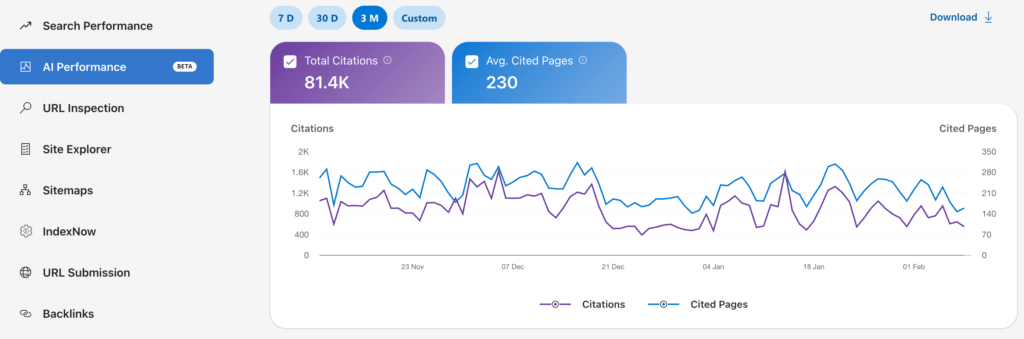
Microsoft Bing Webmaster Tools has introduced AI Citation Performance as a feature to track how often specific content from a website is cited in AI-generated answers and platforms like Copilot. This addition provides insights into content visibility across AI surfaces.
How does the AI Performance dashboard function in Bing Webmaster Tools?
The AI Performance dashboard is a dedicated feature that tracks citation visibility for web pages mentioned in AI responses. It provides page-level data and citation metrics for a better understanding of how AI-powered systems reference provided content.
Why is AI Citation Performance important for website owners?
AI Citation Performance helps website owners comprehend how their content is represented in AI models, offering clarity regarding citation frequency, the relevance of their content, and how it’s utilized in AI-generated answers.
What kind of data is available in Bing’s AI Performance report?
The AI Performance report offers metrics such as how often a page is cited, historical citation data spanning up to a few months, and the distribution of citations over time. It focuses on enhancing content visibility for site owners.
Which platforms benefit from Bing’s AI Performance tracking?
Bing’s AI Performance tracking is integrated with services like Bing AI search, Copilot, and other AI-based engines. This allows publishers to monitor how their content performs and contributes to the AI ecosystem.
How does Bing Webmaster Tools differ from other platforms in AI tracking?
Bing Webmaster Tools is one of the first platforms to provide granular insights into AI citations, offering real-time data and historical analytics. This distinguishes it from competitors like Google, which currently lack similar reporting capabilities.
Can small businesses leverage Bing AI reports for visibility?
Yes, small businesses can utilize Bing AI reports to monitor how their content is utilized, giving them the opportunity to refine strategies to increase their AI citation footprint and target more relevant audiences.
What are common challenges in managing AI citations?
Common challenges include difficulty in understanding how AI systems interpret and use content, maintaining content relevance, and ensuring that content is accurate and visible for citation in AI-generated results.
How is AI impacting the SEO industry with tools like Bing Webmaster AI reports?
AI is redefining SEO by focusing on how content interacts with AI systems. Tools like Bing Webmaster AI reports highlight the importance of creating AI-friendly, structured, and relevant content to optimize citation and visibility.
Is Bing AI Citation Performance tracking available to everyone?
As of its public preview, Bing AI Citation Performance tracking is accessible to all users of Bing Webmaster Tools. Site owners can log in to the platform and begin tracking citation data for pages on their websites.
FAQ on AI Citations and Bing Webmaster Tools Integration
Why are AI citations becoming the new metric for startups?
AI citations measure a site’s trustworthiness and relevance in AI-generated content responses. For startups, building authoritative, high-value content boosts visibility in the AI ecosystem, opening doors to higher SEO rankings. Discover AI SEO tactics for startups.
How can generative AI models impact localized SEO strategies?
Generative AI models emphasize hyperlocal citations, making niche expertise essential for small businesses to thrive in competitive local markets. Create structured, region-focused content to gain AI visibility. Explore local SEO AI solutions.
What strategies can startups use to avoid ranking penalties on Bing?
Avoid keyword stuffing, focus on unique and reliable content, and audit for inconsistencies in AI citations. Building E-E-A-T content frameworks aligns with AI trust metrics. Learn optimization secrets for AI visibility.
Why does collaboration matter in the AI citation space?
Partnering with authoritative platforms ensures high-reference citations, reinforcing a site’s AI trust level. For startups, co-authored assets generate more linkable content for citation boosts. Dive deeper into strategic collaboration.
Can startups rely solely on large-scale content for SEO dominance?
No. While volume matters, success hinges on structured, high-impact, evergreen materials tailored for AI reference systems. Balance quantity with quality for sustainable results. Discover modular content optimization.
How are AI advancements aiding small-scale creators in 2026?
Microsoft AI tools such as Performance Max empower startups to redefine storytelling efficiently, improving AI citations while maintaining budgets. Apply innovative tools for dynamic growth. Enhance your visibility with smart tools.
Why is modular architecture key for AI citation rates?
Modular content architecture enhances adaptability, allowing startups to repurpose data into varied AI-friendly formats. This ensures consistency and maximized AI visibility. Learn modular tactics to win AI rankings.
How can niche entrepreneurs improve their AI citation metrics?
Develop localized, data-rich assets that align with specific industry needs. Leveraging hyper-focused solutions scales visibility and strengthens citation influence. See verified growth tips for niche execution.
Could poor AI integration affect startup traffic drastically?
Yes. Recent mismanagement in AI citation tools has led to traffic collapses for sites like Neocities, highlighting risks. Implement proactive systems to safeguard visibility. Read case studies of AI fallout.
What is the best starting point to audit AI citation relevance?
Start with Bing Webmaster Tools to analyze AI presence rates and competitor benchmarks. Adjust content using citation-friendly frameworks for iterative improvement. Unlock actionable AI audit strategies now.
About the Author
Violetta Bonenkamp, also known as MeanCEO, is an experienced startup founder with an impressive educational background including an MBA and four other higher education degrees. She has over 20 years of work experience across multiple countries, including 5 years as a solopreneur and serial entrepreneur. Throughout her startup experience she has applied for multiple startup grants at the EU level, in the Netherlands and Malta, and her startups received quite a few of those. She’s been living, studying and working in many countries around the globe and her extensive multicultural experience has influenced her immensely.
Violetta is a true multiple specialist who has built expertise in Linguistics, Education, Business Management, Blockchain, Entrepreneurship, Intellectual Property, Game Design, AI, SEO, Digital Marketing, cyber security and zero code automations. Her extensive educational journey includes a Master of Arts in Linguistics and Education, an Advanced Master in Linguistics from Belgium (2006-2007), an MBA from Blekinge Institute of Technology in Sweden (2006-2008), and an Erasmus Mundus joint program European Master of Higher Education from universities in Norway, Finland, and Portugal (2009).
She is the founder of Fe/male Switch, a startup game that encourages women to enter STEM fields, and also leads CADChain, and multiple other projects like the Directory of 1,000 Startup Cities with a proprietary MeanCEO Index that ranks cities for female entrepreneurs. Violetta created the “gamepreneurship” methodology, which forms the scientific basis of her startup game. She also builds a lot of SEO tools for startups. Her achievements include being named one of the top 100 women in Europe by EU Startups in 2022 and being nominated for Impact Person of the year at the Dutch Blockchain Week. She is an author with Sifted and a speaker at different Universities. Recently she published a book on Startup Idea Validation the right way: from zero to first customers and beyond, launched a Directory of 1,500+ websites for startups to list themselves in order to gain traction and build backlinks and is building MELA AI to help local restaurants in Malta get more visibility online.
For the past several years Violetta has been living between the Netherlands and Malta, while also regularly traveling to different destinations around the globe, usually due to her entrepreneurial activities. This has led her to start writing about different locations and amenities from the point of view of an entrepreneur. Here’s her recent article about the best hotels in Italy to work from.

