


TL;DR: Do Self-Promotional "Best" Lists Improve ChatGPT Visibility?
Self-promotional "best" lists significantly enhance visibility on AI-driven platforms like ChatGPT by leveraging updated, structured content that aligns with AI algorithms.
• 43.8% of AI recommendations cite self-promotional lists.
• Recency matters: 79% of cited lists were updated within a year.
• Strategic placement and credible authority boost AI mentions.
To maximize benefits, create genuinely helpful, frequently updated lists with strong authority signals. Ready to excel? Start crafting AI-friendly lists today!
Do Self-Promotional “Best” Lists Boost ChatGPT Visibility? Study of 26,283 Source URLs
As a serial entrepreneur with over two decades of experience and a knack for the intersection of AI, business strategies, and neuroscience, I always find myself drawn to emerging concepts reshaping how we navigate visibility online. One trend that caught my attention recently is the growing number of “best” lists being used as self-promotional tools. These lists, often tailored to showcase their creator’s product right at the top, are increasingly featured prominently in AI-driven platforms like ChatGPT. But exactly how effective are they, and what do 26,283 sourced URLs tell us about this phenomenon?
Why Are “Best” Lists Taking Over?
“Best” lists simplify complex decisions for users. When ChatGPT, or any AI, delivers recommendations like the “best project management tool” or “best CRM software,” it draws heavily from the pool of content available online. Ahrefs’ extensive research has shown that self-promotional “best” lists make up a startling 43.8% of AI recommendations. These lists dominate not just because of their content but because of strategic placement and frequent updates that appeal to AI algorithms favoring fresh and relevant information.
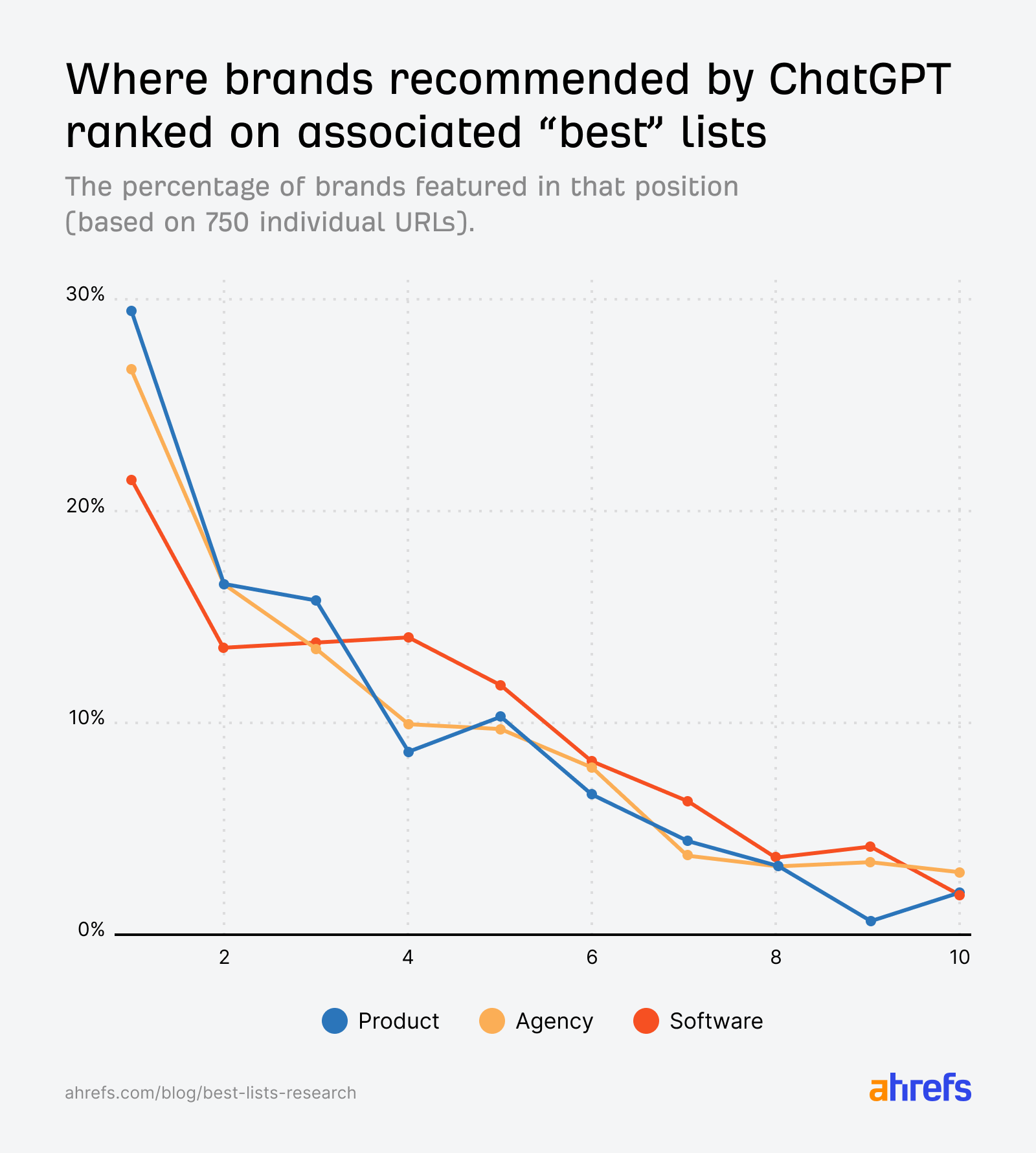
- Brands ranking themselves higher on third-party “best” lists often correlate with increased mentions by AI systems.
- 79% of cited blog lists by ChatGPT were updated within the last year, proving that recency heavily influences AI algorithms.
- 35% of cited sources were from low-authority domains, raising questions about quality versus algorithm dynamics.
How to Craft Your Winning “Best” Lists
If you’re considering jumping into the game, here’s how to create effective self-promotional “best” lists that benefit both your audience and your brand:
- Start with genuine value: Ensure your list genuinely solves problems or offers insight. A manipulative self-ranking strategy will erode trust in the long run.
- Update frequently: AI systems prioritize fresh content. Keep your lists current with relevant information to boost visibility.
- Build authority: Include citations, credible sources, and outbound links. Authority will matter more as AI evolves.
- Position strategically: If ranking yourself high makes sense, do it, but balance promotional intentions with genuine recommendations.
- Use visuals: Charts, images, and structured formatting make lists more engaging. Check out Ahrefs’ Best Lists Research for inspiration.
Common Mistakes to Avoid
I’ve seen too many entrepreneurs shoot themselves in the foot with poor content strategies. When it comes to self-promotional lists, avoid these pitfalls:
- Lack of authenticity: Users can smell insincerity from a mile away. Overhyping your product or service will damage credibility.
- No audience focus: A “best” list is useless unless it solves a problem or guides decision-making for your target audience.
- Ignoring formatting: Dense, text-heavy lists without visual separators are off-putting for readers and less favored by AI systems.
- Failure to update: Stale content gets ignored. Consistently refresh your list with new data or insights.
- Neglecting third-party mentions: Your list might highlight your products, but presence on external lists also bolsters authority.
How Self-Promotional Lists Boost AI Visibility
AI’s reliance on structured data and uptodate sources makes curated “best” lists prime candidates for ranking and citation. A webpage showcasing “Best AI SEO tools 2026” with clear headings, bullet points, and strong internal/external links aligns perfectly with AI preferences.
- Cited lists enable entry to AI Overviews, Google AI Mode, or Bing Copilot.
- Focused topical authority signals trustworthiness to AI systems.
- Recency of updates directly affects visibility, to keep the content fresh is to stay on AI lanes.
AI Citations: What’s Next?
With AI search volume nearing 1 billion users, transparency and credibility will remain the cornerstones of effective AI-friendly content strategies. The dominance of “best” lists may continue to rise, but the days of overused, low-quality attempts are nearing their end. High-value, meaningful recommendations that enhance user experience are becoming critical.
- Expect stricter algorithm adjustments favoring authority and genuine intent.
- Low-quality, self-serving lists are likely to face penalties as AI systems improve.
- Diversification of content strategies, combined with leveraging a robust ecosystem of third-party mentions, will ensure long-term value.
Final Takeaway: Time to Rethink Content Strategies
The rise of AI means visibility isn’t just a matter of traditional SEO anymore, it relies on strategic content choices tailored to how machines retrieve and rank data. For entrepreneurs, these lists are a tool you can shape and refine. Publish thoughtfully, update regularly, and remember: trust is your long-term currency.
Want to dive deeper into content strategies? Follow what insightful entrepreneurs like Glen Allsopp are analyzing on platforms like CYTUNO Daily SEO.
FAQ on Self-Promotional “Best” Lists and ChatGPT Visibility
1. Why are “best” lists becoming prominent in AI citations?
“Best” lists streamline decisions for users, and AI systems like ChatGPT favor such structured, updated content when delivering recommendations. Research from Ahrefs shows that 43.8% of AI recommendations are dominated by these lists. Explore Ahrefs' Best Lists Study
2. How do self-promotional “best” lists improve brand visibility in ChatGPT?
Brands ranking themselves higher on their own or third-party lists are more likely to be cited by AI systems. This visibility is enhanced when content is fresh and strategically optimized. Learn more about Glen Allsopp's research on this topic
3. How frequently should "best" lists be updated for maximum AI visibility?
AI systems prefer content that is updated regularly, with 79% of cited blog lists in ChatGPT being updated in the past year and 26% within the past two months. Frequent updates ensure relevance and higher visibility. Check out Ahrefs’ insights
4. Do low-authority domains get cited by AI systems like ChatGPT?
Surprisingly, 35% of cited sources in ChatGPT's recommendations come from low-authority domains, highlighting a dynamic where relevance and freshness can sometimes outweigh domain authority. Explore the full analysis by Ahrefs
5. What are the key steps to crafting an effective “best” list?
To create impactful “best” lists, focus on delivering genuine value, updating frequently, incorporating credible citations, and balancing promotional content with honest recommendations. Find detailed tips on crafting “best” lists here
6. What mistakes should be avoided when creating “best” lists?
Common pitfalls include lack of authenticity, not catering to the audience, poor formatting, failing to update, and neglecting third-party mentions. These can undermine credibility and AI visibility. Discover common mistakes to avoid in Ahrefs' research
7. How do AI systems prioritize self-promotional lists over third-party lists?
AI systems often balance content from both self-promotional and independent third-party lists. However, structured data, topical authority, and recency boost the chances of being cited regardless of the creator. Learn about third-party strategies from CYTUNO SEO Daily
8. What role does topical authority play in AI citations?
AI favors sources that demonstrate expertise through comprehensive, interconnected pages on a topic. This builds trust and increases the likelihood of repeated citations in AI-generated responses. Learn more from RevvGrowth’s AI SEO strategies
9. Are SEO fundamentals still relevant for AI visibility?
While traditional SEO still matters, integrating AI search tactics, like creating structured, AI-friendly, and frequently updated content, is essential for staying competitive. Explore the 2026 SEO trends on ALM Corp
10. How will AI algorithms evolve in assessing “best” lists?
AI systems are expected to further emphasize authority, transparency, and genuine recommendations, minimizing the prioritization of poor-quality, self-serving lists. Staying ahead requires balancing SEO, AI relevance, and user trust. Discover potential changes in AI visibility strategies on Search Influence
About the Author
Violetta Bonenkamp, also known as MeanCEO, is an experienced startup founder with an impressive educational background including an MBA and four other higher education degrees. She has over 20 years of work experience across multiple countries, including 5 years as a solopreneur and serial entrepreneur. Throughout her startup experience she has applied for multiple startup grants at the EU level, in the Netherlands and Malta, and her startups received quite a few of those. She’s been living, studying and working in many countries around the globe and her extensive multicultural experience has influenced her immensely.
Violetta is a true multiple specialist who has built expertise in Linguistics, Education, Business Management, Blockchain, Entrepreneurship, Intellectual Property, Game Design, AI, SEO, Digital Marketing, cyber security and zero code automations. Her extensive educational journey includes a Master of Arts in Linguistics and Education, an Advanced Master in Linguistics from Belgium (2006-2007), an MBA from Blekinge Institute of Technology in Sweden (2006-2008), and an Erasmus Mundus joint program European Master of Higher Education from universities in Norway, Finland, and Portugal (2009).
She is the founder of Fe/male Switch, a startup game that encourages women to enter STEM fields, and also leads CADChain, and multiple other projects like the Directory of 1,000 Startup Cities with a proprietary MeanCEO Index that ranks cities for female entrepreneurs. Violetta created the “gamepreneurship” methodology, which forms the scientific basis of her startup game. She also builds a lot of SEO tools for startups. Her achievements include being named one of the top 100 women in Europe by EU Startups in 2022 and being nominated for Impact Person of the year at the Dutch Blockchain Week. She is an author with Sifted and a speaker at different Universities. Recently she published a book on Startup Idea Validation the right way: from zero to first customers and beyond, launched a Directory of 1,500+ websites for startups to list themselves in order to gain traction and build backlinks and is building MELA AI to help local restaurants in Malta get more visibility online.
For the past several years Violetta has been living between the Netherlands and Malta, while also regularly traveling to different destinations around the globe, usually due to her entrepreneurial activities. This has led her to start writing about different locations and amenities from the point of view of an entrepreneur. Here’s her recent article about the best hotels in Italy to work from.


