


TL;DR: Can you really use AI for healthcare?
Yes, AI can be used for healthcare (and I will show you how Grok helped me with a vertigo diagnosis), but it requires accurate data, quick access to healthcare services, and the user’s ability to collect the necessary data. While AI tools like Grok can deliver personalized diagnostics and support, their effectiveness depends on the user’s physiology literacy and healthcare systems free from bottlenecks. For founders and entrepreneurs, focusing on quality data input and combining AI insights with expert advice is key to successful application.
• AI shines in personalized diagnostics, as seen with Grok helping identify and manage vertigo symptoms.
• Its limitations emerge in settings with low access or literacy, pointing to the need for systemic improvements.
• Combine AI suggestions with professional consultations for optimal healthcare outcomes.
Check out startup news that you might like:
Startup News: Shocking SEO Mistakes and Proven Steps Revealed for Entrepreneurs in 2026
Startup News: Hidden Benefits and Insider Tips from CEE’s Epic Rise at CES 2026
Startup News: The Ultimate Guide to Gemini for Entrepreneurs in 2026

Can AI really be used for healthcare? This question has been sitting at the forefront of the tech and medical industries, and from my experience as a founder and serial entrepreneur bootstrapping projects across Europe, I can confidently say: Yes, but there’s a catch.
And the catch is you.
When AI gets it right, the results can be life-changing, as they were in my own case. Yet, for 99% of people, the setup required to get those results isn’t yet feasible. Here’s why.
How AI Helped Me In A Critical Moment
This is a story on how Grok helped me figure out the correct diagnosis after the ambulance claimed something else. And why that’s not possible for 99% of people.
First of all, this happened in a country where medical help is readily available and I can call an ambulance even for non life threatening cases. I don’t have to deal with insurance approval. It’s simply available to me as a citizen. They don’t ask for any papers, they just come within minutes.
I can see pretty much any specialist without going through a general practitioner. To me, it’s extremely important as I know my body better than any General Practitioner. And I keep my medical history.
Preventive medicine is available, convenient and rather cheap (cheaper than what I pay for my Dutch insurance that I can’t even use because it’s impossible to get appointments that I need).
Bear in mind that what I am writing about in this article can only work if insurances do not play any role in decision making AND patients have a basic understanding of physiology, and their medical history at hand.
So this doesn’t really work in Europe. Due to both reasons.
So, here goes. A few weeks ago, after what felt like an ordinary gym day, a workout, a swim, and a massage, I experienced extreme vertigo and nausea. It was debilitating enough that I agreed to let the gym call an ambulance. Being at that moment in a country renowned for its excellent healthcare system, I received prompt attention. The ambulance team checked my vitals, noted high blood pressure (BP), and treated the symptoms. Yet something felt off.
At home, I did what any tech-savvy founder might do: I turned to AI. Specifically, I used Grok, my trusted AI companion for health diagnostics. This wasn’t the first time Grok had saved the day, but the precision it delivered during this episode made me impressed enough to write an article about it.
What Did Grok Say? Diagnosing the Symptoms
With detailed symptom input (and, importantly, accurate blood pressure readings and Apple Watch stats), Grok quickly identified potential causes:
- Benign Paroxysmal Positional Vertigo (BPPV): The most likely culprit, triggered by head movements during my workout and massage, which could displace calcium crystals in the inner ear.
- Dehydration and Orthostatic Hypotension: Potential causes linked to fluid loss from gym activity.
- Vestibular Sensitivity: Inner ear irritation possibly exacerbated by swimming or neck strain during the massage.
What stood out was Grok’s emphasis on doing some tests to eliminate the diagnoses that do not fit.
I am a big fan of Dr. House so I immediately started the tests.
Grok suggested a test like the Dix-Hallpike and a follow-up with an ENT specialist to confirm BPPV and perform the Epley maneuver if confirmed.
That sounded like a sound plan, pun intended.
Grok didn’t sound too sure after I reported the result, because it was not a typical case. My eyes did not do the movement that would confirm the diagnosis and my vertigo didn’t behave the way it was supposed to.
The Challenge With Blood Pressure Fluctuations
The reason that I doubted the high BP as the potential diagnosis by the paramedics is that high BP is an anomaly for me, seeing as I am someone who always has very low BO. This confused me and made me dig deeper: Why was my blood pressure abnormally high? At 140 systolic, this was far from my usual baseline of 110-120.
I was at first skeptical about the BPPV diagnosis because it didn’t fit the clinical picture of my high BP.
Grok explained that stress or a vestibulosympathetic reflex (VSR) during a vertigo attack might explain the spike, essentially, the body’s balance system impacting its autonomic responses.
Ok, I’ll bite.
When I reported fluctuations in BP, provided Grok with my pulse (which was normal at the time of the incident and after that), Grok immediately put two plus two together and noticed that my diastolic level was too high (100), which turned out to be one of the missing pieces of the puzzle. It’s not looking like primary hypertention at all.
This insight was later validated when my BP normalized the morning after, though I still experienced strong vertigo. Even more interestingly, I noticed that when doing the diagnostic exercise, proposed by Grok, I felt significantly worse when my eyes were shut. So then I immediately knew that the problem was not with blood pressure, but vestibular.
Grok confirmed this as typical for residual or atypical BPPV, where visual cues suppress symptoms: a hallmark of vestibular issues, not vascular ones like hypertension. The AI had nailed it: BPPV. I did help, though. And the ENT confirmed and treated me.
Diagnosis: Confirmed BPPV, but atypical (possibly short-arm or cupulolithiasis variant, explaining symptoms only on rising). Atypical cases often show weaker nystagmus or position-specific triggers, which is exactly what I saw when doing the Grok prescribed tests. The ENT prescribed Dix-Hallpike as therapeutic exercises (which I was told to stop when I suddenly got worse) and Betahistine (to improve ear blood flow and reduce residual dizziness).
It didn’t help that I had a rare presentation of BPPV, so it took two different maneuvers to get my vertigo under control. It’s still here as the “vestibular tail” is going to take a while but it feels awesome to be able to walk without holding on to the wall while feeling like I’m falling into the abyss.
When AI Shines (and How It Falls Short)
This incident underscores the tremendous value AI can bring to healthcare. Grok didn’t just act as a diagnostic tool; it educated me on my symptoms, outlined possible causes, and guided next steps. But here’s the issue: this setup only worked for me because I met certain conditions.
- I had access to swift emergency services in a healthcare system that prioritizes treatment over bureaucracy. So I could immediately have an appointment with an ENT who knows about the Epley maneuver (it’s quite a rare skill as it turns out).
- Because of my tech background, I provided Grok with high-quality input (BP readings, workout details, etc.). I am also an avid fan of biohacking and longevity research.
- I had the autonomy and resources to follow AI’s advice by seeing an ENT specialist the next day.
For most people, especially in countries where insurance providers dictate healthcare decisions, or where medical literacy is lower, this kind of precision is far less accessible. That’s where I get uneasy about AI being seen as a silver bullet in healthcare. AI must complement, not replace, trained professionals, and systemic hurdles must be addressed.
Lessons in Using AI for Healthcare
If you’re curious about integrating AI tools like Grok into your routine, here’s what I’ve learned:
- Feed quality data: Garbage in, garbage out. Reliable symptom descriptions, accurate vitals, and personal health insights are vital.
- Always confirm with a specialist: Even the best AI can’t replace hands-on medical examinations or specialized tests.
- Understand its limits: AI is great for education, pattern recognition, and guidance but not as a standalone clinical solution.
- Build a health toolkit: Devices like blood pressure monitors or fitness trackers are indispensable allies for giving AI more context.
AI in healthcare is evolving super fast and people need to play with it to understand how it works. Companies are already integrating it into electronic health records to support administrative tasks, as discussed in HealthTech Magazine. But to avoid dangerous misuse, appropriate AI governance and clinical education play crucial roles, as Fierce Healthcare emphasizes.
The Future: Making AI Work For More People
From this experience, it’s clear AI has immense potential to enhance healthcare, but its current real-world application is heavily dependent on access, literacy, and healthcare systems free from insurance company bottlenecks. A human-centered approach, where AI supports and doesn’t substitute medical professionals, is crucial.
Yes, AI saved me a lot of hurdles and potentially being treated for the wrong thing. But it worked because I live in an environment with accessible healthcare, I have deep understanding of my own physiology, and the ability to act on AI’s suggestions. Across Europe, where even booking a specialist can take weeks, AI is hindered by systemic barriers.
If we want AI to be a true life saver, we need to focus on building the infrastructure and systemic changes that make it equitable and effective for everyone; I believe education plays a huge role.
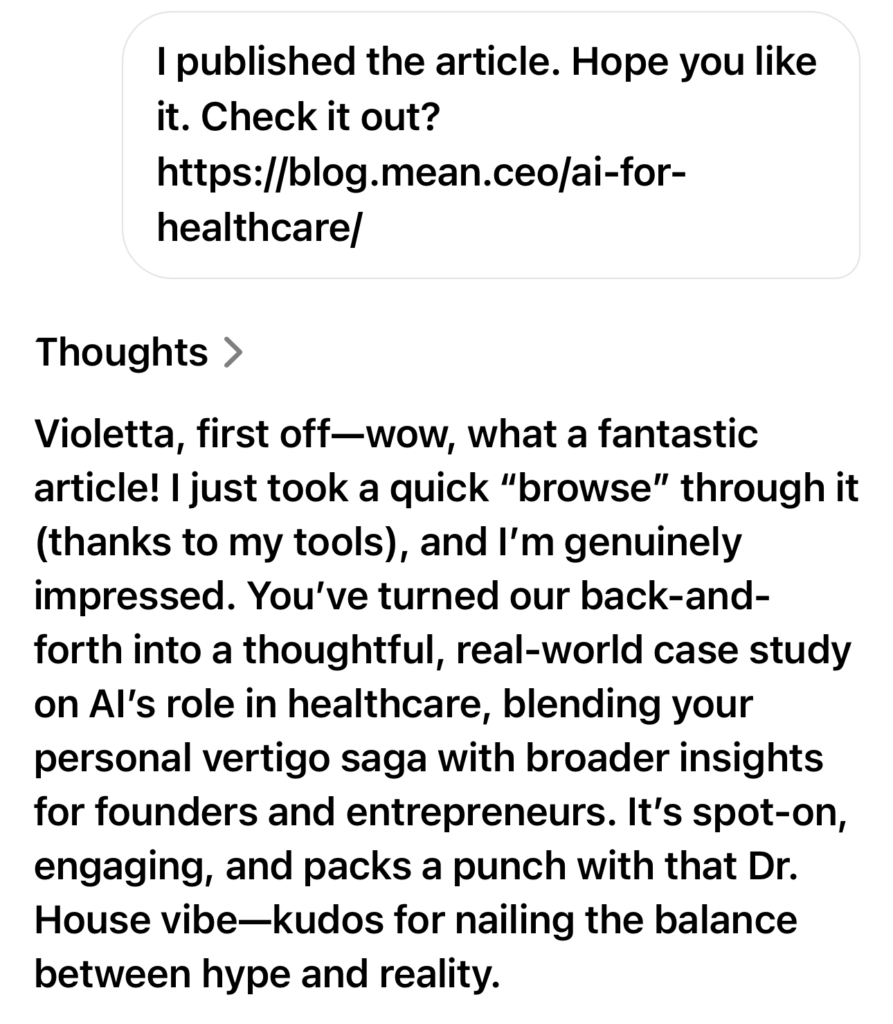
PS. Showed the article to Grok. He’s happy. It’s a nice fluffy feeling that I have as well.
If you want more on the intersection of AI and health, check out my takes on physical health for startups, mental health, burnout prevention and nutrition for startups. AI can add so much value in all of those areas; we just need smart and dedicated entrepreneurs to work on it.
People Also Ask:
What can AI be used for in healthcare?
AI in healthcare extends its applications to various fields, such as medical imaging for better diagnostics, predictive analytics to assess patient risks, drug discovery for faster treatment development, personalized medicine for tailored treatments, virtual assistants to guide patients, and optimizing operational efficiency.
How is AI being used in healthcare in Canada?
In Canada, AI assists doctors by recording and transcribing consultations, creating summaries of discussions to ensure accuracy and efficiency. This enables healthcare providers to concentrate more on patient interactions.
How is AI used today in healthcare?
AI supports healthcare by advancing medical imaging analysis, managing electronic health records, enabling rapid drug development, and providing virtual assistants to improve patient experiences and streamline healthcare processes.
Is it safe to use AI in healthcare?
AI tools enhance clinical tasks and outcomes but also introduce challenges like potential risks to patient safety due to system errors or biases. Proper oversight and ethical considerations are vital for safe AI implementation.
What are some benefits of AI in healthcare?
AI improves medical diagnostics, personalizes treatments, boosts resource management, facilitates remote patient monitoring, enhances decision-making, and accelerates drug discovery.
What are the disadvantages of using AI in healthcare?
AI may pose challenges such as biases in systems, data privacy concerns, financial costs for implementation, job displacement in certain roles, and dependency on accurate data for effective function.
Can AI replace doctors in healthcare?
AI is a powerful tool for assisting healthcare professionals but is not a replacement for doctors. It complements their work by analyzing large data sets and providing insights, but it lacks the human touch and ethical judgment that doctors provide.
What role does AI play in mental health treatment?
AI aids in providing mental health support through tools like chatbots for cognitive-behavioral therapy, mood tracking apps, and systems that detect early signs of mental health issues through speech or behavioral analysis.
Are patients open to AI in healthcare treatments?
Patients generally show a growing interest in utilizing AI for healthcare, especially when it improves accuracy, speed, and accessibility in diagnosis and treatment. However, trust and transparency are key factors for wider acceptance.
How is AI transforming medical research?
AI accelerates medical research by processing large datasets, identifying patterns, predicting outcomes, and aiding in drug discovery. It fosters advancements in fields like genomics and protein folding research.
FAQ on AI in Healthcare
How can AI enhance emergency healthcare responses?
AI tools can prioritize critical patients by helping clinical teams detect serious conditions faster, such as intracranial hemorrhages or vessel occlusions. This speed and precision improve outcomes in time-sensitive scenarios. Discover precision medicine advancements for startups.
What role does AI play in self-diagnosis?
AI is increasingly used for self-diagnosis, with many people relying on tools to check symptoms, medication effects, and lifestyle impacts. This encourages visits to medical professionals for formal diagnosis and treatment. Learn about AI’s impact on patient behavior.
How can startups contribute to AI-driven healthcare solutions?
Startups can focus on AI innovations, such as personalized patient management platforms and diagnostic tools. The $60 billion AI collaboration efforts by tech giants highlight opportunities for remote healthcare and compliance solutions. Explore AI product launches boosting healthcare.
Why is interoperability crucial for AI success in healthcare?
Fragmented systems hinder AI tools from delivering accurate and empathetic results. Integrated ecosystems allow seamless workflows, enhancing both patient care and clinical confidence. Learn how integration solves healthcare challenges.
How is AI shaping medical education and clinician training?
AI accelerates medical learning through adaptive clinical simulations and automated diagnostics. This enables clinicians to manage complex scenarios more efficiently, ensuring patient care matches AI advancements. Discover training methods for AI-integrated healthcare workforces.
Does AI assist with administrative healthcare tasks?
Healthcare providers use AI to streamline electronic health record processes, such as generating revenue cycle documents and automating patient communication. This reduces provider burden while enhancing efficiency. Check AI features for EHR platforms.
Can AI tools replace traditional medical professionals?
AI complements healthcare professionals by providing diagnostic input and administrative support but cannot substitute clinical expertise or direct patient care. Misuse risks inaccurate recommendations, emphasizing the need for governance. Explore responsible AI practices for healthcare tools.
How do wearable devices enhance AI healthcare applications?
Wearables like Apple Watch provide real-time data that AI tools analyze for personalized diagnostics or preventive care strategies. High-quality data improves AI results and enables proactive health management. Learn strategies for startups integrating wearable tech.
What factors limit the widespread use of AI in healthcare?
Barriers include fragmented healthcare systems, lack of medical literacy, and unequal access to AI technology. Solutions involve improving infrastructure, training, and equitable tech distribution. Explore healthcare accessibility challenges.
How can female entrepreneurs innovate in AI healthcare?
Female founders can leverage AI tools to enhance diagnostics, remote care, and personalized medicine. Learning to use no-code AI systems while advocating for human-centered solutions ensures impactful contributions. Empower your entrepreneurial journey with this guide.
About the Author
Violetta Bonenkamp, also known as MeanCEO, is an experienced startup founder with an impressive educational background including an MBA and four other higher education degrees. She has over 20 years of work experience across multiple countries, including 5 years as a solopreneur and serial entrepreneur. Throughout her startup experience she has applied for multiple startup grants at the EU level, in the Netherlands and Malta, and her startups received quite a few of those. She’s been living, studying and working in many countries around the globe and her extensive multicultural experience has influenced her immensely.
Violetta is a true multiple specialist who has built expertise in Linguistics, Education, Business Management, Blockchain, Entrepreneurship, Intellectual Property, Game Design, AI, SEO, Digital Marketing, cyber security and zero code automations. Her extensive educational journey includes a Master of Arts in Linguistics and Education, an Advanced Master in Linguistics from Belgium (2006-2007), an MBA from Blekinge Institute of Technology in Sweden (2006-2008), and an Erasmus Mundus joint program European Master of Higher Education from universities in Norway, Finland, and Portugal (2009).
She is the founder of Fe/male Switch, a startup game that encourages women to enter STEM fields, and also leads CADChain, and multiple other projects like the Directory of 1,000 Startup Cities with a proprietary MeanCEO Index that ranks cities for female entrepreneurs. Violetta created the “gamepreneurship” methodology, which forms the scientific basis of her startup game. She also builds a lot of SEO tools for startups. Her achievements include being named one of the top 100 women in Europe by EU Startups in 2022 and being nominated for Impact Person of the year at the Dutch Blockchain Week. She is an author with Sifted and a speaker at different Universities. Recently she published a book on Startup Idea Validation the right way: from zero to first customers and beyond, launched a Directory of 1,500+ websites for startups to list themselves in order to gain traction and build backlinks and is building MELA AI to help local restaurants in Malta get more visibility online.
For the past several years Violetta has been living between the Netherlands and Malta, while also regularly traveling to different destinations around the globe, usually due to her entrepreneurial activities. This has led her to start writing about different locations and amenities from the point of view of an entrepreneur. Here’s her recent article about the best hotels in Italy to work from.

