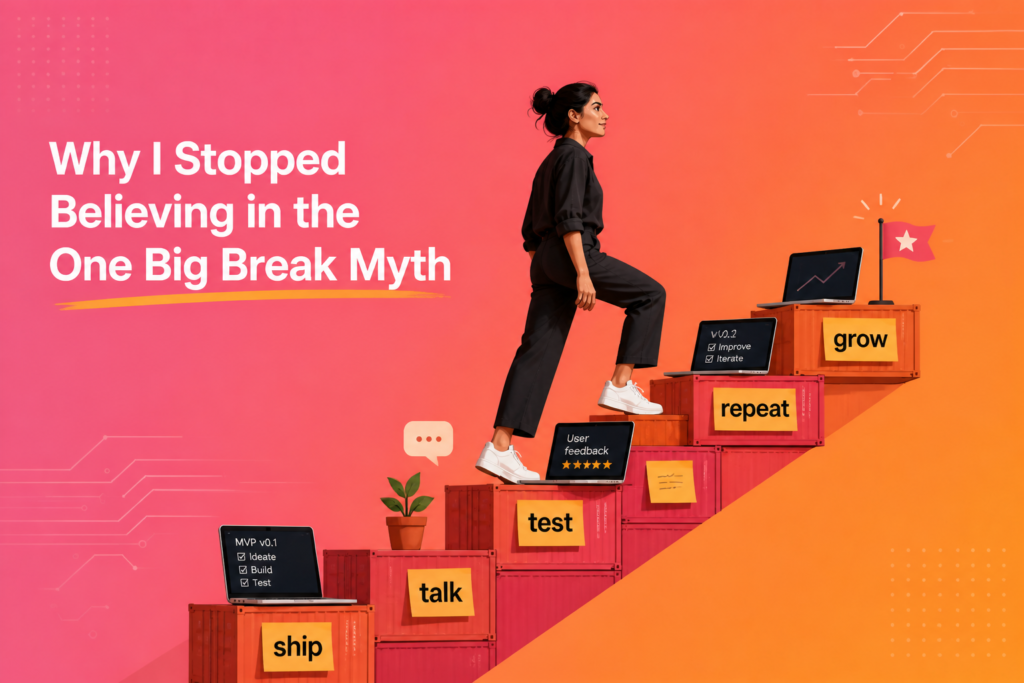
TL;DR: Why I Stopped Believing in the One Big Break Myth
Why I Stopped Believing in the One Big Break Myth comes down to one hard truth: you grow faster when you stop waiting to be discovered and start making small, public moves that build trust, traction, and luck over time.
- The real benefit for you: this mindset helps you stop chasing one investor intro, one viral post, or one press hit, and focus on repeatable actions that bring users, sales, and proof.
- What works better than the “big break”: shipping often, talking to customers, publishing what you learn, and building skills like sales, SEO, no-code, and AI use.
- What founders regret most: spending too long preparing for a future moment instead of building a working business now.
- What women founders should hear most: do not wait for permission, funding, or a technical co-founder before you test your idea.
The article’s main point matches other startup lessons on startup myths and system-building: steady execution beats relying on one dramatic event.
If you want traction, make your next move this week: ship something small, talk to real prospects, and keep building in public.
Check out startup news that you might like:
Breaking Through Creative Ops Bottlenecks: Your 2026 Technology Roadmap by Canto
WHY I STOPPED BELIEVING IN THE ONE BIG BREAK MYTH is a question I have asked myself more times than I can count.
Not as a researcher. Not as a consultant dropping in with borrowed certainty. As a founder who has spent about a decade building companies, bootstrapping through chaos, shipping with tiny teams, and talking to women founders almost every day. I mean the early-stage ones trying to get their first users, the women building with no-code tools at midnight, the ones with revenue but no press, and the ones everyone calls “promising” while they are quietly exhausted.
When I started CADChain, I was building in deeptech, IP, blockchain, and CAD workflows. It was not a trendy overnight-win category. Nobody was going to tap me on the shoulder and hand me a market. I had to decide whether I would wait for some magical investor, flagship client, media moment, or accelerator badge to validate us, or whether I would build distribution, product, and credibility one uncomfortable step at a time.
I chose the second path, although not cleanly. I still wasted time hoping for a shortcut. And honestly, I got part of it right and part of it wrong.
What changed my mind was simple. The founders who lasted were rarely the ones who got one dramatic break. They were the ones who kept making SMALL PUBLIC BETS. They shipped. They learned. They stacked trust. They built assets. They stayed visible long enough for luck to find them.
Here is what actually matters when deciding whether to believe in the one-big-break fantasy: MOMENTUM BEATS MYTH.
What I Chose And Why It Made Sense For Me
When I faced this belief head-on, here is what I decided: I STOPPED WAITING TO BE DISCOVERED. I started treating startup growth as a chain of repeatable moves, not a fairy tale event.
- Stage: early and messy, across products and experiments, with more ambition than resources.
- Constraint: limited capital, limited time, and the usual European founder problem of building far from the loudest hype centers.
- Goal: get real traction, real users, and real proof without depending on gatekeepers.
- Personal priority: autonomy. I would choose bootstrapping over performing for investors almost every time.
This choice matched my situation for a few reasons. First, I have never believed that waiting is a strategy. Second, I had already seen that women founders are often told to seek permission before they seek customers. I reject that. We need more women in startups, and not as mascots. As builders. Third, no-code and AI made speed cheap enough that I could test ideas without begging for technical resources. My view is blunt: anyone can build a minimum viable product, meaning a stripped-down first version of a product, in an hour if they stop romanticizing software.
A concrete example came from Fe/male Switch. Instead of treating startup education like some polished university module, I treated it like a live system. We built game-based startup learning with no-code tools, layered in AI support, and kept refining based on what users actually did. No single launch “changed everything.” The gains came from many releases, many conversations, many corrections.
What actually happened was less cinematic and far more useful. We built assets. We built know-how. We built pattern recognition. We also became much harder to kill.
If I am honest about what I got wrong, I still overestimated the value of external validators. Accelerators are often overrated. Advisors and consultants waste founder time more often than they save it. X, Reddit, and founder communities gave me more practical education than most formal programs ever did.
“I thought the next introduction might change everything. In reality, the next ten useful actions mattered more.”
Looking back, I did not make a universally right choice. I made the choice that matched my values, my risk profile, and my stubborn commitment to building without waiting for applause.
What Have I Heard From Hundreds Of Founders?
Over years of conversations with women founders through my work, communities, startup programs, and Fe/male Switch, I noticed a pattern. The founders who are happiest are not the ones who got the biggest splash. They are the ones whose actions matched their stage and constraints.
The Founders Who Say It Was Worth It
- They tend to be early-stage or lightly funded founders.
- They care about control, learning speed, and staying close to customers.
- They publish before they feel ready.
- They treat every release, post, call, and experiment as part of compounding visibility.
What they usually tell me is: “Nothing exploded, but everything started working better.”
That is the hidden pattern. Their outcomes rarely look dramatic from the outside. But inside the business, the shift is real. Better messaging. Better sales calls. Better product focus. Better search traffic. Better referrals. Better emotional stamina because they stop tying hope to a single event.
I have seen this in founders building SaaS, service businesses, education products, deeptech tools, and creator-led businesses. The shared habit is consistent output. They do not disappear for six months to “perfect.” They stay in the market.
The Founders Who Wish They Had Decided Differently
- They often wait for funding before validating demand.
- They confuse visibility with vanity.
- They spend months polishing branding without talking to users.
- They believe one investor intro, one media feature, or one viral post will rescue weak fundamentals.
What they tell me later is more painful: “I kept preparing for the moment instead of building the machine.”
The regret is rarely about not getting luck. The regret is about making luck their business model. That is a dangerous move. If your startup only works after a dramatic break, it probably does not work yet.
When I dig deeper, the blind spot is usually one of these:
- They overvalue hidden brilliance and undervalue distribution.
- They wait for confidence before action instead of letting action create confidence.
- They assume quality speaks for itself.
- They think education, incubators, and polished theory can replace market contact.
What About The Founders Who Say “It Depends”?
These are usually the most mature founders. They know luck matters, but they define luck properly. Luck is not magic. Luck is exposure meeting preparation. Luck is what happens when your work has enough surface area to be found.
They say things like: “Yes, a big client changed the pace, but we had spent two years becoming ready for that client.”
That view matches what many creators and artists have observed too. The pattern from Dorien May’s essay on the myth of the big break is very close to what founders experience. Relevance often comes through many releases, many small bets, and years of invisible work that later looks sudden from the outside.
What Is The Common Thread Across All Of Them?
The founders who feel good about their progress make decisions actively. They do not drift into someone else’s fantasy. The founders who regret their path usually made choices reactively. A VC told them to chase scale. A peer made bootstrapping sound morally superior. An accelerator made them feel late. Social media made them think everyone else had already “arrived.”
THE QUALITY OF THE DECISION MATTERS LESS THAN THE INTENTIONALITY BEHIND IT.
How Do I Help Founders Decide Whether They Are Chasing A Myth?
When founders ask me how to stop waiting for a big break, I walk them through three questions.
Question 1: What Stage Are You Actually At?
- Pre-revenue: your job is proof, not prestige. Talk to users, build the stripped-down first version, and get signal.
- Early revenue: your job is repeatability. Find which channel, offer, and audience combination keeps producing sales.
- Scaling: your job is systems. At this point, one lucky event helps less than reliable acquisition and retention.
- Seven figures and beyond: your job is disciplined expansion, not founder drama.
Stage matters because the wrong belief compounds. If you are pre-revenue and dreaming about press before proof, you are building theater. If you are scaling and still acting like one viral post will save weak operations, you are gambling.
Question 2: What Are You Actually Optimizing For?
Most founders answer this badly at first. They say they want scale, freedom, money, impact, authority, and flexibility all at once. Pick one to lead.
- Fast learning
- Cash flow
- Equity control
- Lifestyle fit
- Market reach
- Mission fit
When founders rank these honestly, the fog clears. A bootstrapped founder who wants control should stop copying venture-backed timelines. A founder who wants broad market capture may need a different pace. But even then, the “big break” story remains weak. You still need repeated execution.
From my own path, I thought I was optimizing for speed through external validation. Later I realized I was optimizing for autonomy and compounding assets. Once I admitted that, my decisions got cleaner.
Question 3: What Is Your Real Risk Tolerance?
Not your social-media risk tolerance. Your real one.
- How long is your runway?
- Do you have dependents or fixed obligations?
- Can you handle long periods of low external validation?
- What happens if this experiment fails?
Some founders can take business risk but not personal financial risk. Others are the opposite. That changes how much you can rely on slow compounding. It also changes how much pressure you place on each move. Founders who need every action to be “the one” usually freeze. Founders who can run many cheap tests learn faster.
Once a founder answers those three questions, the advice gets much simpler. The answer for you may be different from the answer for the founder you admire. That is normal. That is the whole point.
What Does The Data Around This Myth Actually Suggest?
I do not claim a formal academic study here. But I do have years of pattern recognition from founder communities, startup game participants, deeptech teams, and women building under resource constraints. I also pay attention to adjacent evidence from creator economies, independent businesses, and startup media.
Here is the repeated signal:
- Founders who publish, launch, and test repeatedly tend to improve their odds of traction.
- Founders who wait for one dramatic event often overinvest in appearance and underinvest in learning.
- The real difference is usually not talent. It is volume of useful reps.
- Luck matters more when there is already a body of work for luck to land on.
This matches broader startup logic too. Y Combinator’s startup library has long emphasized talking to users, shipping, and doing things that do not scale in the beginning. That philosophy is the opposite of waiting for rescue. It is about creating traction by direct contact with reality.
The biggest surprise for many founders is this: CONSISTENCY OF OUTPUT OFTEN BEATS INTENSITY OF A SINGLE MOMENT. Not glamorous. Very profitable when done well.
What Would I Do Differently If I Could Rewind?
If I could go back, I would stop outsourcing belief to external signals much earlier. I would publish faster, validate faster, and ignore more startup theater.
Not because my original path was wrong. Because I now see how much time founders lose by preparing for a moment that may never come. I would also invest earlier in SEO, AI fluency, and distribution systems. Those are compounding skills. They keep paying long after the excitement of a launch disappears.
The lesson is simple. The best decision is the one you make with the information you have. Then later you update. If your answer changes, that is not failure. That is a founder getting sharper.
What Do I Tell Female Founders Who Ask Me This?
When a woman founder asks me whether she should hold out for a big break, I start with the real constraint. She is making this decision in an ecosystem that often gives women less capital, less warm access, less benefit of the doubt, and more pressure to appear polished before they are allowed to be ambitious.
So I tell her this:
- DO NOT WAIT FOR PERMISSION.
- BUILD THE FIRST VERSION NOW.
- LET AI BE YOUR CO-FOUNDER IF YOU CANNOT HIRE YET.
- DEFAULT TO NO-CODE UNTIL YOU HIT A REAL WALL.
- LEARN TO SELL BEFORE YOU LEARN TO FUNDRAISE.
- JOIN COMMUNITIES, NOT JUST PROGRAMS.
I also tell her that women do not need more inspiration. We need infrastructure. That means tools, playbooks, AI support, legal hygiene, SEO skills, and honest peers. It means less worship of gatekeepers and more direct contact with users. It means building enough competence that nobody can easily patronize you.
One founder I spoke with kept delaying her product because she thought she needed a technical co-founder before she was “allowed” to start. I pushed her to build the first version with no-code and AI. What surprised her was not just that she could do it. It was how much better her conversations became once she had something concrete to show. That is what the myth steals from founders: momentum.
And yes, this is also why I am so outspoken about bootstrapping. Bootstrapping trains judgment. It forces clarity. It teaches you to build with what is available, not what is ideal. For many founders, especially women outside the usual power circles, that is not a consolation prize. That is an edge.
What Should You Do Instead Of Waiting For A Big Break?
Let’s make this practical. If you want to replace the myth with a real operating system, start here.
- Ship one thing this week. A landing page, offer, prototype, waitlist, outreach script, or feature.
- Talk to five real people. Not friends who clap for you. Prospects.
- Create visible proof. Publish what you are learning on X, LinkedIn, your site, or a niche community.
- Track what compounds. Search traffic, replies, demos, conversions, referrals, retention.
- Build skills that reduce dependency. SEO, AI prompting, no-code building, copywriting, sales.
- Run many cheap tests. Small bets beat heroic fantasies.
- Stop worshipping hidden quality. Make your work easy to find and easy to understand.
Next steps are boring in the best way. Build. Publish. Learn. Repeat. That loop is where careers are made.
The Real Answer
If I had to compress everything into one sentence, it would be this: THE ONE BIG BREAK MYTH IS COMFORTING BECAUSE IT LETS YOU DELAY THE HARD PART, WHICH IS REPETITION IN PUBLIC.
Most founders do not fail because they lacked one magical moment. They fail because they spent too long waiting for one. Once you stop treating success like a lottery ticket and start treating it like a stack of assets, your behavior changes. Your company changes too.
That is also why female founders often become stronger decision-makers. We cannot rely on the default playbook. So we get sharper. We become more intentional. We build with constraints. And if we do it well, we become very hard to ignore.
MAKE THE NEXT MOVE. NOT THE MYTHICAL ONE. THE NEXT ONE.
People Also Ask:
What is “Why I Stopped Believing in the One Big Break Myth”?
“Why I Stopped Believing in the One Big Break Myth” appears to be a title or phrase about rejecting the idea that success comes from one single lucky moment. It points to the belief that progress usually comes from steady work, repeated effort, learning, and small chances over time rather than one dramatic breakthrough.
What does the “one big break” myth mean?
The “one big break” myth is the idea that one event, one connection, or one lucky opportunity will suddenly change everything. People often use it when talking about careers, business, writing, acting, or creative work. The phrase suggests that success is less about one magical moment and more about consistency and persistence.
Why do people stop believing in the one big break myth?
People often stop believing in it after seeing that long-term success usually builds slowly. Many find that growth comes from improving skills, meeting people, taking small chances, and staying active over time. Real progress often looks less dramatic than the myth suggests.
Is success usually one big moment or many small steps?
Success is usually many small steps. A big opportunity may happen at some point, but it often comes after years of work, practice, and showing up consistently. What looks like an overnight success is often the result of a long buildup behind the scenes.
Why is the one big break idea misleading?
It can be misleading because it makes people wait for one perfect chance instead of building momentum through regular action. This mindset may cause frustration or make people overlook smaller opportunities that can matter a lot. In many cases, steady progress matters more than one sudden event.
Does one lucky break ever matter?
Yes, a lucky break can matter, but it usually works best when someone is ready for it. Luck may open a door, but preparation, skill, and follow-through often decide what happens next. A single opportunity rarely works on its own without effort behind it.
What can you focus on instead of waiting for a big break?
Instead of waiting, focus on improving your craft, building relationships, creating consistently, and learning from each step. Small wins can add up and lead to bigger chances later. This approach gives you more control than relying on luck alone.
Is the phrase about career growth or personal mindset?
It can be about both. In a career sense, it challenges the belief that one event creates success. As a mindset, it encourages patience, discipline, and trust in gradual progress rather than hoping for one perfect turning point.
How does this idea apply to creative work?
In creative work, many people imagine that one viral post, one book deal, or one big client will change everything. In reality, creative careers often grow through repeated publishing, practice, audience-building, and steady improvement. The phrase suggests that lasting success usually comes from ongoing effort.
What is the main takeaway from “Why I Stopped Believing in the One Big Break Myth”?
The main takeaway is that lasting success is usually built, not suddenly handed over. Big moments can happen, but they often come after many smaller efforts that prepare a person for them. The message is to keep going, keep improving, and value steady progress.
FAQ on The One Big Break Myth and Momentum
How can I apply the momentum mindset with a tiny team without burning out?
Adopt a weekly rhythm of tiny bets: ship something small, get user feedback, and publish what you learned. Use no-code/AI to accelerate. Track concrete signals (signups, referrals, retention) and weather the wave of small results over a season. How We Turned Our Internal Playbooks Into a Revenue Stream | STARTUP POV Bootstrapping Startup Playbook The Myth of the Big Break (Dorien May) YC Startup Library: learning from shipping and users
What exactly counts as a “small public bet” in the earliest stages?
A bet is small when it’s low-cost, fast to learn from, and publicly traceable. Examples: a landing page with a waitlist, a one-page prototype, a targeted outreach script, or a short user interview sprint. The goal is repeatable feedback, not one grand reveal. How We Turned Our Internal Playbooks Into a Revenue Stream | STARTUP POV The Myth of the Big Break (Dorien May)
How should I measure progress when results feel slow or invisible?
Prioritize a few leading indicators: user interviews conducted, landing-page conversions, active waitlist changes, and demo bookings. Publish these learnings regularly to build surface area for luck to land. The loop beats the dramatic moment every time. Bootstrapping Startup Playbook YC Startup Library: learning from shipping and users
How can I balance external validation with internal milestones?
Treat validation as a byproduct, not a plan. Build systems that create proof internally, prototypes, customer conversations, early traction, and share progress publicly to attract aligned attention later. Read more about sustainable momentum in ongoing playbook discussions. How We Turned Our Internal Playbooks Into a Revenue Stream | STARTUP POV The Myth of the Big Break (Dorien May)
How can female founders build distribution without gatekeepers?
Leverage no-code, AI, and community-led channels to reach customers directly. Create visible, repeatable assets (content, demos, case studies) and publish consistently. This reduces gatekeeper dependence and accelerates feedback loops with real users. How We Turned Our Internal Playbooks Into a Revenue Stream | STARTUP POV Bootstrapping Startup Playbook
When should I decide between bootstrapping vs. seeking external funding?
Start with market-fit first, then decide if you want autonomy or scale velocity. Bootstrapping sharpens judgment and distribution, funding can accelerate but isn’t a cure for weak fundamentals. The Myth of the Big Break (Dorien May) Bootstrapping Startup Playbook
How can I avoid common myths about luck and breaks when planning growth?
Treat luck as a multiplier for a prepared, visible, repeatable engine. Build a disciplined pipeline of small bets; publish learnings; and maintain momentum even when external signals are quiet. The Myth of the Big Break (Dorien May) YC Startup Library: learning from shipping and users
What practical steps can I take today to start moving away from waiting?
Ship something this week, talk to five real people, publish a learnings note, track what compounds, and build a few distribution skills (SEO, copy, outreach). Start with Low-cost tests and scale from validated edges. How We Turned Our Internal Playbooks Into a Revenue Stream | STARTUP POV Bootstrapping Startup Playbook
How do I position a public narrative that’s credible and useful, not vanity-driven?
Highlight real experiments, learnings, and customer conversations, not just wins. A transparent cadence of releases demonstrates competence and resilience, which compounds trust over time. The Myth of the Big Break (Dorien May) YC Startup Library: learning from shipping and users