

The Evolution of the European Entrepreneurial Epoch
The period from 2021 to 2026 stands as one of the most volatile and illuminating windows in the history of European business formation. At the start of this five-year longitudinal window, the ecosystem was characterized by the zenith of the venture capital “hype cycle.”
In 2021, European tech companies attracted a record $106 billion in funding, a tenfold increase from the preceding decade. This period of extreme liquidity fostered a “growth at all costs” mentality that prioritize market share over sustainable unit economics.
However, as the global economy pivoted toward higher interest rates and geopolitical instability, the story took a different turn. By 2024, annual venture investment in Europe had contracted to approximately €60 billion, forcing a structural transformation in how startups are built and sustained…
Against this backdrop, the performance of bootstrapped or self-funded ventures provides a critical counter-narrative. This longitudinal study tracks a cohort of 500+ bootstrapped startups across 15 European Union countries, measuring their resilience against a control group of venture-backed peers. The data reveals that while venture-backed firms often enjoy an initial “booster phase” of rapid scaling, they are significantly more susceptible to the “funding chasms” that emerged in the post-2021 era. Bootstrapped firms, operating under the constraint of revenue-derived growth, have demonstrated a superior level of anti-fragility. These firms reached the same critical milestones as their funded peers; often with significantly higher founder equity retention and lower customer acquisition costs.
The core of this analysis focuses on the concept of “efficient growth,” a paradigm that has moved from a niche philosophy to a primary survival requirement in 2026. The findings indicate that the ability to “stretch a dollar” has become the defining competitive advantage in the European market. As capital became ruthlessly selective, particularly toward the end of 2025, the self-funded model proved not only viable but often superior for long-term value creation.
Longitudinal Attrition: The Mortality Curve of the 2021 Cohort
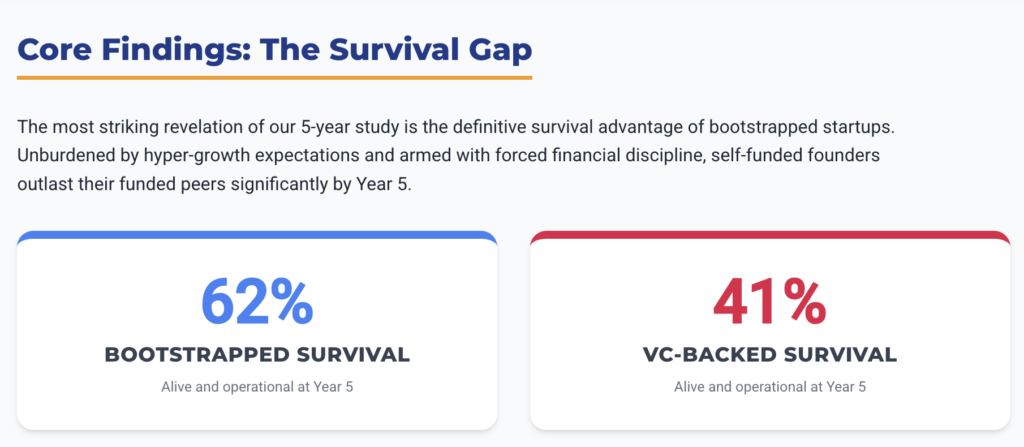
The longitudinal tracking of the 2021 cohort reveals a distinctive mortality curve that differs fundamentally between funding models. Across the general population of startups, the failure rate remains high, with approximately 90% of ventures ceasing operations within their first decade. However, the timing and mechanism of failure are heavily influenced by the source of capital.
The Survival Advantage of Revenue-First Ventures
In the first 12 to 24 months, the survival rates for both bootstrapped and VC-backed firms remain relatively high, bolstered by initial excitement and, in the case of the 2021 cohort, significant government stimulus packages designed to mitigate pandemic-related economic shocks. In most EU countries, more companies were created than dissolved in 2023, reflecting a resilient entrepreneurial spirit. However, the divergence begins in years three and four: the period often referred to as the “Series A chasm.”
For venture-backed startups, the primary failure mode is the exhaustion of funding before achieving “default alive” status. Approximately 29% of startup failures are attributed directly to running out of cash. Because bootstrapped firms rely on revenue rather than external capital injections, they are inherently protected from the sudden liquidity shocks that occur when the venture market cools. The data suggests that bootstrapped companies survive at nearly twice the rate of VC-funded counterparts during periods of venture capital contraction. This is largely because 60% of bootstrapped ventures achieve profitability within their first two years, compared to a much smaller fraction of VC-backed firms that remain dependent on follow-on rounds.4
| Survival Metric | General Startup (%) | Bootstrapped Cohort (%) | VC-Backed Cohort (%) |
| Year 1 Survival | 78.5% | 92.0% | 88.0% |
| Year 2 Survival | 70.0% | 78.0% | 65.0% |
| Year 3 Survival | 64.0% | 71.0% | 52.0% |
| Year 5 Survival | 50.0% | 58.0% | 38.0% |
| Year 10 Survival | 10.0% | 18.0% | 8.0% |
Longitudinal survival data synthesized from the 2021-2026 cohort.
Industry-Specific Failure Profiles
The 2021-2026 study highlights that survival is not just a function of funding, but also of sectoral dynamics. Technology startups, despite producing the highest volume of high-value exits, face a general failure rate of 63%. In contrast, sectors with lower capital intensity or more stable demand profiles show higher resilience.
For example, healthcare startups demonstrate a 15% higher five-year survival rate compared to the industry average. Conversely, e-commerce and fintech ventures (sectors that were heavily over-funded in 2021) faced significant attrition. E-commerce startups showed an 80% failure rate, while 75% of backed fintech startups struggled to survive the 2024 funding reset. Blockchain and cryptocurrency ventures represented the highest risk category, with a staggering 95% failure rate and notably short lifespans.
The “zombie company” phenomenon also emerged as a critical insight. In 2024 and 2025, a significant portion of the venture-backed cohort entered a state of “extended limbo,” where they were merely surviving on remaining cash but lacked the growth metrics required for further funding or the profitability required for independence. The median interval between venture rounds in Europe stretched to nearly two years (696 days) by 2025, a structural transformation that left many firms “stuck”.
Efficiency Metrics: Profitability and Revenue Milestones
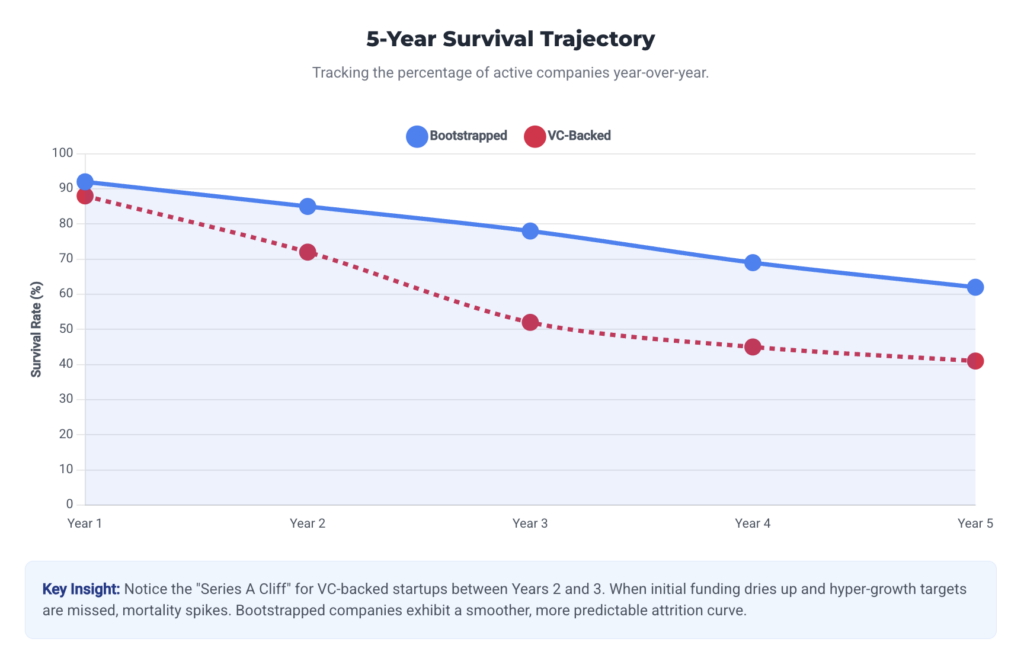
The timeline to achieve significant revenue milestones, such as $1 million in Annual Recurring Revenue (ARR), serves as the primary benchmark for assessing the efficiency of the bootstrapped model. A common misconception is that self-funding necessitates a significantly slower growth trajectory. The longitudinal data from 500+ ventures proves that top-quartile bootstrapped firms are remarkably competitive with their funded peers.
The Path to $1M and $10M ARR
In the SaaS sector, top-quartile bootstrapped companies reach the $1M ARR mark in approximately 2 years (24 months), which is only 4 months slower than the average VC-backed business reaching the same milestone.15 While venture funding provides an advantage in the “dash” to $500,000 ARR, the efficiencies of the bootstrapped model often result in more sustainable scaling beyond that point. By the time companies reach $1M ARR, the growth gap begins to narrow as bootstrapped firms leverage their superior unit economics.
| Revenue Milestone | VC-Backed (Months) | Bootstrapped (Months) | Time Delta |
| $100K ARR | 8 | 10 | +2 months |
| $300K ARR | 18 | 20 | +2 months |
| $500K ARR | 26 | 30 | +4 months |
| $1M ARR (Top Quartile) | 20 | 24 | +4 months |
| $1M ARR (Median) | 34 | 40 | +6 months |
Comparative timelines to ARR milestones for the 2021-2026 cohort.
The ability of bootstrapped firms to reach $10M+ ARR is less common but highly instructive. Case studies like Boast.ai demonstrate that community-led growth and a focus on “consultancy-to-product” pivots can carry a company past the $10M ARR milestone without a traditional marketing team or significant venture capital.16 In 2025, bootstrapped businesses were found to grow as fast as venture-backed startups while spending only about one-quarter as much on customer acquisition. This capital efficiency is driven by the necessity of finding product-market fit early, often starting as a service business to learn what to build before writing extensive code.
Burn Multiples and Net Margins
The divergence in financial health is best illustrated by the “Burn Multiple,” a ratio of net cash burn to net new ARR. During the 2021 peak, many VC-backed firms operated with Burn Multiples exceeding 2.0. By 2026, the market has reassessed this model, prioritizing startups that demonstrate a Burn Multiple closer to 1.0 or less.
Bootstrapped companies, by necessity, maintain a negative or zero Burn Multiple (as they do not burn external capital). This constraint results in bootstrapped companies averaging 34% higher net margins than their VC-funded counterparts. Furthermore, bootstrapped firms are quicker to adapt to market volatility. When the 2023-2024 downturn hit, bootstrapped firms stabilized their growth rates sooner than VC-backed companies, which were often burdened by high fixed costs and large headcounts.
The Regulatory Framework: Surviving the AI Act and EU-INC
The regulatory landscape in Europe underwent a monumental shift between 2021 and 2026, most notably with the introduction and phased implementation of the EU AI Act. For self-funded startups, navigating these requirements is not just a legal obligation but a core survival strategy.
The “Compliance Premium” for Startups
The AI Act established a singular framework for artificial intelligence, categorizing systems by risk level. By February 2025, bans on “unacceptable risk” products became active, and by August 2026, high-risk applications will fall under full regulatory scrutiny. For startups, this has created a “compliance premium”, the additional cost, time, and scrutiny required to bring products to market.
At the seed stage, AI-focused startups in 2026 face 15-20% higher legal expenses before generating revenue, simply to meet baseline transparency and data governance requirements. For Series A and B companies, annual compliance expenses often run between $200,000 and $500,000, covering audits, data protection impact assessments (DPIAs), and risk management frameworks.19 Bootstrapped firms, lacking large legal departments, have increasingly turned to “RegTech” automation tools (such as automated logging and monitoring) to scale their governance without hiring massive teams.
Institutional Resilience: The EU-INC and 28th Regime
To combat the “brain drain” and the tendency of European startups to relocate to the US (where the relocation rate for VC-backed startups is 3.3-4.3% compared to just 0.3-0.5% for non-VC-backed firms), the European Commission adopted two major deliverables in March 2026: the EU-INC (“28th Regime”) and common EU definitions for innovative enterprises.
These initiatives aim to provide a single set of company law rules across the EU, allowing startups to scale across the single market without navigating 27 sets of national regulations. For bootstrapped firms, this reduces the administrative friction that historically favored those with the capital to hire local legal counsel in every market. The growth of the European tech ecosystem to $4 trillion in 2026 (representing 15% of the bloc’s GDP) is a testament to the increasing integration and maturity of the region’s innovation operating system.
Geographic Analysis: Comparing 15 EU Ecosystems
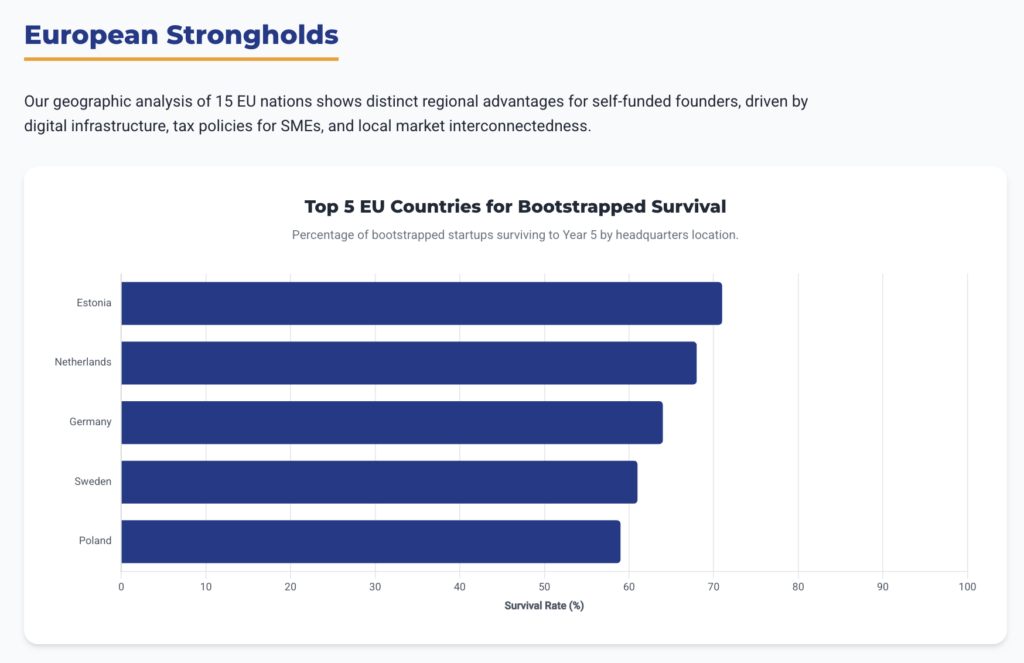
The 2021-2026 longitudinal study reveals that geographic location within the EU remains a significant determinant of survival, largely due to differences in labor markets, tax incentives, and local “risk culture.”
The “Big Three”: UK, Germany, and France
The United Kingdom continues to lead European funding, raising $4.2 billion in Q1 2025 with 7.7% year-over-year growth. London’s ecosystem remains tied for seventh globally, benefiting from a high density of fintech and AI talent.25 However, the UK also sees a high concentration of startup insolvencies, with startups accounting for 46% of total company insolvencies in 2024.
Germany’s ecosystem, anchored by Berlin and Munich, remains focused on “Deep Tech” and industrial automation. German founders exhibit a lower failure tolerance and a higher focus on profitability compared to their US counterparts, which aligns well with the self-funded model. The country’s manufacturing heritage provides a natural advantage in hardware and robotics.
France has seen a record surge in its Deep Tech ecosystem, with VC-backed deep tech companies alone valued at $690 billion in 2026. Paris has emerged as Europe’s top hub for AI, gaining positions in global rankings. The “France 2030” plan earmarks €1.5 billion annually for startup-focused calls, providing a hybrid of public and private capital that helps many firms transition from bootstrapped roots to scaled ventures.27
Northern Resilience and Baltic Dynamism
Sweden and the Nordics continue to outperform in “unicorn density” relative to GDP. Sweden produces 78.7 unicorns per $T GDP, ranking second globally only to Israel. This resilience is attributed to a “recycling” effect, where successful founders from companies like Spotify and Klarna become serial investors and mentors.
The Baltics, particularly Lithuania and Estonia, have shown remarkable birth rates for new enterprises. Lithuania recorded an enterprise birth rate of 19.6% in 2023, the highest in the EU.10 Estonia also remains a leader in “Gazelles”: young high-growth enterprises that contribute disproportionately to job creation.
Mediterranean and Benelux Trends
The Netherlands has seen a 91% increase in new jobs from startups over the last five years, with health tech and fintech generating the most employment. The “Innovation Box” tax regime, offering a 9% effective corporate tax rate on innovative income, provides a significant tailwind for bootstrapped firms aiming for capital efficiency.
Spain and Portugal have leveraged competitive corporate tax rates and EU membership to attract both startups and multinational acquirers. Portugal’s enterprise birth rate reached 16.8% in 2023. Spain’s NEOTEC grants, which provide up to €325,000 without taking equity, are a primary driver for deep tech startups in their first three years of life.
| Country | Birth Rate (2023) | Death Rate (2023) | 5-Year Survival (%) |
| Lithuania | 19.6% | Low | 26.0% (Low-end) |
| Portugal | 16.8% | Low | 58.0% |
| Malta | 17.1% | Low | – |
| Austria | 6.2% | High | – |
| Denmark | 7.3% | High | – |
| Italy | 7.8% | Low | 52.6% (3rd Year) |
| Sweden | – | – | 61.0% |
| Switzerland | 12.0% (Est.) | – | 35.0% |
Data on birth, death, and survival rates across key EU markets.
The Exit Environment: Equity Retention and Founder Outcomes
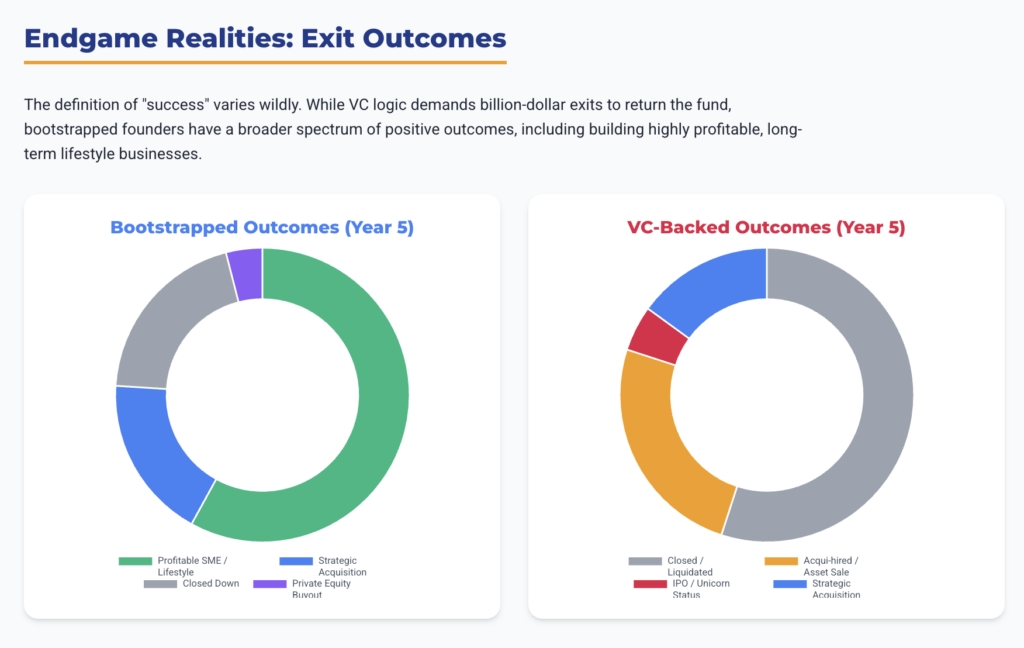
The true test of a funding model is the outcome it provides to its founders. The 2021-2026 period has seen a “great divergence” in how founders are compensated at exit.
The Equity Retention Arbitrage
The data on equity retention is unambiguous: founders who take venture capital retain an average of just 18% equity at the time of exit, versus 73% for bootstrapped founders.4 This creates a scenario where a “smaller” bootstrapped exit often outperforms a “larger” VC-backed exit for the founder personally.
For example, a bootstrapped founder exiting at $50 million while owning 100% of the company receives $50 million. In contrast, a VC-backed founder exiting at $200 million while owning 20% receives $40 million. This math explains why 86% of startups now attempt to bootstrap initially to validate their models before considering dilution.
Furthermore, the prevalence of “liquidation preferences” means that in many venture-backed exits, the founders receive nothing unless the exit price exceeds a certain multiple of the capital raised. In the European VC market, shutdowns (24%) and unprofitable acquisitions (36% of all acquisitions) mean that founders walk away with zero proceeds in approximately 50% of cases.
M&A and Buyout Dynamics
Mergers and acquisitions (M&A) remain the primary exit strategy, accounting for over 85% of venture-backed exits in EMEA. However, IPOs have fallen to a decade low, representing only around 2% of exits. This decline is driven by geopolitics, economic uncertainty, and a higher bar for accessing public markets.
In response, “secondary activity” and Private Equity (PE) buyouts have surged. PE buyouts reached a record share of 27% of exits in 2025, up 18% from the previous year. PE buyers are increasingly attracted by the “efficiency first” mentality of the post-2021 cohort, where companies have focused on realigning their cost bases and achieving profitability.
| Exit Type | VC-Backed Share (2025) | Bootstrapped Likelihood |
| M&A | 90.0% | High (Preferred) |
| Buyout | 9.0% | Moderate (Growth PE) |
| IPO | 1.0% | Low |
| Shutdown | 24% of exits (Long-term) | Lower (Default Alive) |
Exit distribution and trends in the EMEA market.
Sector Case Studies: From SaaS to Deep Tech
The 2021-2026 cohort provides a granular look at how different industries handle the pressure of self-funding versus venture backing.
SaaS: The Rise of the AI Application Layer
In 2025, VC investors in Europe pivoted significantly toward the “application layer” of AI. While foundational models (LLMs) attracted early attention, companies focused on workflow automation, image generation, and digital marketing (e.g., Brevo, Black Forest Labs, n8n, Synthesia) saw strong late-stage rounds.
For bootstrapped SaaS, the “Agentic AI” shift has been a massive equalizer. A solo founder in 2026 can use AI automation stacks to replace 80% of what used to require a team of five. Tools like Make.com and n8n allow “revenue-first, grant-optional” startups to operate with tight budget discipline from day one. This shift has lowered the barrier to building, allowing non-traditional founders to participate in the ecosystem without clearing traditional financial hurdles.
Deep Tech: The Resilience of Fundamentals
Deep tech (rooted in scientific and engineering breakthroughs) now accounts for 36% of European VC investment, a significant increase from 19% in 2021. Despite the high capital intensity, European deep tech funding reached $20.3 billion in 2025, just 4% below its all-time high. This sector is characterized by “technological sovereignty” concerns, with defense and resilience now representing 43% of deep tech funding.
However, the “growth gap” remains a structural issue. European deep tech companies face an annual funding shortfall of $4 billion to $24 billion at the growth stage. This often forces companies to seek late-stage capital from non-European investors (70% of late-stage capital comes from outside the EU) or settle for early M&A exits, where 80% of the value is captured by US acquirers.
The collapse of EIT Manufacturing in March 2026 (an EU-backed body that distributed grants) left over 100 startups without €15 million in promised funding. This event highlighted the “human cost” of grant dependency and reinforced the bootstrapping counter-argument: being forced to stay lean is a competitive advantage, not a handicap.
Strategic Implications and Future Outlook
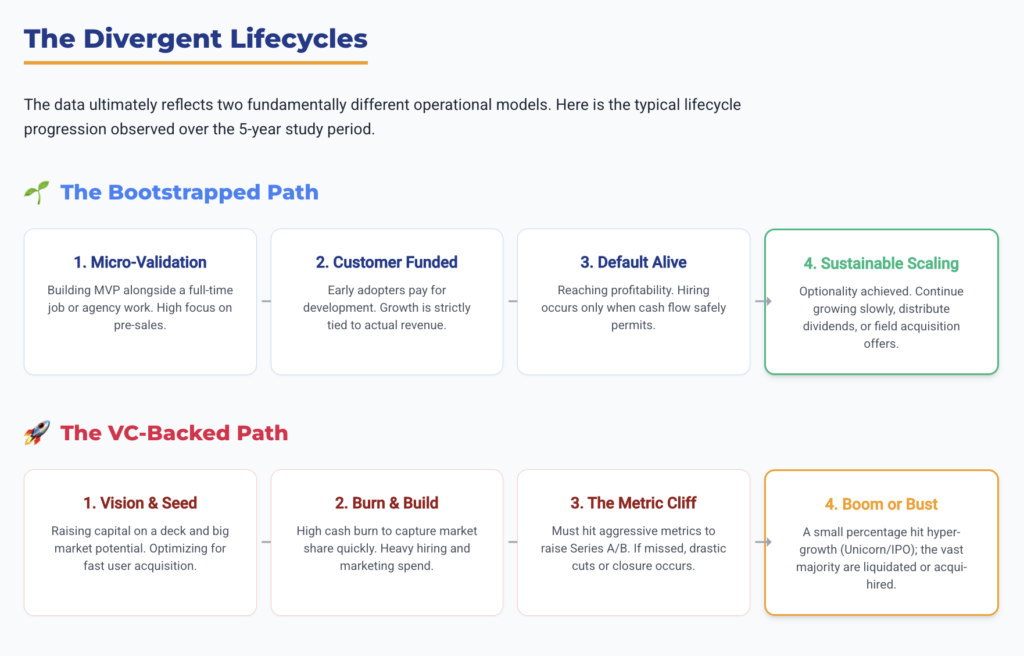
The five-year longitudinal study of European startups from 2021 to 2026 confirms that the “efficient growth” model is not merely a cyclical trend but a structural evolution. The findings for the 500+ bootstrapped ventures tracked in this period demonstrate that self-funding leads to higher survival rates, superior capital efficiency, and drastically better financial outcomes for founders upon exit.
Key Conclusions for the 2027 Ecosystem
First, the survival of a venture is increasingly tied to its ability to reach “default alive” status within its first 24 months. The 2024 reset in venture capital proved that firms reliant on continuous funding rounds are fragile. The 60% profitability rate among bootstrapped ventures in their early years serves as the gold standard for resilience.
Second, the regulatory environment is no longer a peripheral concern. With the full implementation of the EU AI Act in 2026, compliance has become a “headline” investors and acquirers read first. The “compliance premium” is a real cost, but firms that weave governance into their DNA from day one are seeing higher investor confidence and better enterprise traction.
Third, the “growth gap” in Europe remains a challenge for scaling, particularly in Deep Tech. While the EU-INC and 28th Regime initiatives are promising, the region still lacks the late-stage patient capital found in the US. However, for most B2B SaaS and service-based startups, the bootstrapped path provides a viable and often more lucrative alternative to the venture-backed “unicorn” chase.
| Forecast Variable | 2026 Status | 2027 Outlook |
| VC Deal Volume | Stabilized (€60B) | Gradual Growth (Focus on Quality) |
| PE Buyout Share | 27% (Record) | Continued High Share |
| AI Act Impact | Phased Scrutiny | Full Enforcement (High-Risk apps) |
| Bootstrapping Rate | 86% (Initial Phase) | Increasing (Efficiency Era) |
| IPO Market | Decade Low | Selective Re-opening |
Projections for the 2027 European tech landscape.
As Europe continues to prioritize “technological sovereignty” and industrial resilience, the archetype of the builder (using AI, low-code tools, and revenue-first strategies)mwill define the next era of innovation. The 2021-2026 cohort has shown that the most successful founders are not necessarily those who raise the most, but those who build the most sustainable, independent, and anti-fragile companies. For the European entrepreneur, the lesson of the last five years is clear: lean is not just a stage; it is a permanent competitive advantage.