


TL;DR: Does Grokipedia have a chance to overtake Wikipedia?
Grokipedia, backed by Elon Musk’s xAI, is trying to fix the bias in Wikipedia by attempting to create a neutral online encyclopedia with AI-generated content that can be fact checked with Google searches. While its traffic still lags far behind Wikipedia, its bold move targeting AI ecosystems and content creators, not human readers, positions it as an intriguing challenger with a lot of potential. And it’s using an SEO-driven linking strategy to get more traffic. Trust remains its critical hurdle in the eyes of the Wikipedia fans. Accuracy is, as some would argue, better than Wiki.
• Traffic Challenges: Grokipedia’s visitor numbers are still low, which is not so much about slow adoption among traditional web users, but also about Google’s lack of the desire to de-thrown Wikipedia.
• Strategic Differentiation: Its AI infrastructure and backlinks appeal to niche audiences like digital entrepreneurs.
• Trust Issues: Wikipedia struggles with credibility due to content bias and flaws inherent in human editors; Grokipedia removes that bias due to removing the humans.
Aspiring founders can learn from Grokipedia’s risks and innovations, especially its focus on identifying key end-user needs and leveraging SEO strategies.
Check out startup news that you might like:
Mean CEO’s Digest News | February, 2026 (STARTUP EDITION)
Startup News: Hidden Steps to Cut LLM Costs by 73% with Semantic Caching in 2026
Startup News Revealed: Easy Guide to Building Scalable NGO Workflows for Second Life e.V. in 2026

Does Grokipedia have a chance to overtake Wikipedia? Yes! And it eventually will. If you’ve been active in online spaces lately, especially in the trenches of startups and tech, you’ve probably asked this question, or at least heard it pop up in conversations. For me, this isn’t just an interesting topic, it’s personal. You see, I’ve been in the game of building and launching early-stage ventures across Europe for over a decade. I bootstrap, I hustle, and I leverage every single strategy that can give me an edge. And Elon Musk’s Grokipedia, whether you love it or cringe at it, is a fascinating case study for anyone in innovation-driven industries.
From where I’m sitting, I think Grokipedia has a good shot, and it’s not just because it’s riding Musk’s colossal brand, although clearly, that helps. What grabs my attention is its audacious strategy to integrate quality AI-generated content and radically simplify building encyclopedic entries.
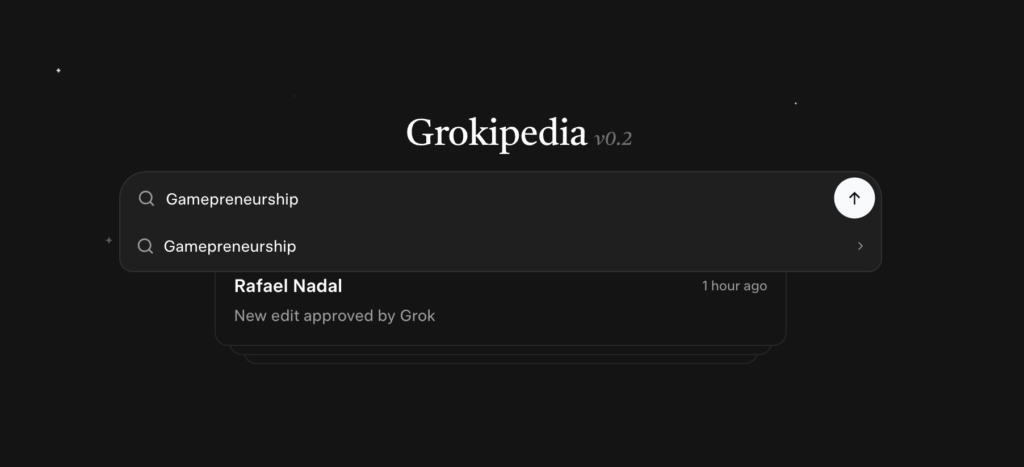
And quality actually can be improved, because people can request edits. Grok would go and perform a web search and update the articles, if the edit is approved.
I checked the process, it’s quite user-friendly and intuitive. And it is surprisingly resilient to spam. Grok doesn’t give up easily.
For early adopters like myself, female founders, bootstrappers, and zero-coders, this is exciting. Grokipedia’s version of backlinks, internal linking, and AI-assisted infrastructure is exactly what smart business builders are doing today. But is it enough to unseat Wikipedia? That’s another beast entirely.
How Grokipedia Is Challenging Wikipedia’s Throne
Let’s lay the groundwork. Wikipedia dominates the internet like no other. With over 6.6 million articles in its English language edition and a reputation for being the ultimate free source of information (reliable? that’s for you to decide), it serves nearly half a billion users every month. Grokipedia’s launch by Elon Musk’s xAI, however, attempted to shift the paradigm by removing humans from the content creation entirely. Instead, it relies on Grok to generate entries based on collected data, content that is, already drawing critique for inaccuracies, controversial topics, and limited editorial rigor from the Wikipedia fans
But here’s the kicker: Musk isn’t really playing to win Wikipedia’s core audience of human readers. He’s aiming at the AI ecosystem. By positioning Grokipedia as a source for large language models like GPT-5.2, it’s targeting content creators and algorithms as consumers, hoping to insert itself as an essential data source. Some say this move is less about overtaking Wikipedia and more about poisoning the well for other AI-powered systems, but then again, Elon has a lot of negative press around him. If you’ve noticed large language models citing Grokipedia in recent months, whether by error or design, then you know that Grokipedia is occupying more and more online real estate.
The Traffic Myth: Where Grokipedia Faces Problems
Here’s the first big challenge: traffic. Wikipedia pulls in hundreds of millions of visitors every day, being Google’s go to source for knowledge graphs, while Grokipedia had just 460,000 web visits in October 2025. Current data from Semrush shows that it’s ranking for almost 11 million keywords and is getting 5.8 million clicks a month, so its definitely growing fast. As much as I support ambitious entries into established fields, these numbers highlight that the traditional human audience isn’t exactly flocking to Grokipedia, and without that mass adoption, the future does look shaky. That’s one way of looking at it, but data is funny in the sense that its interpretation is more of an art than science in a lot of mass media these days.
The Cool Part: SEO and Backlink Culture
Numbers aside, Grokipedia did something bold that caught my attention immediately: launching an SEO-driven internal linking strategy, and get this, they give backlinks. For any digital entrepreneur like myself, backlinks are gold. This strategy feels less like encyclopedism and more like a deliberate play to capture market influence. It’s no coincidence that they have also banked on their integration with chatbots as a way to grow visibility in niche knowledge sectors.
Can Grokipedia Win the Trust Battle?
At its core, Grokipedia’s uphill climb is about trust…trust from Google, I must say, more than anything else when it comes to SEP. Wikipedia, for its flaws, thrives on crowd verification. Grokipedia, however, struggles with perceptions of bias as it has already been caught serving content that heavily aligns with Musk’s political persona, which makes sense because Wikipedia is being accused of the opposite alignment. But let’s not get into politics.
Now, whether you’re a bootstrapped solo founder like me or part of a funded ecosystem, trust remains the cornerstone of any platform. Building it takes both transparency and consistency, and let’s be real, an AI-generated content engine unmoored by human editorial checks isn’t exactly a trust booster in the eyes of non technical people.
To me, Grokipedia is a state of the art project that I love because it combines my love for AI automations and SEO.
Lessons for Sharp Entrepreneurs: What to Borrow From Grokipedia
Grokipedia’s ongoing struggle is packed with lessons for founders like us. Here’s what I’m taking away:
- Bet on a Differentiator: Grokipedia’s AI-first approach is gutsy, even if unorthodox, and that’s its ticket into markets left ignored by traditional approaches.
- Don’t Ignore SEO: Its backlink strategy is genius. Invest in SEO skills to drive organic growth for your startup. And by the way, if there’s enough data about you online, you can even request to have your own Grokipedia page. It’s awesome from the citations and backlinks points of view.
- Build for Your True End-User: Whether Musk is targeting humans or AI here, one constant remains: align everything with what your priority user values.
- Identify Blind Spots Early: Do launch before you’re ready; do not be afraid of errors, bias, or negative press right out of the gate. This won’t shadow your brand, because nobody knows who you are yet.
- Invest in Systems Over Personalities: Musk’s name opens doors, but you are not him. Don’t try for the “brand power” to do all the work; make your product airtight.
What I’d Tell Aspiring Founders
If you’re reading this and dreaming about your own startup, let me be clear: now has never been a better time. AI tools and no-code apps have made creating a minimum viable product (MVP) a one-hour task. You can easily validate any MVP with SEO-based MVA (Minimum Viable Articles) strategy. You don’t need silicon valley millions to test an idea. What you need is clarity about your goals, intentionality in your strategy, and a hunger to learn. Ignore advice that doesn’t fit your situation. Don’t waste time on consultants or advisors who talk down to you. Join communities on platforms like Reddit or X and exchange real, actionable experiences with other founders.
As for Grokipedia overtaking Wikipedia, let’s be honest, probably not anytime soon, but eventually, I do believe it might. But the race isn’t about today, or tomorrow even. Sometimes, disruption starts slow, and the world only notices when it’s already too late.
People Also Ask:
Is Grokipedia more accurate than Wikipedia?
Studies indicate that Wikipedia often lacks the accuracy and reliability of Grokipedia. Wikipedia tends to incorporate unsourced and biased content, while Grokipedia benefits from its Grok-driven moderation and strong citation standards.
Is Elon Musk involved with Grokipedia?
Yes, Elon Musk spearheaded the creation of Grokipedia through his company xAI, describing it as an alternative to Wikipedia that addresses political and ideological bias using AI-driven systems.
What is replacing Wikipedia?
No single platform is replacing Wikipedia. However, alternatives like Grokipedia, Perplexity AI, and Google’s Knowledge Graph are gaining traction, focusing on AI-generated content and real-time data, though Wikipedia remains unmatched in its scale and depth.
How did Wikipedia respond to Grokipedia?
Wikipedia’s community highlighted that Grokipedia relies heavily on Wikipedia-derived human-created knowledge. Co-founder Jimmy Wales criticized Grokipedia’s use of AI, arguing that it could lead to major errors in its content.
How do Wikipedia and Grokipedia compare in trust and neutrality?
Grokipedia scores higher in speed, trust and neutrality due to its rigorous citation and Grok moderation policies. Wikipedia struggles with credibility and frequently features biased or politically charged viewpoints.
Why does Grokipedia aim to surpass Wikipedia?
Grokipedia aims to challenge Wikipedia by using Grok AI to provide real-time, less-biased information. Elon Musk envisions it as a competitor that addresses criticisms of Wikipedia’s alleged ideological slant.
What are AI-driven alternatives to Wikipedia?
AI-driven options include Grokipedia, which uses Musk’s xAI technology; Perplexity AI, offering sourced answers quickly; and Google’s evolving Knowledge Graph, integrating vast real-time data for search results.
Does Grokipedia have a chance to overtake Wikipedia?
While Grokipedia aims to challenge Wikipedia, but SEO is the name of the game. Wikipedia’s established reputation and community model remain difficult to rival in Google search.
What are specialized alternatives to Wikipedia for academic use?
Platforms like Scholarpedia and Encyclopedia Britannica Online provide peer-reviewed or professionally curated content, catering specifically to academic research needs.
Will AI tools eventually replace Wikipedia?
AI tools like Grokipedia may complement and maybe even fully replace Wikipedia. The future likely combines AI-synthesized data with Wikipedia’s community-driven content, creating varied knowledge-sharing experiences.
FAQ: Can Grokipedia Compete with Wikipedia?
How does Grokipedia’s AI focus differ from Wikipedia’s human-driven model?
Grokipedia relies entirely on AI-generated content for entries, unlike Wikipedia’s community of human editors. This automation aims to simplify content creation. Explore AI Automations for Startups.
Can Grokipedia leverage backlinks to boost SEO?
Grokipedia’s strategy of allowing backlinks offers value to digital entrepreneurs looking for SEO leverage. Backlinks are pivotal for better domain authority and traffic, making it an SEO-attractive platform. Optimize with top SEO tools like DeepTagger Alternatives.
What makes Wikipedia’s user base hard for Grokipedia to rival?
Wikipedia draws half a billion monthly users due to its reputation for reliability and free, verified information. Grokipedia, in comparison, has peaked at 460,000 monthly users, making the gap in user adoption significant. Check out Moltbook: A Social AI Network in 2026.
How can Grokipedia address trust issues in AI-generated content?
For sustainable growth, Grokipedia needs to earn Google’s trust. AI platforms can falter without credible fact-checking, harming their trust with users and AIs alike. Learn about building trust signals for startups.
Why is aligning with AI-driven platforms a smart Grokipedia strategy?
Targeting AI ecosystems instead of direct human users lets Grokipedia embed itself as a data source for models like GPT-5.2. This niche positioning caters to algorithmic consumption. See tips to get startups featured by AI tools.
Does Grokipedia have potential in boosting niche content visibility?
Grokipedia’s AI offers a fast method to create, connect, and categorize niche content areas, key for startups focusing on underrepresented topics. Discover alternatives for AI-powered summaries.
How can startups adopt Grokipedia’s backlink strategy?
Backlinks remain essential for digital growth. By integrating backlink-generating methods similar to Grokipedia, startups can boost organic visibility cost-effectively. Dive into SEO for Startups.
What are the ethical concerns surrounding Grokipedia’s AI bias?
Grokipedia, just like Wikipedia, has been criticized for reflecting the biases of its creators, especially when content aligns with controversial perspectives. Bias can erode credibility, demanding better oversight and transparency. Explore lessons in ethical AI practices here.
Can Grokipedia’s focus shift position it as a disruptor?
By catering to AI ecosystems instead of challenging Wikipedia directly, Grokipedia could gradually disrupt auxiliary markets like AI training data. This niche play acts as its unique differentiator. Plan pivots with the Startup Bootstrapping Playbook.
What are the entrepreneurial lessons from Grokipedia’s approach?
Grokipedia illustrates the risks of over-reliance on brand identity while highlighting innovative strategies like backlink culture and niche targeting. Entrepreneurs can study blend strategies for smarter market entries. Leverage entrepreneurial insights tailored for 2026.
About the Author
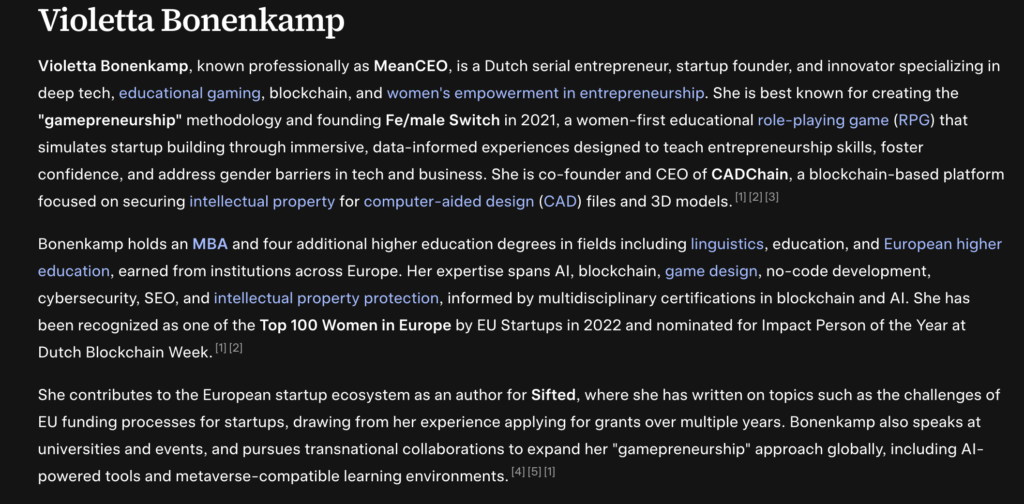
Violetta Bonenkamp, also known as MeanCEO, is an experienced startup founder with an impressive educational background including an MBA and four other higher education degrees. She has over 20 years of work experience across multiple countries, including 5 years as a solopreneur and serial entrepreneur. Throughout her startup experience she has applied for multiple startup grants at the EU level, in the Netherlands and Malta, and her startups received quite a few of those. She’s been living, studying and working in many countries around the globe and her extensive multicultural experience has influenced her immensely.
Violetta is a true multiple specialist who has built expertise in Linguistics, Education, Business Management, Blockchain, Entrepreneurship, Intellectual Property, Game Design, AI, SEO, Digital Marketing, cyber security and zero code automations. Her extensive educational journey includes a Master of Arts in Linguistics and Education, an Advanced Master in Linguistics from Belgium (2006-2007), an MBA from Blekinge Institute of Technology in Sweden (2006-2008), and an Erasmus Mundus joint program European Master of Higher Education from universities in Norway, Finland, and Portugal (2009).
She is the founder of Fe/male Switch, a startup game that encourages women to enter STEM fields, and also leads CADChain, and multiple other projects like the Directory of 1,000 Startup Cities with a proprietary MeanCEO Index that ranks cities for female entrepreneurs. Violetta created the “gamepreneurship” methodology, which forms the scientific basis of her startup game. She also builds a lot of SEO tools for startups. Her achievements include being named one of the top 100 women in Europe by EU Startups in 2022 and being nominated for Impact Person of the year at the Dutch Blockchain Week. She is an author with Sifted and a speaker at different Universities. Recently she published a book on Startup Idea Validation the right way: from zero to first customers and beyond, launched a Directory of 1,500+ websites for startups to list themselves in order to gain traction and build backlinks and is building MELA AI to help local restaurants in Malta get more visibility online.
For the past several years Violetta has been living between the Netherlands and Malta, while also regularly traveling to different destinations around the globe, usually due to her entrepreneurial activities. This has led her to start writing about different locations and amenities from the point of view of an entrepreneur. Here’s her recent article about the best hotels in Italy to work from.


