


TL;DR: How to launch a startup on Social Media
Launching a startup on social media is one of the greatest tricks in startup marketing as helps resource-limited entrepreneurs connect with their audience, test ideas, and build communities without large budgets.
• Start with 1-2 platforms where your audience is active. For visual niches, try Instagram; for professional spaces, use LinkedIn.
• Build engagement through storytelling and thoughtful interaction within niche communities.
• Use simple social media scheduling tools for planning and analytics to optimize efficiency.
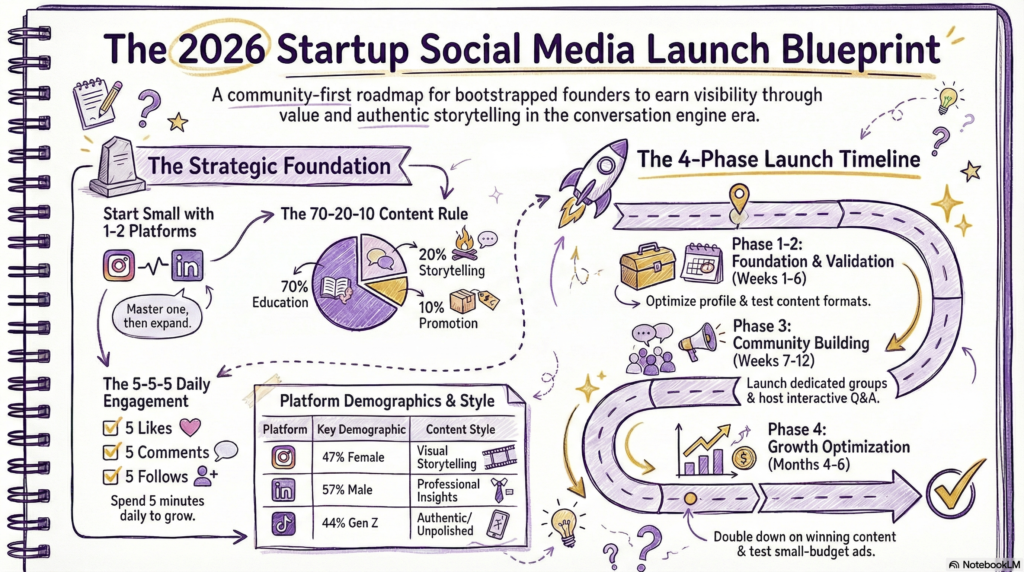
Avoid spreading across too many platforms or over-promoting your product. Instead, focus on authentic connections that grow a loyal audience. For more tips, explore strategies on leveraging social media effectively.
Check out startup news that you might like:
Startup News: The Ultimate Guide to ESA’s Ariane 6 Mistakes and what Founders Can Learn in 2026
Startup News: Hidden Insights and Tested Tips for Open Publishing and Decentralisation in 2026

Launching a startup on social media is a solid foundation for social media strategy for startups. Social platforms are platforms that allow founders to connect with audiences, validate ideas, build communities, and even generate revenue without massive marketing budgets. I’ve built multiple startups, bootstrapped most of them, and I can tell you this: social media levels the playing field for resource-constrained founders. But diving in without strategy often results in wasted time and missed opportunities.
So let’s get you started social media, one of the pillars of the startup marketing strategies.
What Is Launching a Startup on Social Media?
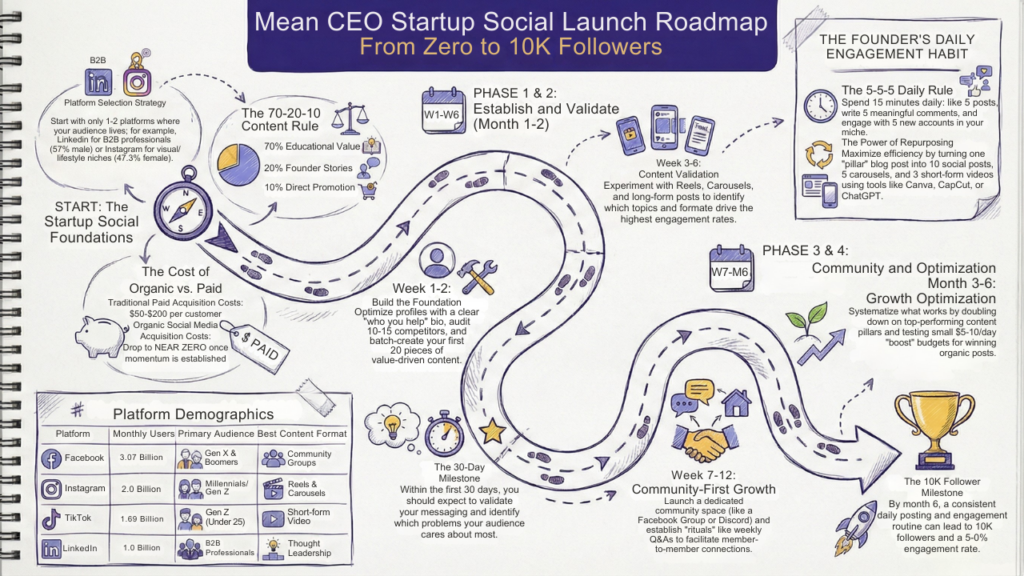
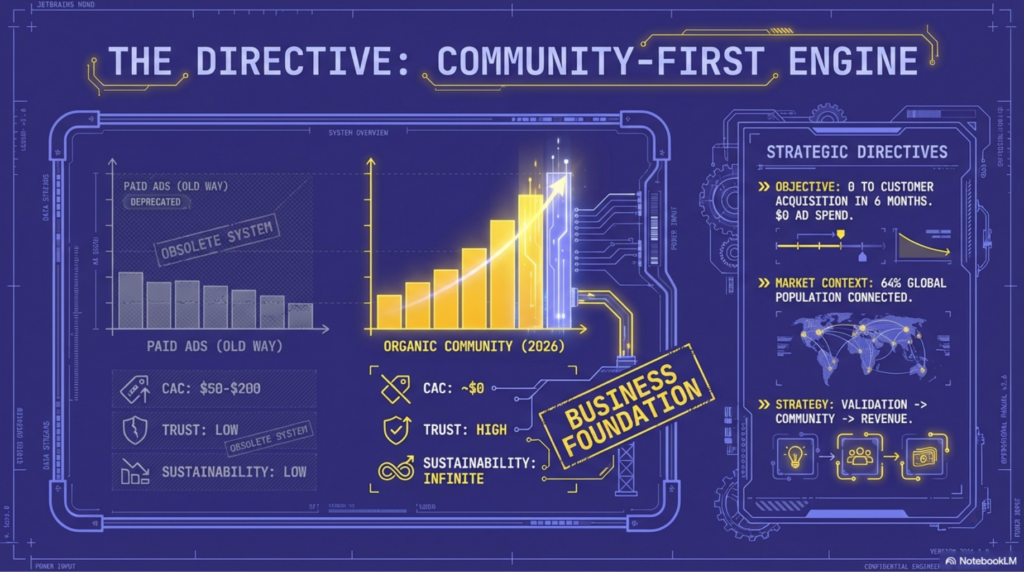
Launching a startup on social media means using platforms like Instagram, LinkedIn, Reddit, and TikTok as your primary channels to introduce your business, validate ideas, and grow an audience. This approach transforms social platforms from marketing channels into full-fledged business foundations where you can test products, gather feedback, build communities, and generate revenue.
For bootstrapped founders and entrepreneurs in Europe, this method levels the playing field. You don’t need massive ad budgets or fancy marketing agencies. What you need is strategy, consistency, and authenticity. Social media allows you to reach 5.66 billion users worldwide who spend an average of 2 hours and 21 minutes daily on these platforms.
The approach differs from traditional marketing. Instead of broadcasting messages, you’re creating conversations. Instead of paying for visibility, you’re earning it through valuable content and genuine engagement. You become part of existing communities before asking them to become customers.
Why Social Media Matters for Startups in 2026
Social media has evolved from an experimental marketing channel into the primary customer acquisition engine for early-stage startups. The numbers tell the story: over 64% of the world’s population uses social platforms, and that number continues to grow by 4.8% year over year.
Three key factors make social media essential for startups right now. First, algorithm changes favor authentic, community-driven content over polished ad campaigns. Platforms reward creators who spark conversations and build relationships. Second, social commerce integration means you can sell directly through Instagram, TikTok, and Facebook without building complex e-commerce infrastructure. Third, AI tools have democratized content creation, allowing solo founders to produce quality content at scale.
The cost advantage alone makes this approach compelling. Traditional customer acquisition through paid ads can cost $50-200 per customer depending on your industry. Organic social media acquisition costs drop to near zero once you establish momentum. You’re investing time instead of money, which works perfectly for bootstrapped operations.
European female founders and bootstrappers find particular advantage here. Social platforms let you test market fit before writing a single line of code. You can validate demand, refine messaging, and build a waiting list all before launch. That validation reduces risk and increases your chances of securing funding or achieving profitability faster.
Who Should Use This Startup Marketing Strategy?
This strategy works best for specific founder profiles. If you’re bootstrapping without external funding, social media becomes your primary growth engine. If you’re a solo founder or small team without a marketing budget, these tactics let you compete with larger competitors. If you’re building a B2C product targeting millennials or Gen Z, you’ll find your audience already active and engaged on these platforms.
B2B startups benefit too, particularly on LinkedIn where 57% of users are male and decision-makers actively seek solutions. Service businesses, SaaS products, and marketplace startups all find traction through strategic social presence. The key is matching your product to the right platform where your specific audience already spends time.
Female entrepreneurs in Europe particularly benefit from this approach. Social platforms let you build credibility and thought leadership without the traditional gatekeepers of business media. You can share your founder story, demonstrate expertise, and connect directly with potential customers and investors.
This strategy also works for product categories with strong visual appeal: fashion, fitness, food, design, travel. Instagram and Pinterest drive high-intent traffic for these niches. For complex B2B solutions, LinkedIn’s professional context and longer content formats work better.
Quick Wins You Can Expect
Within your first 30 days, expect to validate whether your target audience exists and engages with your messaging. You’ll identify which content types resonate, which platforms drive the most engagement, and what problems your audience cares about most. This early feedback shapes everything that follows.
By day 60, you should have 100-300 engaged followers who consistently interact with your content. They’re potential early adopters who will provide feedback, share your content, and eventually become customers. You’ll also start seeing referral traffic to your website or landing page.
Within 90 days, properly executed social strategies generate your first customers or sign-ups. You’ll have established content patterns that work, identified platform-specific best practices for your niche, and built relationships with micro-influencers or complementary brands for partnerships.
The compound effect kicks in after six months. Your content archive becomes discoverable through search, your community starts generating user-generated content, and your network effects accelerate growth. This is when organic reach starts replacing paid efforts as your primary customer acquisition channel.
Quick wins also include learning what doesn’t work. Failed content teaches you about audience preferences faster than any market research. Each post is a mini-experiment that generates data about messaging, timing, format, and positioning. This rapid iteration cycle compresses what used to take months into weeks.
Core Concepts: Platform Selection Strategy
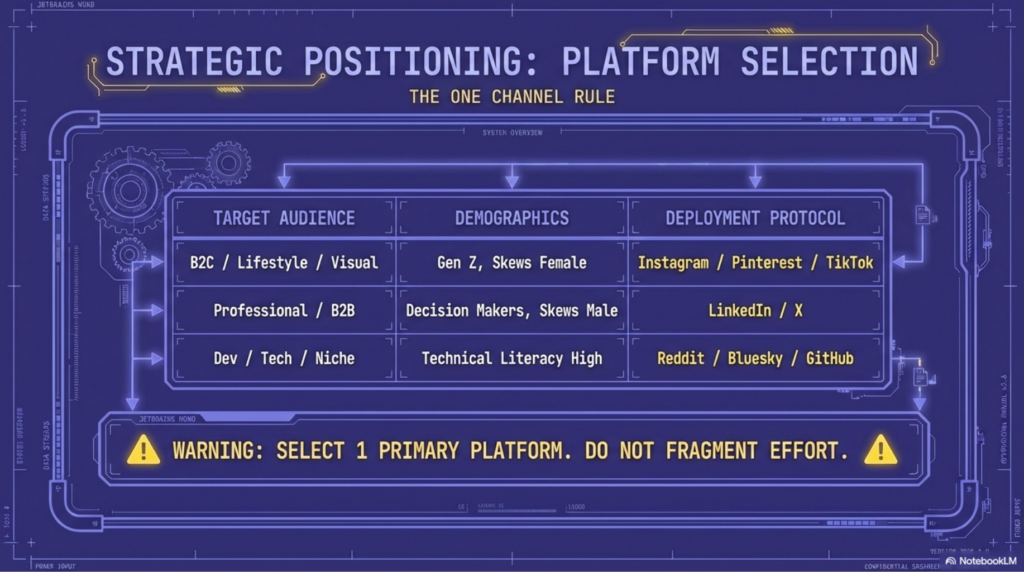
Choosing the right platform is your most critical early decision. Each platform serves different demographics, content types, and user behaviors. Instagram attracts 2 billion monthly users with 47.3% female audiences who prefer visual storytelling and lifestyle content. LinkedIn reaches 1 billion professionals with 57% male users who engage with thought leadership and industry insights.
TikTok brings 1.59 billion users with 44% Gen Z audiences under 25 years old who reward creativity and authentic engagement over polished production. Facebook still dominates with 3.07 billion users, particularly Gen X and Boomers (58% adoption rate) who engage with community groups and longer-form content.
Platform selection starts with audience mapping. Where does your ideal customer spend time? A B2B SaaS selling to enterprise CTOs belongs on LinkedIn, not TikTok. A sustainable fashion brand targeting 25-35 year old women should prioritize Instagram and Pinterest. A developer tools startup needs to build presence where developers congregate: Reddit, X, and GitHub.
Start with one platform, not five. Master one channel’s content formats, posting rhythms, and community norms before expanding. This focused approach lets you build real traction instead of spreading thin across multiple platforms with mediocre results everywhere.
Platform selection also considers your content creation capabilities. Video-first platforms like TikTok and YouTube require different skills than text-based platforms like X or Medium. If you’re comfortable on camera, lean into video. If writing is your strength, prioritize text-heavy platforms.
Core Concepts: Content Pillars and Mix
Content pillars organize your messaging into consistent themes that serve different purposes. Most successful startup social strategies use four pillars: educational content that solves problems, behind-the-scenes content that builds connection, social proof content that establishes credibility, and promotional content that drives conversions.
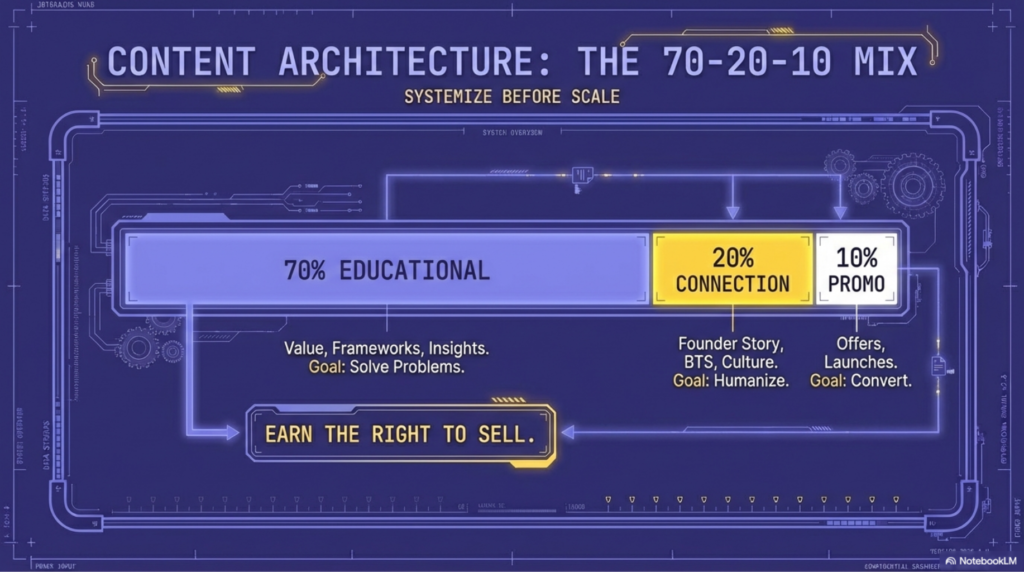
The 70-20-10 rule works well for content distribution. Dedicate 70% to valuable educational content that helps your audience regardless of whether they buy. This includes how-to guides, industry insights, tips, and frameworks. The next 20% features behind-the-scenes stories, founder journey content, company culture, and customer spotlights. The final 10% promotes your product directly through launches, feature announcements, and special offers.
Educational content positions you as an expert while providing genuine value. When someone discovers your account, they should immediately understand what you know and how you can help them. This content also has the longest shelf life and best discoverability through platform search features.
Behind-the-scenes content humanizes your brand and builds emotional connection. Share your startup journey, the problems you’re solving, lessons learned, and even failures. This authenticity resonates particularly well with female entrepreneurs and bootstrapped founders who relate to the struggles and wins.
Social proof content includes customer testimonials, case studies, metrics and milestones, press mentions, and partnerships. This content builds credibility with new audiences who don’t know you yet. It answers the question: “Why should I trust this startup?”
Content mix also varies by platform. Instagram favors visual storytelling through Reels, Stories, and carousel posts. LinkedIn rewards longer-form posts with personal insights and professional lessons. TikTok thrives on trend-jacking and authentic, unpolished video.
Core Concepts: Community-First Growth
Community-first growth means prioritizing relationships over transactions. Instead of broadcasting promotional messages, you join existing conversations, add value to communities, and build trust before asking for anything in return. This approach works particularly well on platforms like Reddit, Quora, and X.
Start by identifying where your target customers already congregate. For Reddit, this means finding relevant subreddits where your audience discusses problems your product solves. On X, follow industry hashtags and join conversations with thoughtful replies. On LinkedIn, participate in relevant groups and comment meaningfully on posts from industry leaders.
The 5-5-5 rule structures daily community engagement: spend 5 minutes liking 5 posts, commenting meaningfully on 5 posts, and engaging with 5 new accounts. This consistent engagement builds visibility and relationships without requiring hours of social media management.
Community-first growth also means creating spaces for your audience. Facebook Groups work well for building dedicated communities around your niche. You can host discussions, share exclusive content, and facilitate peer-to-peer connections. This creates a moat around your startup as the community itself becomes valuable to members.
The key is genuineness. People spot self-promotion immediately and reject it. But when you consistently help others, answer questions, and share insights without agenda, you build social capital. When you eventually share your product, the community supports you because you’ve already proven your value.
Community building also accelerates validation. By participating in conversations before launching, you understand exactly what problems people face, how they describe those problems, and what solutions they’ve already tried. This intelligence shapes your product positioning and messaging.
Core Concepts: Content Calendar Planning

Content calendars transform sporadic posting into systematic growth. Plan content 4-6 weeks ahead to maintain consistency while staying flexible enough to capitalize on trending topics and real-time opportunities. Your calendar should balance planned content pillars with space for reactive posts.
Start by mapping key dates relevant to your industry: product launches, industry events, seasonal trends, and awareness days. Build content around these anchor points. For example, a fintech startup might plan tax season content, quarterly earnings analysis, and budget planning guides aligned with when people naturally think about money management.
Content batching improves efficiency. Dedicate specific days to creating multiple pieces of similar content. Film several videos in one session, write multiple LinkedIn posts in one sitting, or design a week’s worth of graphics in one afternoon. This batching reduces context switching and improves creative flow.
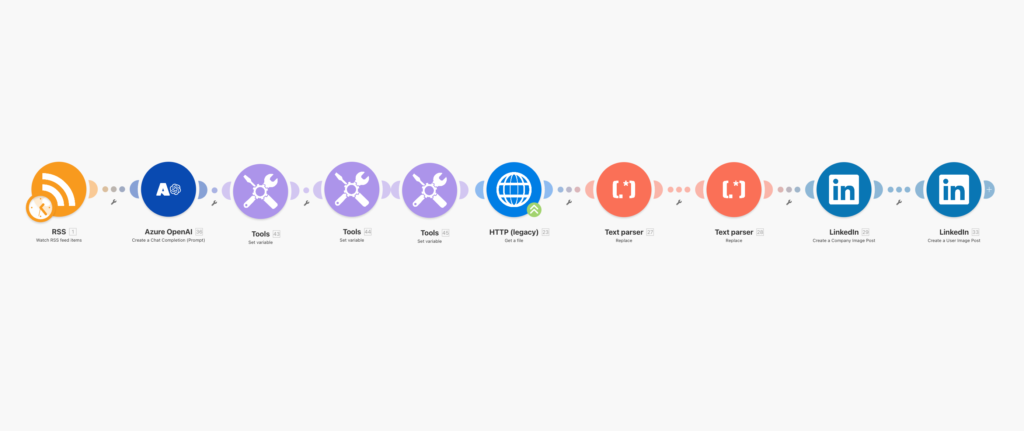
Tools like Buffer, Hootsuite, and Later let you schedule content across platforms from one dashboard, but I prefer having my own workflows in N8N and make.com. You can plan a month of content in a few hours, then spend daily time on engagement and reactive content. This systematic approach ensures you maintain presence even during busy periods.
Your calendar should also track performance. Note which posts drove the most engagement, what time of day worked best, and which content types resonated. Use this data to refine your calendar over time. Double down on what works and eliminate what doesn’t.
Include content variety in your calendar. Mix formats: static images, carousels, videos, text posts, polls, and questions. Vary topics across your content pillars. Test different posting times and days to identify your audience’s peak engagement windows.
Core Concepts: Storytelling and Founder-Led Content

Founder-led content means you, the founder, become the face and voice of your startup. This approach works exceptionally well in 2026 as audiences increasingly trust people over brands. Your personal story, lessons learned, and authentic perspective become your competitive advantage.
Start by documenting your journey. Share why you started the company, what problem you’re obsessed with solving, and the challenges you face along the way. This narrative arc keeps audiences invested in your success. People root for founders they connect with personally.
Storytelling follows proven structures. The problem-agitation-solution framework works well: identify a problem your audience faces, agitate it by exploring the implications, then present your solution. The hero’s journey structure also resonates: you faced a challenge, overcame obstacles, learned lessons, and now help others on the same journey.
Video content amplifies founder-led strategies. Short-form videos on TikTok, Instagram Reels, and YouTube Shorts let audiences see and hear you directly. This builds trust faster than text alone. Even simple talking-head videos outperform polished corporate content when the message resonates.
Storytelling also applies to customer stories. Feature how customers use your product, what results they achieved, and how their lives improved. These stories provide social proof while demonstrating your product’s value in real-world contexts.
The key is consistency between your personal brand and company brand. Your values, tone, and perspective should align. This authenticity prevents the disconnect that happens when founders try to project an image different from who they really are.
Core Concepts: Social Proof and Validation
Social proof demonstrates that others trust and value your startup. In early stages, social proof comes from early adopter testimonials, beta user feedback, engagement metrics, press mentions, and endorsements from respected industry figures.
Start collecting testimonials from day one. When beta users share positive feedback, ask permission to feature it publicly. Screenshot positive DMs, emails, and comments. These genuine reactions carry more weight than any marketing copy you write.
Engagement metrics serve as social proof. When your posts generate hundreds of likes, dozens of comments, and multiple shares, new audiences perceive you as credible. This creates a positive feedback loop where social proof attracts more engagement, which generates more social proof.
Strategic partnerships amplify social proof. When you collaborate with established brands or influencers in your space, their credibility transfers to you. Even small collaborations like guest posts, podcast interviews, or joint webinars expose you to new audiences with built-in trust.
Medium and Quora build social proof through content authority. Publishing in-depth articles that rank well and get shared positions you as an expert. Consistently providing valuable answers on Quora builds your reputation as someone who genuinely helps others.
Milestone celebrations create social proof moments. When you hit 1,000 followers, land your 100th customer, or raise funding, share these wins. They demonstrate momentum and validate that others are choosing your startup.
User-generated content represents the strongest social proof. When customers create content featuring your product without prompting, it signals genuine enthusiasm. Encourage and amplify this content by resharing and crediting creators.
Core Concepts: Platform-Specific Optimization
Each platform has unique content formats, algorithms, and user expectations. Optimization means adapting your core message to each platform’s specific requirements rather than cross-posting identical content everywhere.
Instagram prioritizes Reels and Stories over static feed posts. The algorithm reads on-screen text, captions, audio, and engagement velocity. Optimize by adding clear on-screen text, contextual captions, and creating “silent-first” content that works without audio. Hashtags still matter on Instagram, so use 10-15 relevant tags mixing popular and niche terms.
LinkedIn rewards longer-form posts (1,300-2,000 characters) that tell stories and share professional insights. Posts with personal lessons and vulnerability outperform corporate announcements. Comment on others’ posts to increase your visibility in feeds. Document and PDF posts see high completion rates and generate strong engagement.
TikTok demands hook-first content: you have 1-3 seconds to capture attention. Use trending sounds, participate in challenges, and create content that feels native to the platform rather than like ads. The algorithm rewards watch time and completion rate, so focus on keeping viewers through the entire video.
X favors real-time engagement and threaded content. Viral threads that break down complex topics into digestible tweets perform well. Reply thoughtfully to tweets in your niche to build relationships. Timing matters more on X than other platforms: post when your audience is active.
Facebook Groups drive engagement better than Pages for most startups. Create or join Groups where your audience gathers. Facebook’s algorithm favors content that sparks conversation, so ask questions and create posts that encourage comments.
Core Concepts: Analytics and Iteration

Analytics transform guesswork into strategy. Track metrics that matter for your stage: awareness metrics early on (reach, impressions, followers), engagement metrics as you grow (likes, comments, saves, shares), and conversion metrics when you’re ready to monetize (click-through rates, sign-ups, sales).
Platform-native analytics provide the most accurate data. Instagram Insights, Facebook Analytics, LinkedIn Analytics, and TikTok Analytics show you what content works, when your audience is active, and how people discover you. Check these weekly to identify patterns.
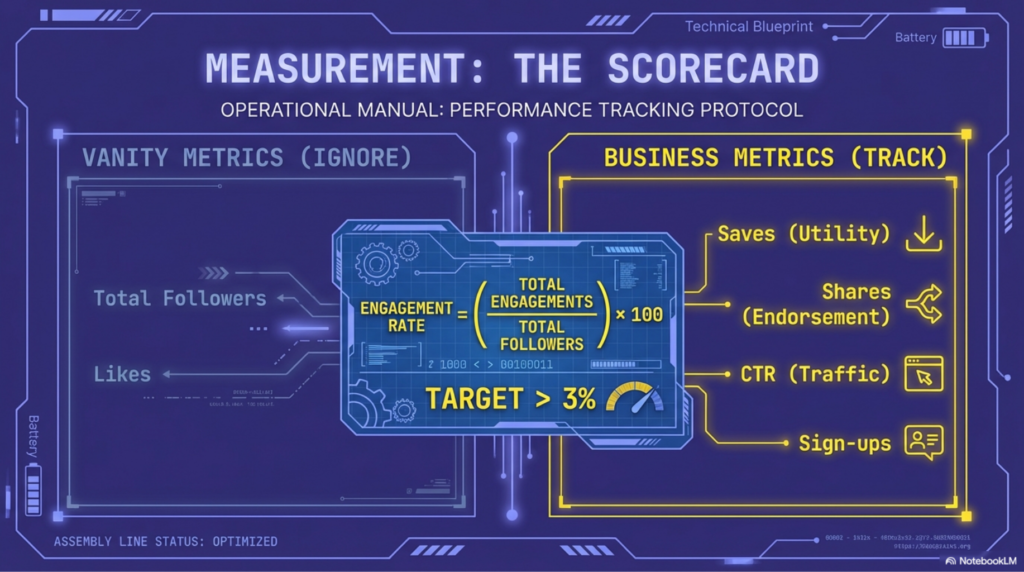
Focus on engagement rate over follower count. An account with 1,000 engaged followers outperforms one with 10,000 passive followers. Calculate engagement rate by dividing total engagements by total followers, then multiplying by 100. Rates above 3% indicate strong audience connection.
Saves and shares matter more than likes. When someone saves your post, they’re indicating it has lasting value. When they share it, they’re endorsing you to their network. These actions carry more algorithmic weight and business value than passive likes.
Use UTM parameters to track traffic from social to your website. This shows which platforms and posts drive actual website visits and conversions. Google Analytics reveals what these visitors do once they arrive: which pages they visit, how long they stay, and whether they convert.
A/B test systematically. Change one variable at a time (post timing, caption length, content format, call-to-action) and measure results. Document what works in a swipe file you can reference when creating future content.
Core Concepts: Paid Social Strategy for Startups
Paid social amplifies organic success rather than replacing it. Start with small budgets ($5-10 per day) to test ad formats and targeting before scaling. Use paid ads strategically to boost top-performing organic content, reach new audiences with lookalike targeting, and retarget website visitors who didn’t convert.
Instagram and Facebook Ads Manager offers precise targeting by demographics, interests, behaviors, and custom audiences. Start with saved audience targeting based on detailed demographics and interests. Once you have 100+ customers or email subscribers, create lookalike audiences to find similar users.
Test multiple ad variations simultaneously. Run 3-5 different ad creatives with varying images, headlines, and copy. The platform’s algorithm will optimize delivery toward top performers. Let ads run for at least 3-5 days before making decisions; initial performance often shifts as the algorithm learns.
Video ads outperform static images across platforms. Short-form videos (15-30 seconds) that hook viewers immediately and deliver value quickly generate the best results. User-generated content style ads (casual, authentic, unpolished) often outperform professional production.
Retargeting campaigns target people who already engaged with your content or visited your website. These “warm” audiences convert at 2-3x higher rates than cold audiences. Install platform pixels on your website to build retargeting audiences from day one.
For bootstrapped founders, paid social works best as an accelerant after you’ve validated organic content that resonates. Don’t use paid ads to test messaging; test organically first, then amplify winners with ad spend.
Core Concepts: Influencer and Partnership Strategy
Micro-influencers (1,000-100,000 followers) deliver better ROI for startups than mega-influencers. They have higher engagement rates, more niche audiences, and lower costs. Many will partner for free product, affiliate commissions, or small fees ($100-500 per post).
Identify influencers by searching relevant hashtags on Instagram and TikTok, exploring who your competitors work with, and using influencer discovery tools like Upfluence or AspireIQ. Look for authentic engagement: check if their comments seem genuine and if they respond to their audience.
Reach out with personalized messages explaining why you admire their content and how your product aligns with their audience’s interests. Offer value first: send free product, share their content, or create something useful for them before asking for promotion.
Collaboration types include product reviews, unboxing videos, tutorial content featuring your product, affiliate partnerships, and takeovers where influencers create content for your account. Give influencers creative freedom: their audience trusts their voice, not scripted ads.
Track influencer performance through unique discount codes, affiliate links, and UTM parameters. This shows which partnerships drive actual results versus vanity metrics. Focus future partnerships on influencers who deliver conversions, not just impressions.
Strategic partnerships with complementary brands extend reach without direct costs. Co-host webinars, create joint content, cross-promote to each other’s audiences, or bundle products. These partnerships provide value to both audiences while splitting effort and costs.
Core Concepts: Community Management and Engagement
Community management transforms followers into advocates. Respond to every comment on your posts within the first hour when possible; this signals to algorithms that your content sparks conversation, increasing its reach. Personalize responses rather than using generic replies.
Direct messages create deeper connections. When someone DMs with questions, product feedback, or just to share appreciation, respond thoughtfully. These private conversations often convert cold followers into warm leads. Set aside 15-30 minutes daily for DM engagement.
Create conversation-starter content specifically designed to generate comments. Ask questions, request opinions, run polls, and create “choose your favorite” posts. Content that prompts comments outperforms content that just receives likes in algorithmic ranking.
Feature community members in your content. Reshare user-generated content, spotlight customer stories, host takeovers, and create round-up posts featuring community contributions. This recognition encourages others to engage hoping for similar features.
Moderate negativity professionally. Address legitimate criticism with solutions, ignore trolls, and delete spam. Public handling of complaints demonstrates customer service quality to everyone watching. Turning a complaint into a positive resolution can actually strengthen brand perception.
Build community rituals like weekly themes (Motivation Monday, Feature Friday), recurring AMAs, monthly challenges, or live Q&A sessions. These predictable touchpoints give your community reasons to return regularly.
Core Concepts: Content Repurposing and Efficiency
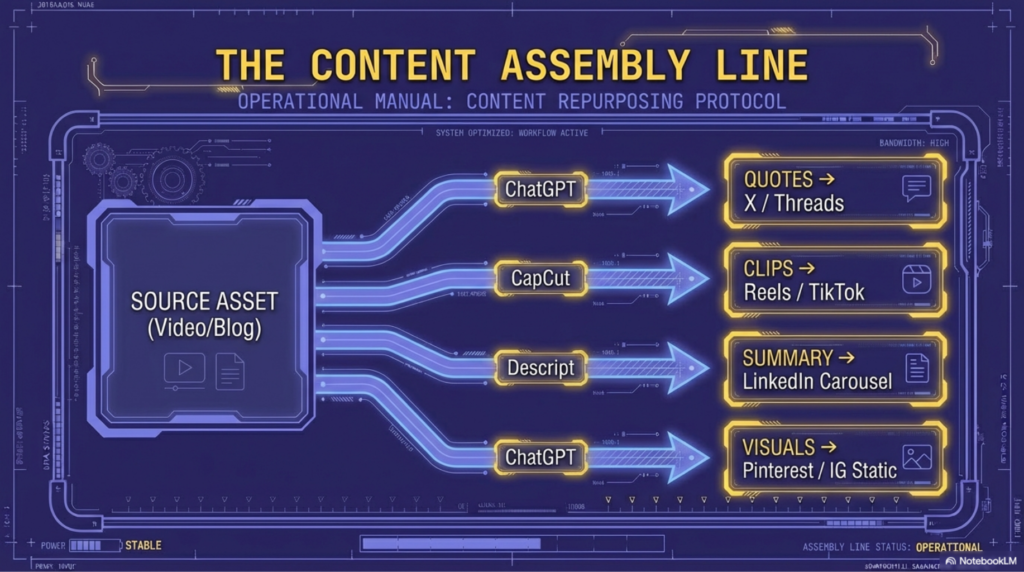
Content repurposing maximizes value from each piece of content you create. A single long-form blog post can become 10 social posts, 5 carousel posts, 3 videos, and 20 quotes. This systematic approach multiplies your content output without multiplying effort.
Start with one “pillar” content piece: a comprehensive blog post, podcast episode, or video. Break this into smaller pieces: pull key quotes for text posts, extract statistics for visual graphics, transform main points into carousel slides, and edit video into short clips for Reels and TikTok.
Platform-to-platform repurposing extends reach. Turn LinkedIn posts into Medium articles, convert Instagram Reels to TikTok videos, and adapt X threads into LinkedIn posts. Adjust formatting and tone for each platform’s norms.
AI tools accelerate repurposing. Use ChatGPT to transform long content into social captions, generate variations of successful posts, and brainstorm content angles. Use Canva to quickly create visual variations of the same core message.
Create content templates for repeated use. Develop carousel post templates, Reel formats, and caption structures you can fill with new information each time. This reduces decision fatigue and speeds creation while maintaining consistency.
Evergreen content can be reshared periodically. Posts about fundamental concepts, how-to guides, and framework explainers remain relevant for months. Reshare these every 60-90 days to reach new followers and reinforce key messages with existing audience.
The Social Launch Framework: Overview
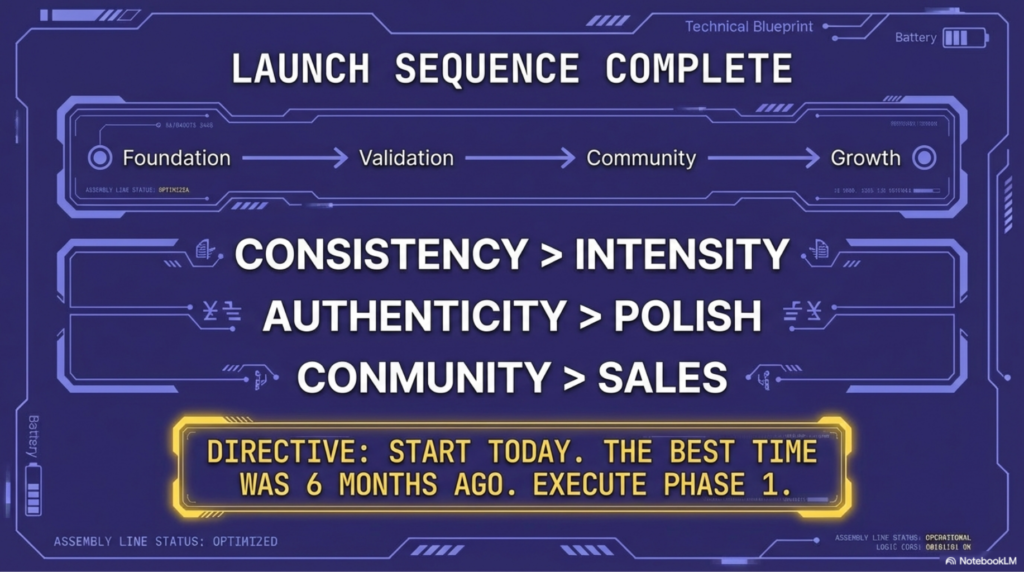
The Social Launch Framework provides a systematic approach to building startup presence across social platforms. This framework works in four phases: Foundation (weeks 1-2), Content Validation (weeks 3-6), Community Building (weeks 7-12), and Growth Optimization (months 4-6).
Each phase builds on the previous one. You can’t skip Foundation to jump straight to Growth: the early work creates the infrastructure that makes later growth possible. The framework also adapts based on your results, so iteration is built in.
This framework assumes you’re bootstrapping with limited resources. You’re likely a solo founder or small team handling social alongside product development. The time commitment starts at 1-2 hours daily and stabilizes at 30-60 minutes daily once systems are established.
Phase 1: Foundation (Weeks 1-2)
Foundation phase establishes your presence and baseline content. Start by setting up optimized profiles on your chosen 1-2 platforms. Complete every profile field like bio, profile image, cover image, contact info, website link. Your bio should clearly state what you do, who you help, and include a call-to-action.
Audit competitor and adjacent brand accounts. Analyze what content types they post, how often, what generates engagement, and what gaps exist that you could fill. Create a spreadsheet documenting 10-15 accounts to monitor regularly.
Define your content pillars and initial content themes. Write these down explicitly: “We create content about [theme 1], [theme 2], and [theme 3].” This prevents decision paralysis when creating content. Map each theme to specific post types you’ll create.
Create your first 15-20 pieces of content in a batch. This initial library lets you schedule consistent posting while you refine your content creation process. Include a mix of educational posts, founder story content, and industry insights. Don’t promote your product yet. Instead focus on providing value.
Set up scheduling tools and analytics tracking. Install platform pixels on your website if you plan to use paid ads later. Configure Google Analytics to track social referral traffic.
Establish your posting schedule. Start with 3-5 posts per week on your primary platform. Consistency matters more than frequency. It’s better to post 3x weekly consistently than 7x one week and 0x the next.
Phase 2: Content Validation (Weeks 3-6)
Content Validation tests which content resonates with your target audience. Post consistently while tracking performance metrics for each piece. Your goal is identifying patterns: which topics, formats, and approaches generate the most engagement.
Experiment with content formats. If you’re on Instagram, test Reels, carousel posts, single images, and Stories. On LinkedIn, try long-form text posts, document posts, polls, and video. On TikTok, experiment with trending sounds, original audio, different video lengths, and formats.
Document results weekly. Create a simple spreadsheet tracking post topic, format, posting time, and key metrics (reach, engagement rate, saves, shares). After 3-4 weeks, patterns emerge showing what your specific audience responds to.
Engage actively during this phase. Spend 30 minutes daily commenting on posts in your niche, responding to comments on your content, and engaging with potential followers. This manual engagement seeds your growth while algorithms learn your account’s relevance.
Start conversations with engaged followers. DM people who consistently engage with your content to thank them and ask what content they find most valuable. This direct feedback shapes your strategy more accurately than metrics alone.
Identify your top 3-5 posts from this period. Analyze what made them successful: topic, format, hook, call-to-action. Create variations of these winners to compound success. If a carousel about “5 ways to X” performed well, create another carousel about “7 mistakes to avoid with X.”
Phase 3: Community Building (Weeks 7-12)
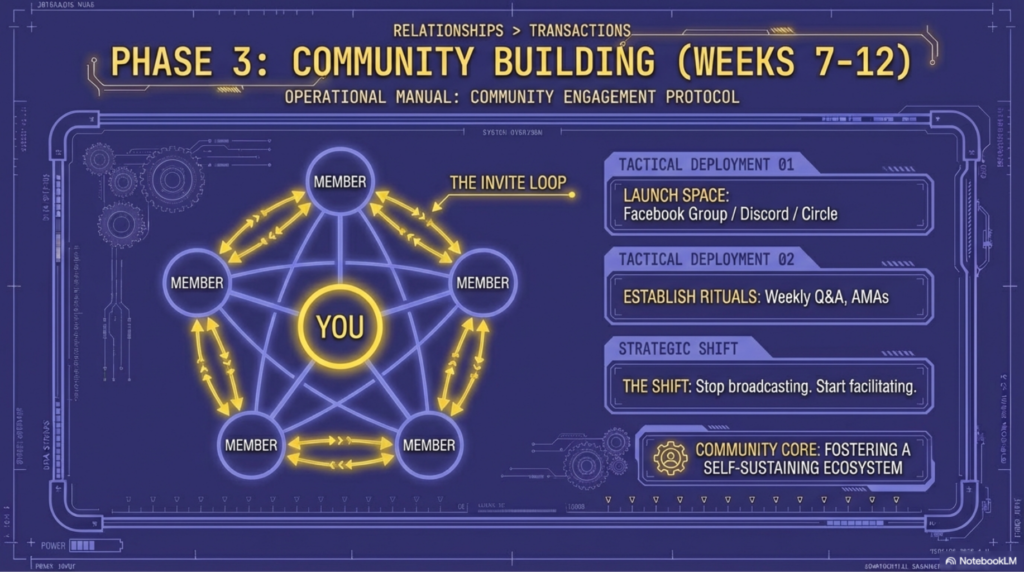
Community Building shifts focus from content creation to relationship development. You’re no longer just posting but facilitating conversations, creating spaces for your audience to connect, and establishing yourself as a central figure in your niche.
Launch a dedicated community space. For Facebook, create a Group. For other platforms, consider Discord or Circle as companion community platforms. Seed the community with your most engaged followers by inviting them directly.
Create community rituals and recurring events. Host weekly Q&A sessions, monthly challenges, or themed discussion days. These predictable touchpoints give members reasons to return regularly and increase their investment in the community.
Facilitate member-to-member connections. When members ask questions, tag other members who can answer. Highlight member wins and success stories. Create introduction threads where members can share their backgrounds. The community becomes valuable independent of your direct involvement.
Develop a content flywheel where community discussions generate content ideas, which you create and share, which drives more community discussion. Screenshot interesting community conversations to share publicly (with permission), highlighting member insights.
Identify potential brand ambassadors and micro-influencers within your growing community. These are highly engaged members with their own followings who genuinely appreciate your content. Develop deeper relationships with them through DMs and potentially exclusive access or perks.
Collaborate with complementary brands or founders in your space. Co-host Instagram Lives, create joint content series, or run collaborative challenges. These partnerships expose you to new audiences with built-in relevance and trust.
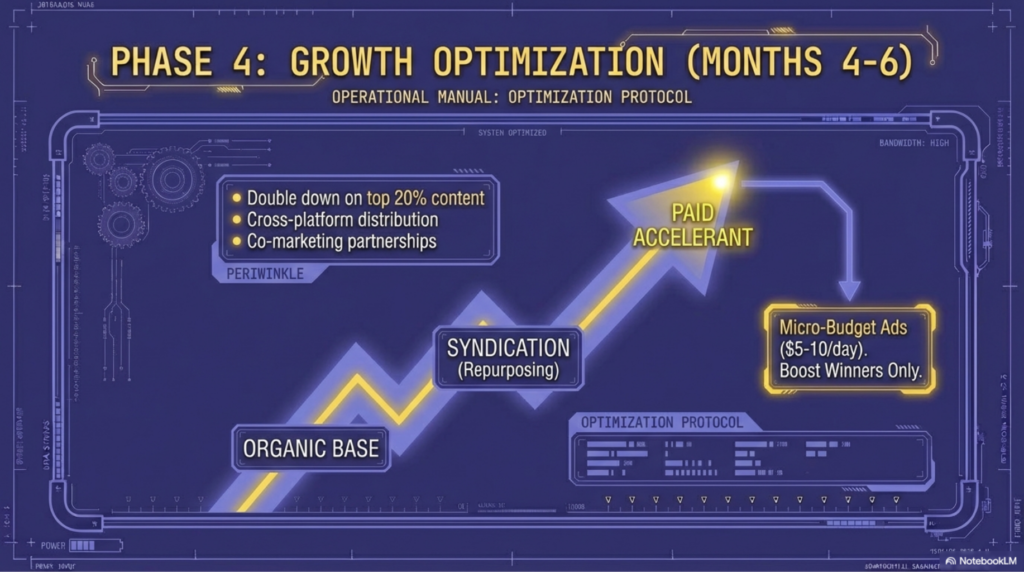
Phase 4: Growth Optimization (Months 4-6)
Growth Optimization systematizes what works and scales your efforts. By month four, you have data showing which content drives results, which platforms provide best ROI, and which growth tactics work for your specific situation.
Double down on top-performing content. If carousel posts consistently outperform other formats, create more carousels. If specific topics generate highest engagement, develop content series exploring those topics in depth. Stop creating content types that consistently underperform.
Implement content batching and templates to improve efficiency. Dedicate one day monthly to creating an entire month’s content, then spend daily time on engagement and reactive content. This separation prevents content creation from consuming all your social time.
Begin testing paid social ads if results warrant it. Start with $5-10 daily budgets boosting your top organic posts to lookalike audiences. Monitor cost per click and cost per conversion carefully. Only scale spending when you achieve positive ROI.
Expand to a second platform if your primary platform is saturated or if data shows opportunity elsewhere. Apply lessons learned from your first platform to accelerate success on the second. Don’t expand until your first platform runs systematically without daily fire-fighting.
Develop partnership programs including affiliate partnerships with aligned creators, co-marketing agreements with complementary brands, and guest content arrangements where you contribute to established platforms in exchange for exposure.
Create advanced content like webinars, downloadable resources, or email courses that capture leads from social traffic. Social media drives awareness, but owned channels like email convert that awareness into customers. Build the bridge between social presence and owned audience.
Decision Framework: When to Pivot vs. When to Persist
Social media success requires persistence, but blind persistence wastes time. Use this decision framework to determine when to adjust strategy versus when to keep executing.
Pivot your platform choice if after 8-12 weeks of consistent posting, you’re not gaining followers or engagement. If you’re posting 4-5x weekly with quality content and seeing no traction, the platform likely doesn’t match your audience.
Persist with platform choice if you’re seeing steady growth even if it’s slow. Gaining 20-30 engaged followers monthly in your first few months is actually good progress. Real growth is gradual, not overnight.
Pivot your content approach if engagement rates decline consistently over 4+ weeks despite consistent posting. This signals audience fatigue with your current content mix. Test new formats, topics, or styles.
Persist with content approach if you’re seeing positive engagement rate trends even if absolute numbers remain small. Growth in engagement percentage indicates improving content-audience fit.
Pivot your posting time if you’re posting during low-activity periods for your audience. Check analytics for when your followers are online, then test posting during those windows for 2-3 weeks.
Persist with your content pillars and brand voice. These should remain consistent even as specific content tactics evolve. Your core message and positioning shouldn’t change based on weekly performance fluctuations.
The key question is whether you’re testing systematically or just hoping for random success. Systematic testing means changing one variable at a time, measuring results, and drawing conclusions. Random hoping means constantly changing everything and learning nothing.
Strategic Considerations for European Founders
European founders face unique opportunities and challenges in social media launch strategies. Time zone differences with US-heavy platforms mean you can post during European evening hours (which correspond to US morning) to maximize initial engagement from both continents.
GDPR compliance matters more for European startups. Be transparent about data collection, obtain proper consents, and include required disclosures. This compliance actually builds trust with European audiences who value privacy.
Language strategy requires deliberate choice. English-language content reaches the broadest audience and attracts international customers and investors. Native language content connects more deeply with local audiences and can dominate smaller markets with less competition.
Many European founders benefit from multi-language strategies. Post in English on LinkedIn and X for professional and international audiences, then create native language content for Instagram and Facebook targeting local customers.
European startup ecosystem differences matter for messaging. Bootstrapping and sustainable growth are more culturally accepted in Europe than the “grow fast, raise big” mentality dominating US startup content. Lean into sustainable growth messaging as it resonates with European audiences and differentiates you.
Regional platforms deserve consideration. While focusing on global platforms makes sense for most startups, some European markets have strong regional platforms worth exploring if your target market is geographically constrained.
Tools and Resources: Content Creation Tools
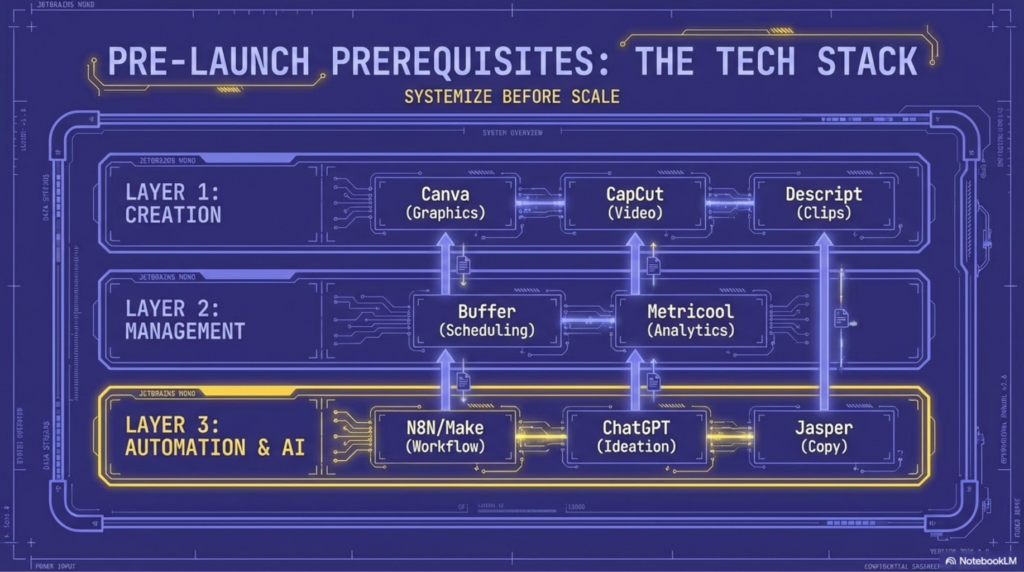
Canva remains essential for creating graphics, carousel posts, and video thumbnails. The free tier provides templates for every social platform. Pro tier ($12.99/month) adds brand kit features, background remover, and larger asset library. Use it for Instagram carousels, LinkedIn document posts, and Pinterest pins.
CapCut dominates video editing for short-form content. Free on mobile and desktop, it includes templates, effects, and auto-captions that work well for TikTok, Instagram Reels, and YouTube Shorts. The learning curve is minimal, making it perfect for founders without video editing experience.
Descript offers advanced video and audio editing with transcript-based editing. Edit video by editing text, remove filler words automatically, and create audiograms for social sharing. Starting at $12/month, it’s worth the investment if video is central to your strategy.
ChatGPT accelerates content ideation and caption writing. Use it to brainstorm content ideas, draft initial caption versions, generate content variations, and create content calendars. The key is using it for first drafts that you then personalize with your voice and expertise.
Figma works well for creating social media templates you’ll reuse frequently. Build carousel post templates, story templates, and branded graphics once, then duplicate and modify for each new post. Free tier works for most founder needs.
Tools and Resources: Scheduling and Management Tools
Buffer provides the cleanest interface for scheduling posts across platforms. The free plan handles 3 social channels with 10 scheduled posts each. Paid plans ($6/month per channel) add analytics, team features, and unlimited scheduled posts. Best for founders managing 2-3 platforms systematically.
Hootsuite offers more robust enterprise features including social listening, team workflows, and detailed analytics. Starting at $99/month, it makes sense for startups with dedicated social media team members or agencies. The free plan is limited but workable for testing.
Later specializes in visual planning, particularly for Instagram and Pinterest. The visual content calendar lets you see how your feed will look before posting. Free plan includes 30 posts per platform monthly. Starting at $18/month for 60 posts.
Metricool combines scheduling with analytics across platforms including TikTok. Free plan allows scheduling on most platforms. Paid tiers ($12+/month) add competitor analysis and advanced analytics. Good all-in-one option for bootstrapped founders.
SocialBee excels at content categorization and evergreen content recycling. You can create content categories (educational, promotional, curated) and the tool rotates posts from each category automatically. Starting at $19/month, it reduces daily content creation burden.
Tools and Resources: Analytics and Insights Tools
Native platform analytics provide the most accurate data. Instagram Insights, Facebook Analytics, LinkedIn Analytics, TikTok Analytics, and X Analytics should be your primary data sources. Check these weekly to understand what content works.
Google Analytics tracks social media traffic to your website. Set up UTM parameters for social links to see which platforms and posts drive website visits and conversions. This connects social efforts to business outcomes.
Iconosquare specializes in Instagram and Facebook analytics with historical data, competitor tracking, and automated reporting. Starting at $49/month, it’s worth considering once you’re scaling Instagram seriously.
Brandwatch (formerly Hootsuite Insights) offers social listening to track brand mentions, industry conversations, and competitor activity. Premium pricing ($800+/month) makes it suitable only for well-funded startups, but the competitor intelligence proves valuable.
Sprout Social provides comprehensive analytics across all major platforms plus social listening and engagement tools. Starting at $249/month per user, it’s built for teams but offers excellent reporting if budget allows.
Tools and Resources: AI and Automation Tools
Lately transforms long-form content into dozens of social posts automatically. Upload a blog post or video transcript, and Lately generates social media posts pulling key quotes and insights. Starting at $49/month, it dramatically accelerates content repurposing.
Jasper AI specializes in marketing copy including social media captions, ad copy, and content variations. The Boss Mode ($59/month) offers more control than ChatGPT for consistent brand voice across social content.
N8N and Make (formerly Integromat) automate workflows between tools. Auto-post blog content to social, add email subscribers when someone DMs specific keywords, or log social mentions to spreadsheets. Both offer free tiers with limited tasks; paid plans start around $20/month.
Phantombuster automates social media actions like following users, scraping profile data, and engaging with content. Use cautiously to avoid platform violations, but it can systematize outreach and research. Plans start at $59/month.
Tools and Resources: Resource Templates and Frameworks
Content Calendar Template: Create a Google Sheet with columns for Date, Platform, Content Pillar, Topic, Format, Caption, Media Assets, Posted (yes/no), and Performance Notes. Schedule content 4 weeks ahead, leaving 20% of slots for reactive content.
Hook Library Template: Document your best-performing hooks (first lines) in a swipe file. Organize by content type (educational, storytelling, controversial, question-based). Reference this library when experiencing writer’s block or testing new post variations.
Competitor Analysis Spreadsheet: Track 10-15 competitor accounts monthly. Document posting frequency, engagement rate, top-performing posts, and content themes. This reveals content gaps and opportunities in your niche.
Engagement Tracker: Log DM conversations, partnership opportunities, and notable community interactions. Include contact info, interaction summary, and follow-up needed. This prevents valuable relationships from falling through cracks.
Platform-Specific Checklists: Create pre-posting checklists for each platform. Instagram: image resolution correct, caption includes call-to-action, 10-15 hashtags added, alt text written. LinkedIn: post is 1,300+ characters, includes line breaks for readability, tags relevant people, poses question for comments.
Advanced Tactics: Viral Content Engineering
Viral content isn’t random luck: it follows patterns. Understanding these patterns lets you engineer content with viral potential. Start by analyzing viral posts in your niche. What hooks do they use? What format? What emotional response do they trigger?
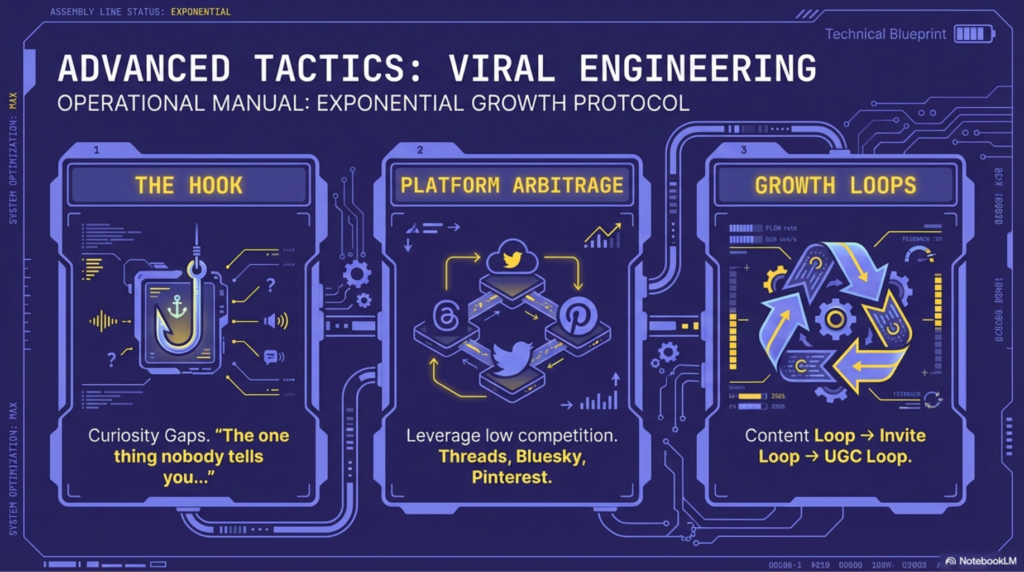
The best hooks create curiosity gaps or make bold claims. “The one thing nobody tells you about X” works because it promises insider knowledge. “I spent $50k learning X so you don’t have to” works because it promises valuable lessons without the cost. “Stop doing X. Do this instead” works because it challenges conventional wisdom.
Listicles and numbered posts perform consistently well. “7 ways to X,” “3 mistakes founders make with X,” “10 lessons from X” all promise specific, digestible value. Odd numbers (7, 9, 11) slightly outperform even numbers in engagement.
Contrarian takes generate engagement through controversy. If everyone in your space says “do X,” create content explaining why Y actually works better. Be prepared to defend your position thoughtfully in comments as controversy without substance damages credibility.
Story-based content with clear narrative arcs holds attention. Structure: Set up a problem you faced, build tension through the struggle, pivot moment where you discovered the solution, share the lesson learned. This structure works across threads, carousels, videos, and long-form posts.
Engagement bait done well asks questions that people want to answer. “What’s your biggest challenge with X?” or “Where are you on your X journey?” invite responses. The key is genuine curiosity about answers, not just farming engagement.
Advanced Tactics: Platform Arbitrage Strategies
Platform arbitrage means identifying platforms where your target audience exists but competition remains low, giving you outsized returns on effort. Several platforms currently offer arbitrage opportunities for startups.
Threads launched by Meta in 2023 remains relatively uncrowded. Early adopters build audiences faster due to lower competition for attention. The platform rewards conversational content and real-time engagement similar to X but with less noise.
Bluesky attracts tech-forward early adopters frustrated with X. The smaller community means higher discoverability for quality content. If your startup targets developers, crypto users, or tech industry professionals, Bluesky offers less competition than established platforms.
Pinterest remains underutilized by startups despite 450M+ monthly users. The platform functions as a visual search engine where content has years of discoverability instead of hours. For e-commerce, design, food, travel, and lifestyle startups, Pinterest drives high-intent traffic with minimal effort.
Quora provides content arbitrage through answer marketing. Comprehensive answers to relevant questions generate passive traffic for years. The platform’s SEO strength means your answers often rank in Google for those questions.
Medium offers distribution arbitrage. Publications with hundreds of thousands of followers will distribute your content if it meets quality standards. One accepted submission reaches far more people than months of organic social growth.
The arbitrage opportunity window closes as competition increases. Early movers gain disproportionate advantage. Monitor emerging platforms and test them before they become saturated.
Advanced Tactics: Multi-Platform Syndication Systems
Multi-platform syndication maximizes content value by systematically distributing it across platforms with platform-specific optimization. This strategic adaptation.
Start with a primary content piece on your strongest platform. A LinkedIn post, Instagram Reel, or TikTok video. Once published, adapt it for other platforms within 24 hours while the topic is fresh.
Transform a LinkedIn post into a Medium article by expanding each point with examples and data. Add a strong introduction, break up text with subheadings, and include a conclusion with call-to-action. Medium favors 1,500-2,500 word articles while LinkedIn prefers 1,300-2,000 characters.
Convert a TikTok video into Instagram Reels, YouTube Shorts, and LinkedIn video. Adjust aspect ratios, update captions for platform norms, and optimize hashtags. What works on TikTok with trending sounds might need original audio on LinkedIn for professional context.
Extract quotes and insights from video content for text-based posts on X and LinkedIn. A 60-second video contains 3-5 quotable insights that become standalone posts. Add context and amplification to each quote for platform-appropriate length.
Create carousel posts for Instagram and LinkedIn from blog post main points. Each slide covers one key point with supporting visual. Carousels generate high engagement and saves because they provide dense value in consumable format.
Document your syndication workflow in a checklist. When you create primary content, the checklist ensures you extract maximum value through systematic adaptation to all relevant platforms.
Advanced Tactics: Community-Powered Growth Loops
Growth loops create self-reinforcing growth where user actions automatically drive more users. Social media enables several growth loop mechanisms for startups.
The Content Loop: User discovers your content → engages with it → algorithm shows your content to similar users → new users discover you → cycle repeats. Optimize by creating highly engaging content that prompts shares and saves, which signal quality to algorithms.
The Invite Loop: User joins your community → gets value → invites others → new users get value → cycle repeats. Facebook Groups excel at this. Create features that encourage members to invite others: exclusive challenges, group discounts, or member spotlights.
The UGC Loop: Customer shares content featuring your product → you amplify their content → more customers create content → cycle repeats. Encourage UGC by featuring customers prominently, creating branded hashtags, running UGC contests, and making sharing easy.
The Network Effects Loop: User gets value from your product/community → tells others → more users join → value increases for everyone → cycle accelerates. LinkedIn groups and Facebook communities exhibit this pattern when critical mass is reached.
The Influencer Loop: Micro-influencer promotes your product → their audience tries it → satisfied users with followings promote it → cycle expands. Seed this loop by giving free product to nano-influencers (1,000-10,000 followers) who genuinely align with your brand.
Build growth loops into your product and content strategy from day one. Each new user or piece of content should naturally create conditions for more users and content.
Advanced Tactics: Hashtag Strategies
Hashtags remain powerful discovery mechanisms on Instagram, TikTok, X, and LinkedIn despite changing algorithms. Advanced strategies go beyond picking random popular tags.
The pyramid strategy uses three hashtag tiers: 3-4 mega hashtags (1M+ posts), 4-5 mid-tier hashtags (100K-500K posts), and 3-4 niche hashtags (10K-50K posts). Mega hashtags provide small chance of massive reach. Mid-tier hashtags offer best discovery-to-competition ratio. Niche hashtags connect you with highly relevant audiences.
Create a branded hashtag unique to your startup. Use it consistently across all content and encourage customers to use it. #gamepreneurship as an example, as it creates a searchable archive of all related content and builds brand identity.
Campaign-specific hashtags work well for launches, challenges, or events. When Fe/male Switch runs a challenge, a unique hashtag tracks all participant content, creates community through shared tag, and provides UGC for resharing.
Hashtag research reveals content opportunities. Search hashtags your audience might follow to discover what questions they’re asking, what content gets traction, and what gaps exist. Create content specifically targeting underserved hashtag niches.
Location hashtags matter for local businesses or regionally-focused startups. #LondonStartups, #BerlinTech, #AmsterdamFounders connect you with local startup communities. Combine with industry hashtags for targeted reach.
On Instagram, place hashtags in first comment instead of caption for cleaner aesthetics. On LinkedIn, use 3-5 hashtags maximum. On TikTok, mix trending and niche tags. On X, 1-2 relevant hashtags suffice; overuse appears spammy.
Case Study: From Zero to 10K Followers
Looking at real execution provides tactical insights. Here’s how a bootstrapped SaaS founder built 10K engaged followers in 6 months on LinkedIn starting from zero.
Month 1: Violetta published daily posts sharing lessons from building startups. No product promotion, just valuable insights about founder challenges. She commented on 20-30 posts daily from industry leaders, adding substantive thoughts that showcased expertise. This engagement drove profile visits.
Month 2: She identified her best-performing content (storytelling posts about specific challenges and solutions) and doubled down. She started writing longer posts (1,500+ characters) with clear structure: hook, story, lesson, application. Engagement rate jumped from 2% to 4%.
Month 3: She began collaborating with other founders through comment conversations that turned into co-created content. Joint posts exposing both audiences to each other. She also started writing carousels breaking down complex startup topics into digestible slides.
Month 4: User-generated content emerged as engaged followers created posts mentioning her insights. She amplified all of these by commenting and resharing. This social proof attracted more followers. She launched a weekly “Startup Office Hours” post where founders asked questions.
Month 5: She repurposed top LinkedIn posts into Medium articles, which ranked in search and drove new LinkedIn followers. She started getting inbound partnership and speaking opportunities from her LinkedIn presence.
Month 6: She hit 10K followers with 5-8% engagement rate on posts. More importantly, her LinkedIn presence generated actual business value: beta customers, angel investor connections, and partnership opportunities. The social proof accelerated all other business development efforts.
Key tactics: Daily posting consistency, commenting as discovery engine, doubling down on what works, collaborating with peers, and treating social media as relationship building rather than broadcasting.
Optimization Through Data Analysis
Data transforms intuition into strategy. Advanced optimization means systematic analysis and application of insights. Set up weekly review rituals where you analyze performance data.
Engagement rate trends matter most. Calculate engagement rate weekly: (Total Engagements / Total Followers) × 100. Track the trend. Upward trend indicates improving content-audience fit even if absolute numbers are small. Downward trend signals need for adjustment.
Content performance tiers reveal patterns. Classify posts into A (top 20%), B (middle 60%), and C (bottom 20%) by engagement. Analyze A-tier posts for commonalities: topics, formats, posting times, hooks. Find patterns, then create more content with those attributes.
Time-of-day analysis identifies when your specific audience engages most. Platform analytics show when followers are online, but test posting at different times to find when your content performs best. This varies by industry and audience composition.
Follower growth rate indicates content-market fit. Growing 5-10% monthly in early stages is healthy. Stagnant growth despite consistent posting signals platform or content mismatch. Accelerating growth suggests you’ve found product-market fit for your content.
Conversion tracking connects social activity to business outcomes. Use UTM parameters on all links to track which posts drive website visits. Set up goals in Google Analytics to track which social traffic converts to email sign-ups or sales.
A/B testing reveals what drives performance. Test one variable at a time: different hooks on similar content, posting times, content formats, caption lengths, call-to-action types. Let each test run for at least 5-7 posts before concluding.
Common Challenges

Challenge 1: “I’m posting consistently but not growing”
Start engaging actively in your niche. Spend 30 minutes daily commenting thoughtfully on posts from accounts your target audience follows. This manual engagement drives profile visits from relevant users. When they check your profile, your content needs to immediately demonstrate value.
Audit your content against successful accounts in your space. What makes their content engaging? What emotional response does it trigger? What format do they use? What hooks? Create variations of proven successful formats adapted to your unique expertise.
Ask your existing engaged followers what content they want. DM your top 10 most engaged followers and ask what topics interest them most, what questions they have, and what content formats they prefer. Create content directly addressing their requests.
This usually signals content-audience mismatch rather than algorithm problems. You’re creating content you think is valuable, but it doesn’t resonate with your target audience. The solution is validation through engagement.
Test hook variations aggressively. The first line determines whether people stop scrolling. Test 5-10 different hook styles on similar content to identify which resonates with your specific audience. Document winners in a swipe file.
Verify you’re on the right platform. If you’ve posted 40-50 pieces of solid content over 8-10 weeks with zero traction, consider testing a different platform. Some products and audiences simply don’t exist where you’re posting.
Challenge 2: “I don’t have time to create enough content”
This challenge reflects lack of systems, not lack of time. Content creation without systems is inefficient. With proper systems, you can create a month of content in one day.
Implement content batching. Block one day monthly for content creation. In one 6-8 hour session, film all videos, write all captions, create all graphics for the next month. This batch production is far more efficient than daily content creation.
Use content templates and frameworks. Create templates for your most common post types: carousel layouts, video intros/outros, caption structures. Templates eliminate decision fatigue and accelerate creation. You’re filling in templates rather than creating from scratch.
Repurpose systematically. Every piece of content you create should become 5-10 pieces across platforms. Record a 10-minute video talking about a topic. That becomes: 3-4 short clips for Reels/TikTok, a long-form YouTube video, a blog post transcript, 5 quote graphics, and 10 text posts. One hour of creation yields weeks of content.
Lower your production standards strategically. Polished content takes 10x longer than “good enough” content but doesn’t generate 10x better results. For most posts, smartphone camera and natural lighting suffice. Perfection is the enemy of consistency.
Use AI tools for first drafts. ChatGPT can generate caption variations, content ideas, and post structures in seconds. You edit and personalize these drafts rather than writing from scratch. This cuts writing time by 60-70%.
Focus on fewer platforms done well rather than many platforms done poorly. One platform with consistent, quality content outperforms three platforms with sporadic, rushed content.
Challenge 3: “My engagement rate is declining”
Declining engagement often indicates content fatigue. Your audience has seen your patterns and stopped finding novelty. This requires strategic refresh, not just more posting.
Introduce new content formats. If you’ve been posting static images, try video. If you’ve been doing talking-head videos, try screen recordings or tutorials. Format changes recapture attention and help algorithms see your content as fresh.
Test controversial or contrarian takes in your niche. If everyone says “do X,” create content explaining why Y works better. Controversy sparks discussion and debate, driving comments and shares. Be prepared to defend your position thoughtfully.
Collaborate with others to inject fresh perspectives. Co-create content with other founders, interview experts in your space, or host takeovers where someone else creates content for your account. This breaks pattern expectation and exposes you to their audience.
Ask more questions and create more conversation-starter posts. Shift from broadcasting information to facilitating discussion. “What’s your biggest challenge with X?” generates more engagement than “Here are 5 tips for X.”
Audit whether you’re over-promoting. If more than 30% of your posts directly promote your product, audiences tune out. Reduce promotional content to 10-20% while increasing valuable, educational content.
Check if you’ve strayed from your best-performing content. Review your top posts from the past 3 months. Have you moved away from what worked? Return to those successful patterns and themes.
Challenge 4: “I don’t know what to post about”
Content ideation becomes easy with systematic approaches.
Mine your customer conversations. Every customer question becomes a post. Every objection becomes content addressing that concern. Every success story becomes a case study post. Your customers literally tell you what content to create.
Answer questions from Quora, Reddit, and industry forums. These platforms reveal exactly what your target audience wants to know. Each question you answer in those forums can also become social content.
Use the “content matrix” approach. Create 5 content pillars (topics you’ll cover) and 5 content formats (ways you’ll present information). This creates 25 content combinations. Fill in the matrix systematically. For example: Pillar “Startup Funding” × Format “Myth vs. Reality” = post debunking funding myths.
Document your own journey. What did you learn this week? What mistake did you make? What surprised you? Your daily startup experiences generate endless content material. The key is capturing these moments in the moment.
Repurpose successful content with new angles. If a post about “5 productivity tips” performed well, create “5 more productivity tips,” “5 productivity myths to avoid,” or “Which productivity tip works best for you?” Mine your winners repeatedly.
Create content series that run multiple posts. “52 Weeks of Startup Lessons,” “Founder Friday Q&A,” or “Tool Tuesday Reviews” give you recurring content frameworks that simplify planning.
Challenge 5: “Comments and DMs are overwhelming”
Growth creates engagement volume that becomes difficult to manage. This is a good problem that requires systematic solutions rather than working harder.
Create template responses for common questions. When people ask the same questions repeatedly, save your best responses as templates. Personalize slightly before sending, but templates save 70% of writing time.
Set communication boundaries. You don’t need to respond to every comment within minutes. Batch your responses: check and respond twice daily rather than constantly. Set expectations by adding response time to your bio: “I respond to DMs within 24 hours.”
Prioritize engagement strategically. Respond to all comments on your posts within first hour (this boosts algorithmic distribution). Respond to thoughtful DMs that ask specific questions. Skip responding to generic messages like “Great post!” unless from someone you want to build relationship with.
Use saved replies on platforms that support them. Instagram lets you save frequently-used responses that you can insert with a shortcut. This speeds up common replies significantly.
Hire a VA for comment management once volume justifies it. A virtual assistant can handle routine comments, flag important messages for your response, and manage basic customer service inquiries. This costs $5-15/hour and frees your time for strategic work.
Create FAQ content that answers common questions. When someone asks a question you’ve answered many times, point them to your FAQ post, blog, or video. This provides better answer than a rushed DM response.
Challenge 6: “I’m not comfortable on camera/with video”
Video dominates social media in 2026, but you don’t need Hollywood production skills or natural on-camera presence. Competence develops through practice, and workarounds exist.
Start with screen recording videos. Tools like Loom let you record your screen while narrating. This works well for tutorial content, product demos, and analytical content. You’re on camera only in a small circle if at all.
Use B-roll with voice-over. Film relevant footage (your hands working, your product in use, nature scenes, city scenes) and add your voice explaining concepts. This provides video content without you being on camera.
Try faceless content formats. Text-on-screen videos with background music work well on TikTok and Instagram Reels. You can also create slideshows, animation, or graphics-based videos without appearing on camera.
Build camera comfort gradually. Start with Stories where content disappears in 24 hours, reducing pressure. Film 10 practice videos and delete them all: this removes performance anxiety. Film in comfortable environment where you feel safe.
Remember that authenticity beats production quality. Audiences prefer real, slightly awkward founder videos over polished corporate videos. Your imperfections make you relatable and trustworthy.
Focus on what you’re saying rather than how you look. When you’re genuinely helping your audience solve problems, they care about your message more than your appearance or delivery style.
Challenge 7: “Negative comments and criticism”
Negative feedback is inevitable as you grow. How you handle it affects your brand perception and mental health. Develop systematic approaches for different types of negativity.
Categorize negative comments into three types: Legitimate criticism, Trolling/hate, and Spam. Each requires different response. Legitimate criticism deserves thoughtful response addressing the concern. Trolling gets ignored or blocked. Spam gets deleted.
Respond to legitimate criticism professionally and publicly. “Thanks for raising this. Here’s my thinking: [explanation]. I appreciate the different perspective.” This demonstrates maturity and can convert critics into supporters.
Delete and block hateful trolling without engagement. Engaging with trolls gives them attention they seek and wastes your energy. One click removes them from your community. Don’t feel guilty about blocking.
Use criticism as content fodder. If someone makes a legitimate criticism that others might share, create content addressing that concern comprehensively. The criticism becomes an opportunity to educate your broader audience.
Remember that criticism increases with visibility. Zero criticism means zero attention. Successful founders all face negativity, it’s a sign you’re building something that matters to people.
Build support network of fellow founders who understand the emotional toll of public criticism. DM friends when something bothers you rather than letting it fester. This perspective helps you process negativity healthily.
Getting Started
Your First 7 Days: Action Plan
Day 1: Choose your primary platform. Research where your target audience spends time. Create or optimize your profile with professional photo, clear bio stating what you do and who you help, link to your website or landing page, and contact information. Study 5-10 accounts similar to what you want to build.
Day 2: Define your content pillars: 3-4 core topics you’ll cover consistently. Write these down explicitly. Map each pillar to specific post types you’ll create. Set up a content tracking spreadsheet with columns for date, topic, format, caption draft, and performance metrics.
Day 3: Create your first 10 posts in batch. Mix formats: some text posts, some images with captions, some quotes or tips. Focus on providing value in your area of expertise. Don’t promote your product yet. Schedule 5 of these posts using Buffer or Later.
Day 4: Start engaging actively. Follow 50 accounts in your niche: competitors, potential customers, industry leaders, complementary brands. Spend 30 minutes commenting meaningfully on posts from these accounts. Join 2-3 relevant groups or communities.
Day 5: Post your first original content. Pay special attention to the hook (first sentence). Monitor it closely for the first hour, responding to every comment quickly. Share the post in relevant groups if appropriate. DM 5-10 people you know asking them to engage.
Day 6: Research and document successful content in your niche. Save 20 posts that performed well from other accounts. Analyze what made them successful: topics, hooks, formats, structure. Begin adapting these patterns to your expertise.
Day 7: Review your first week’s activity. What felt sustainable? What felt forced? What got best response? Adjust your plan based on these learnings. Schedule next week’s content based on what you learned.
Quick Start Checklist
Profile Setup:
- Professional profile photo showing your face clearly
- Bio states what you do in one clear sentence
- Bio includes who you help and how
- Link to your website or landing page
- Contact information included
- All profile fields completed (location, company, etc.)
Content Foundation:
- 3-4 content pillars defined and documented
- First 15 posts created or outlined
- Posting schedule established (days and times)
- Scheduling tool set up
- Content tracking system created
Community Connection:
- 50 relevant accounts followed
- 2-3 relevant groups or communities joined
- Daily engagement time scheduled (30 min minimum)
- Template responses created for common questions
Growth Infrastructure:
- Google Analytics set up to track social traffic
- UTM parameters created for social links
- Weekly analytics review scheduled in calendar
- Swipe file created for successful content ideas
Platform-Specific (LinkedIn example):
- 10 industry hashtags researched and documented
- 3-5 LinkedIn groups joined
- Featured section populated with best content
- Connection request message template created
Next Steps After Launch
Once you’ve completed your first month, you’re ready to advance beyond basics. Month two focuses on optimization based on data from month one.
Analyze your best-performing posts. What topics resonated? What formats? What posting times? Create content calendar for month two doubling down on these proven patterns. Plan to create 3x more of your best-performing content type.
Expand engagement systematically. Join additional groups, follow more relevant accounts, and increase commenting time to 45 minutes daily. Target accounts slightly larger than yours whose followers might be interested in your content.
Test a complementary platform. If you started on LinkedIn, consider adding X or Medium. Apply lessons learned from platform one to accelerate platform two. Don’t add more platforms than you can maintain quality.
Begin building owned assets beyond social platforms. Start an email newsletter capturing your best insights. Create lead magnets (downloadable resources) that convert social followers into email subscribers. Email provides insurance against algorithm changes.
Launch initial partnerships. Identify 5-10 complementary founders or micro-influencers for potential collaboration. Reach out with specific collaboration ideas: co-hosted Instagram Live, joint content series, or mutual promotion.
Consider testing small paid campaigns ($5-10/day) to boost your top organic posts. This accelerates learning about what content resonates and builds initial momentum. Only use paid if you have budget (it’s optional for bootstrappers).
Resources for Continued Learning
Stay current with platform changes through official blogs: Instagram Blog, LinkedIn Marketing Solutions Blog, TikTok for Business Blog, X Business Blog. Platform changes affect strategy: algorithms evolve, new features launch, best practices shift.
Follow social media strategists who share tactical insights: Jasmine Star for Instagram strategy, Brianna Doe for founder-led content, Justin Welsh for LinkedIn solopreneur tactics, Gary Vaynerchuk for multi-platform strategy, and Matt Gray for content systems.
Join founder communities where you can learn from peers: Indie Hackers for bootstrapped founders, Hacker News for tech startup discussions, and relevant Reddit communities like r/startups and r/entrepreneur. Founders can also lean on ZenBusiness resources for startups as they build out the rest of their business.
Platform-specific guides from this site provide deep-dives on individual platforms:
- How to Launch on Reddit for community-driven growth
- How to Launch on LinkedIn for B2B and professional networking
- How to Launch on Instagram for visual storytelling and engagement
- How to Launch on TikTok for short-form video virality
- How to Launch on X for real-time engagement and thought leadership
Books providing foundational understanding: “Traction” by Gabriel Weinberg for customer acquisition channels, “Jab, Jab, Jab, Right Hook” by Gary Vaynerchuk for platform-specific content strategy, and “Building a StoryBrand” by Donald Miller for messaging clarity.
Track industry newsletters: Social Media Examiner for platform updates, Morning Brew for startup and tech news, and Axios Login for technology trends affecting social media.
Conclusion
Launching your startup on social media represents one of the highest-leverage activities you can pursue as a bootstrapped founder. The investment is primarily time and consistency rather than money. The returns compound as your content archive grows, your community strengthens, and your network effects accelerate.
Success doesn’t require being on every platform or posting multiple times daily. It requires strategic platform selection, consistent execution of proven content patterns, genuine engagement with your community, and systematic iteration based on data. Start with one platform, master its unique dynamics, and build from there.
The founders winning with social media in 2026 treat it as community building rather than broadcasting. They provide value first, promote second. They engage authentically rather than optimizing purely for algorithms. They iterate based on data while maintaining authentic voice. They build relationships that transcend transactions.
Your social media presence becomes a moat around your startup: a distribution channel competitors can’t easily replicate, a community that advocates for you, and social proof that accelerates every other business development effort. The compound effects make early effort worthwhile even when initial growth feels slow.
Start today with Day 1 of the action plan. Choose your platform, optimize your profile, and create your first batch of content. The best time to start was six months ago. The second best time is now.
Remember: focus on community first. The customers will follow.
Complete List of Social Media Platforms to Launch on:
Reddit isn’t just an internet forum, it’s where early adopters and niche experts live online. Founders across Europe are launching startups by embedding in subreddits, gathering feedback, and building trust without spending a dime on ads. Explore how to launch a startup on Reddit with this in-depth guide for 2026 and learn to leverage organic visibility, validate ideas, and grow through genuine community connections.
LinkedIn isn’t just for networking; it’s a launchpad for your startup. Female entrepreneurs and European bootstrappers are using the platform to build authority, find early customers, and connect with investors. Learn unique tactics from the ultimate guide to launching a startup on LinkedIn in 2026, tailored for startups aiming to create lasting impact without draining their resources. A strong LinkedIn presence can translate into momentum and trust for your venture.
Digg
Timing matters when entering a new platform, especially for bootstrapped founders trying to stretch limited resources. Discover tactics from expert founders launching on Digg who understand the right moment and messaging to maximize visibility. Learn their secrets for leveraging platform-specific habits and aligning your launch with audience behavior to boost reach without a big ad budget.
Bootstrapped founders in Europe are tapping into Instagram not just for visibility but for authentic engagement. When done right, it becomes a top-of-funnel channel to nurture early adopters and collect real-time feedback. Learn how European SaaS startups leverage Instagram to scale without heavy upfront costs. The lessons include how to craft visual narratives that resonate and the best ways to turn followers into paying customers.
Facebook’s massive reach offers more than just likes and shares. It’s where customers discover, engage, and buy. Learn how you can create an effective strategy for launching your venture on this platform. From setting up a business page to building communities that convert, discover the essential guide to launching a startup on Facebook. Female founders in Europe are already making waves using these tactics, why not join them?
YouTube
Launching a startup on YouTube isn’t just about views, it’s about trust, community, and conversions. Female founders in Europe are mastering this by creating authentic content that resonates with niche audiences, turning subscribers into loyal customers. Learn how to approach YouTube as a growth channel for startups and use video to position your idea, expand your reach, and monetize effectively. This guide shows you how to take those first steps, whether you’re bootstrapped or scaling.
Threads
Many bootstrapping founders are leveraging Threads to seed an audience before they even launch. The platform’s conversational nature rewards direct engagement over polished campaigns, making it perfect for building startup momentum on a budget. Check out how to launch a startup on Threads effectively if you’re looking to grow an audience, validate ideas, and build authentic connections without dumping cash into ads.
Bluesky
Bluesky isn’t just another social network, it’s a playground for startups looking to stand out. With early adopters embracing the platform’s unique structure, it’s an ideal launchpad for founders aiming to build authentic connections. Dive into the step-by-step guide to launching a startup on Bluesky and learn how to cultivate a niche audience, maximize your presence, and adapt to the ecosystem. It’s a must-read for those who want to grow with innovation instead of following the pack.
Quora
Quora often gets overlooked as a startup growth channel. But for bootstrappers and female founders in Europe, it offers something rare, direct access to engaged, problem-aware audiences. Find out how to use Quora to gain traction for your startup in 2026 with specific strategies like answering targeted questions, building authority, and driving organic traffic back to your product. This low-cost, high-impact channel aligns perfectly with lean startup principles.
Medium
Medium offers a direct line to audiences hungry for authentic, actionable insights. But how do you stand out in this crowded publishing space? Learn how to grow your startup using storytelling on Medium by crafting narratives that resonate with your niche, build trust among early adopters, and drive organic growth. For European female founders bootstrapping their way, Medium can be your low-cost, high-impact channel for audience connection.
X
Launching a product on X demands more than just posts and promotions. It’s about knowing your audience’s interests and creating content that naturally fits their feed. Learn how the best startups are growing on X in 2026 through strategies like viral threads, meaningful replies, and spot-on timing. These tactics aren’t just theory; they’re practical steps solo and bootstrapping founders can use to build momentum without relying on paid amplification.
Pinterest isn’t just for recipes and mood boards. Bootstrapped founders in Europe are turning this platform into a powerful low-cost traffic driver. See how the most creative European startups use Pinterest’s visual search engine to attract high-intent leads, build brand loyalty, and generate early traction. This guide is perfect for female entrepreneurs looking to make every euro of their marketing budget count.
TikTok
TikTok can level the playing field for European founders, particularly bootstrappers. The platform rewards creativity and authentic engagement over polished ad campaigns. Learn how your startup can grow through TikTok without massive ad spend by leveraging trends, storytelling, and community engagement. This guide is packed with actionable steps for bootstrapped teams and female entrepreneurs to capture attention and drive conversions, whether you’re building in e-commerce, SaaS, or beyond.
People Also Ask:
How do I start a social media page for my startup?
Start by choosing one primary platform where your ideal customers already hang out and set a clear 90‑day goal like “get 500 targeted followers and 10 real conversations,” then fully optimize your profile with a sharp bio that says what you do, who you help, and a single call to action. Define 3-4 content pillars such as educational tips, behind‑the‑scenes, founder stories, and light product teasers, then batch‑create and schedule at least 15 posts so you can show up consistently without scrambling. For every post, use a strong hook in the first line, a clear visual, 1-3 focused hashtags, and one simple next step like “comment,” “save,” or “click the link.” Spend at least as much time engaging as posting: reply to every comment, DM new followers, and comment thoughtfully on posts from accounts your audience already follows to drive profile visits. Every week, check basic analytics such as profile visits, saves, and DMs, double down on what gets the most meaningful interactions, and ruthlessly cut formats and topics that stay flat.
How to start social media for a startup?
To begin social media for a startup, create a teaser campaign, designate a memorable hashtag, engage users with contests, organize a countdown to your launch, and maintain consistent and engaging posts. Building excitement and connecting with your audience is key during this stage.
What is the 5 5 5 rule on social media?
The 5-5-5 rule focuses on spending 5 minutes to engage by liking 5 posts, commenting on 5 posts, and interacting with 5 new accounts daily. Another interpretation includes balancing content across 5 educational, 5 inspirational, and 5 promotional posts to enhance audience connection without excessive promotion.
What is the 3-3-3 rule in marketing?
The 3-3-3 rule simplifies marketing strategies by focusing on three key messages, three audience segments, and three main channels. This approach ensures clear branding and effective targeting, helping businesses to engage audiences more efficiently.
What is the 30 30 30 rule for social media?
The 30-30-30 rule divides content into 30% about your brand, 30% featuring others through curated or user-generated content, 30% for fun, engaging posts, and 10% for spontaneous interactions. It provides a balanced content strategy to build community and increase engagement.
How can startups quickly build a strong social media presence?
Startups can grow a strong social media presence by creating authentic content, posting consistently with original visuals or embedded media, and engaging actively with their audience to foster trust and credibility.
Why is social media management important for startups?
Social media management guides startups in planning, executing, and monitoring their online activities to build brand awareness, connect with their audience, and ensure cohesive online visibility for long-term success.
What are effective tactics for launching on social media?
Effective tactics include designing teaser campaigns, using vibrant hashtags, creating founder’s lists, organizing countdown events, and leveraging contests. These activities help generate buzz and connect with your audience before launching your product or service.
How to build a social media strategy for a startup?
Create or optimize your social media profiles, define specific goals, develop a content strategy tailored to your audience, engage authentically, and track analytics to refine your approach continuously.
What are examples of pre-launch social media posts?
Examples include countdown graphics, sneak peeks of your product, behind-the-scenes photos, contests leading up to launch day, and short videos highlighting your company’s mission and values.
How to create engaging social media content from scratch?
Start by understanding your audience’s interests and preferences, focus on storytelling through visuals and text, incorporate interactive elements like polls or quizzes, and ensure your content aligns with your brand message to build resonance.
FAQ on Launching a Startup on Social Media
What are the benefits of starting with niche platforms like Reddit?
Niche platforms such as Reddit cater to specific, well-informed communities, making them ideal for idea validation and deeper engagement. Founders can explore Reddit’s potential for startups to foster authentic connections in specialized subreddits suited to their startup’s focus.
How does storytelling improve social media traction?
Storytelling adds relatability and humanizes your brand. Narratives about why your startup exists or the challenges you overcame resonate with audiences. For practical tips, explore insights shared in the 10 Secrets to Bootstrap Your Technological Startup.
What role does AI play in managing social media content?
AI tools streamline repetitive tasks like content scheduling and performance analysis. Platforms like Hootsuite and Buffer integrate with AI to optimize post timing, while AI writing assistants help craft engaging captions and posts faster. Pair these with creative storytelling for maximum results.
How important is a content calendar for social media strategy?
A content calendar ensures consistency and helps you stay ahead with planned promotions, announcements, and varied post types. Startups can mix behind-the-scenes content, customer stories, and marketing campaigns to build a cohesive strategy over time. Effective planning boosts visibility and engagement.
Should startups invest in paid social media advertisements early on?
Paid ads can accelerate growth but must align with your target demographics and clear goals. Focus on testing low-cost campaigns initially and gradually increase the budget once you identify winning strategies through platforms like Instagram Stories or Facebook Ads.
How do you measure success without becoming overly reliant on vanity metrics?
Focus on actionable metrics like click-through rates, conversions, and follower retention. Tools like SproutSocial and Meta Insights can gauge true ROI. However, building a community through valuable interactions should take precedence over follower counts or likes.
Which types of content are best for Instagram versus LinkedIn?
Instagram favors visually compelling content and product showcases, while LinkedIn thrives on professional, informational posts and thought leadership. Learn how startups can make the most of their platforms in the SEO For Startups | 2026 EDITION.
When should startups collaborate with influencers?
Partner with influencers only when they align with your audience and values. Micro-influencers often yield better results for startups due to higher authenticity and niche audiences. Use partnerships for unboxing campaigns, product reviews, or tutorials to drive conversions effectively.
How does community building contribute to long-term success on social media?
Communities foster loyalty and strengthen your brand’s organic reach. Engage meaningfully via comments, host Q&A sessions, and create exclusive groups on platforms like Facebook. Deep insights are shared in Vibe Marketing For Startups, revealing community-driven approaches for early-stage businesses.
What are some innovative trends to watch for social media in 2026?
Conversational advertising is revolutionizing customer engagement by leveraging AI tools like ChatGPT to simulate real-time dialogues, enhancing user experience. Focus on personalized marketing to drive targeted conversions while staying adaptable to emerging algorithms and trends.


